
Acid-Base Balance
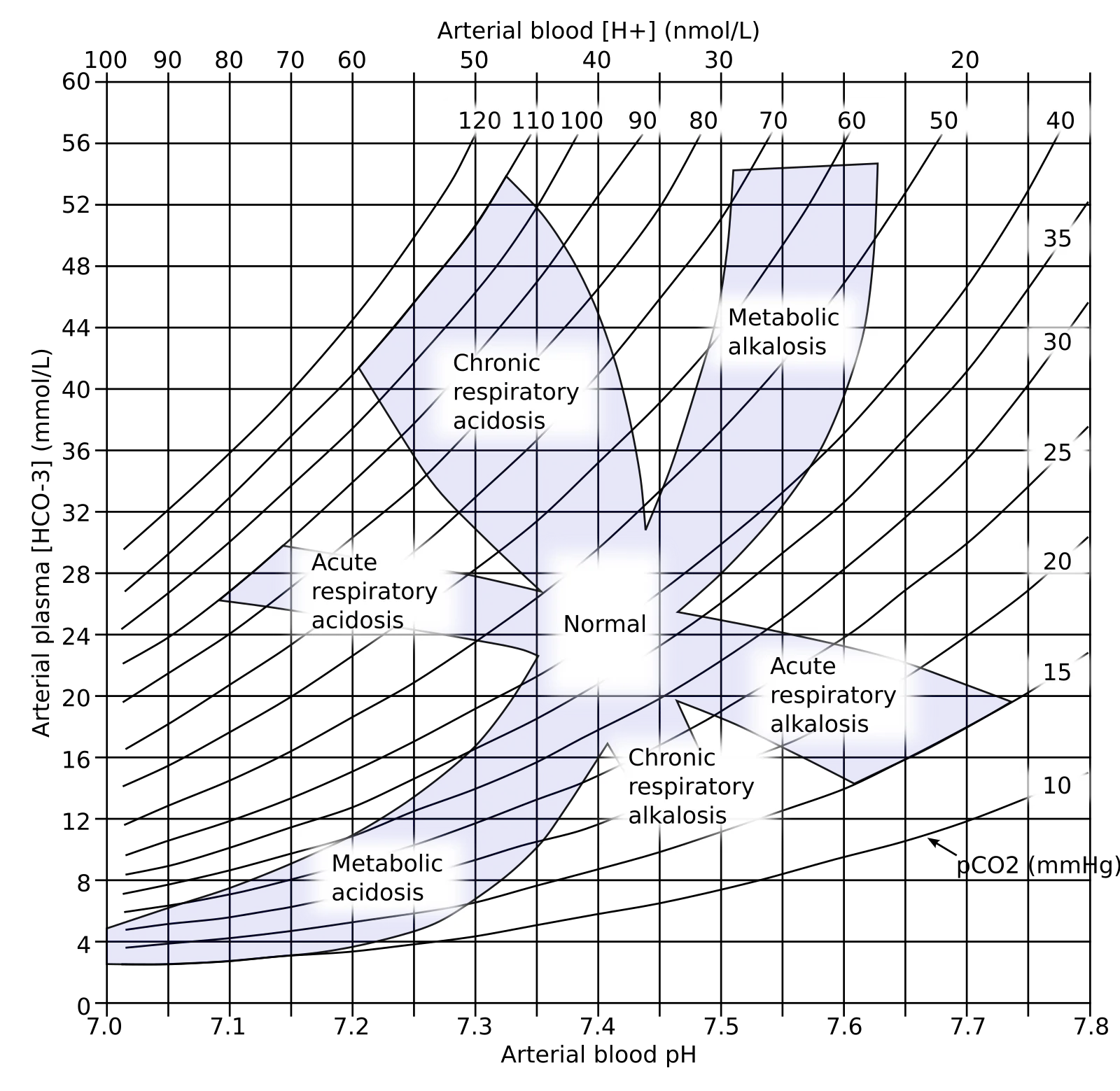
Blood pH must stay between 7.35 and 7.45. A pH below 7.35 is acidosis; above 7.45 is alkalosis. Either extreme can be fatal. Two organ systems share the job of maintaining this narrow range: the lungs handle the fast response (seconds to minutes), and the kidneys handle the slow but powerful response (hours to days).
The MCAT tests acid-base physiology frequently and expects you to identify the disorder, determine the cause, and predict the compensation.
The Bicarbonate Buffer System
The body’s most important extracellular buffer is the bicarbonate system. The chemistry behind this buffer (Henderson-Hasselbalch equation) is covered in general chemistry - here we focus on how the body regulates it:
How the Kidneys Regulate pH
The kidneys have three mechanisms for acid-base regulation:
1. Bicarbonate reabsorption (PCT)
- The PCT reabsorbs ~80-90% of filtered HCO3-
- This is not direct reabsorption - HCO3- cannot cross the apical membrane
- Instead: H+ is secreted into the lumen (via Na+/H+ exchangers), combines with filtered HCO3- to form CO2 + H2O (catalyzed by carbonic anhydrase on the brush border)
- CO2 diffuses into the PCT cell, is reconverted to HCO3- (intracellular carbonic anhydrase), and HCO3- exits on the basolateral side into the blood
- Net effect: each H+ secreted “reclaims” one HCO3-
2. H+ secretion (collecting duct)
- Type A intercalated cells actively secrete H+ via H+ ATPase and H+/K+ ATPase
- This generates NEW bicarbonate (not just reclaiming filtered HCO3-)
- Each H+ secreted generates one new HCO3- that enters the blood
- This is the kidney’s mechanism for correcting acidosis
3. Ammonium (NH4+) excretion
- The PCT produces NH3 (ammonia) from glutamine
- NH3 diffuses into the tubular lumen and combines with H+ to form NH4+ (ammonium)
- NH4+ is trapped in the lumen (charged, cannot diffuse back) and excreted
- This allows the kidney to excrete large amounts of H+ without dropping urine pH below ~4.5 (NH3 acts as a urinary buffer)
The Four Acid-Base Disorders
| Disorder | Primary Problem | pH | Primary Change | Compensation |
|---|---|---|---|---|
| Metabolic acidosis | Excess H+ or loss of HCO3- | < 7.35 | HCO3- low | Lungs hyperventilate (blow off CO2) |
| Metabolic alkalosis | Loss of H+ or excess HCO3- | > 7.45 | HCO3- high | Lungs hypoventilate (retain CO2) |
| Respiratory acidosis | CO2 retention (hypoventilation) | < 7.35 | CO2 high | Kidneys retain HCO3-, excrete H+ |
| Respiratory alkalosis | CO2 loss (hyperventilation) | > 7.45 | CO2 low | Kidneys excrete HCO3-, retain H+ |
How to Read an Arterial Blood Gas (ABG)
The MCAT may give you ABG values and ask you to identify the disorder:
Step 1: Look at pH. Is it acidotic (< 7.35) or alkalotic (> 7.45)?
Step 2: Determine the primary cause.
- If CO2 is abnormal and matches the pH direction, it is respiratory
- If HCO3- is abnormal and matches the pH direction, it is metabolic
Step 3: Check for compensation.
- Is the other value changing in the expected compensatory direction?
Normal values:
- pH: 7.35-7.45
- pCO2: 35-45 mmHg
- HCO3-: 22-26 mEq/L
Example: pH 7.30, pCO2 55 mmHg, HCO3- 28 mEq/L
- pH is low (acidosis)
- CO2 is high (respiratory cause - hypoventilation)
- HCO3- is slightly elevated (renal compensation - kidneys retaining bicarbonate)
- Diagnosis: respiratory acidosis with partial renal compensation
Common Causes of Each Disorder
Metabolic acidosis:
- Diabetic ketoacidosis (excess ketone production)
- Lactic acidosis (anaerobic metabolism)
- Renal failure (cannot excrete H+ or regenerate HCO3-)
- Severe diarrhea (loss of HCO3- in stool)
Metabolic alkalosis:
- Prolonged vomiting (loss of HCl from stomach)
- Excessive antacid use
- Hyperaldosteronism (excess H+ secretion in collecting duct)
Respiratory acidosis:
- COPD, pneumonia, or any cause of hypoventilation
- Opioid overdose (suppresses respiratory drive)
Respiratory alkalosis:
- Hyperventilation (anxiety, pain, high altitude)