
Colloids and Suspensions
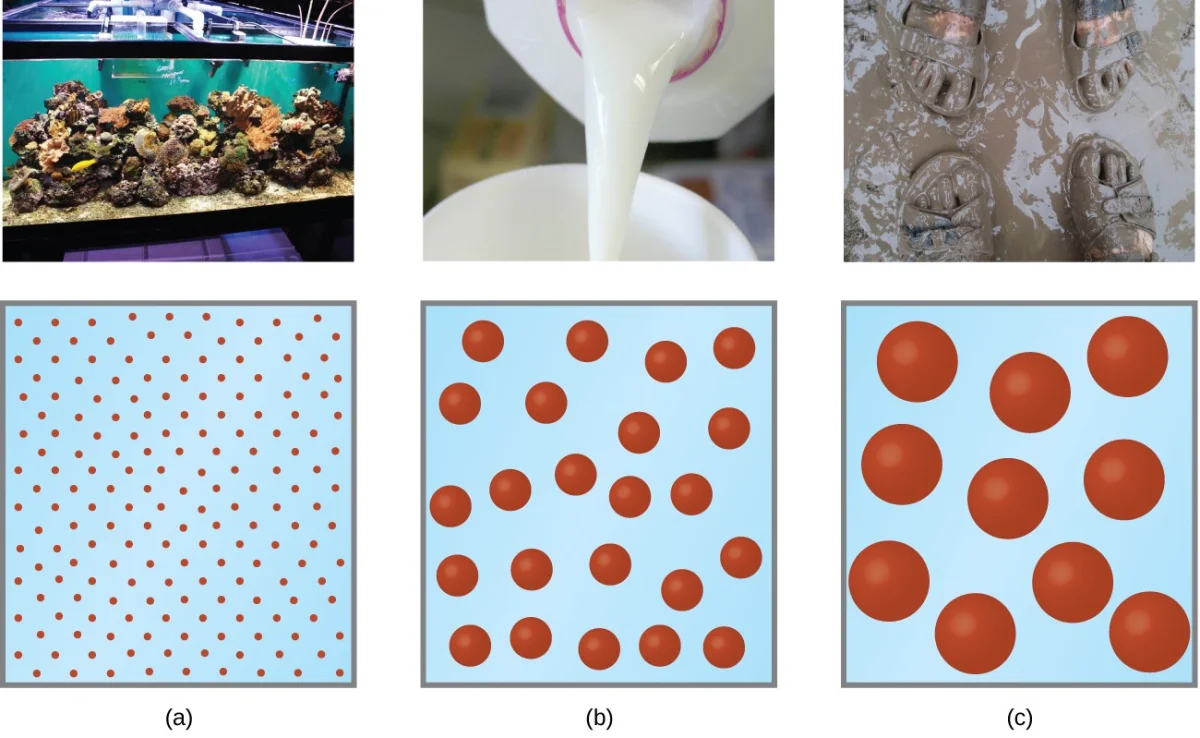
Not every mixture is a true solution. Some mixtures have particles too large to dissolve at the molecular level but too small to settle out immediately. These intermediate mixtures - colloids and suspensions - have unique properties that show up on the MCAT.
The Three Types of Mixtures
| Property | True Solution | Colloid | Suspension |
|---|---|---|---|
| Particle size | < 1 nm | 1 - 1,000 nm | > 1,000 nm |
| Settles on standing? | No | No (or very slowly) | Yes |
| Filterable? | No (passes through filter) | No (passes through filter) | Yes (caught by filter) |
| Tyndall effect? | No | Yes | Yes (but settles) |
| Appears | Transparent | Translucent/opaque | Opaque, cloudy |
| Example | Saltwater, sugar water | Milk, fog, blood | Muddy water, sand in water |
The Tyndall Effect
The Tyndall effect is the scattering of light by colloidal particles. Shine a flashlight through a true solution and the beam is invisible (particles too small to scatter light). Shine it through a colloid and the beam becomes visible as a glowing path through the mixture.
This is why:
- Car headlights are visible in fog (fog is a colloid of water droplets in air)
- A flashlight beam is visible in a dusty room (dust is a colloid of solid particles in air)
- Saltwater appears clear (true solution, no scattering)
- Milk appears white (colloid, scatters all wavelengths)

Brownian Motion
Brownian motion is the random, zigzag movement of colloidal particles suspended in a fluid. It is caused by constant bombardment from surrounding solvent molecules. The particles are small enough to be jostled by individual molecular collisions but large enough to be observed under a microscope.
Brownian motion:
- Is evidence for the kinetic molecular theory (molecules are in constant random motion)
- Keeps colloid particles suspended (prevents settling)
- Increases with temperature (faster-moving solvent molecules hit harder)
Types of Colloids
Colloids are classified by the phases of the dispersed substance and the medium:
| Type | Dispersed Phase | Medium | Example |
|---|---|---|---|
| Sol | Solid | Liquid | Paint, blood |
| Gel | Liquid | Solid | Gelatin, jelly |
| Emulsion | Liquid | Liquid | Milk, mayonnaise |
| Foam | Gas | Liquid | Whipped cream, shaving cream |
| Aerosol (liquid) | Liquid | Gas | Fog, hairspray |
| Aerosol (solid) | Solid | Gas | Smoke, dust |
| Solid foam | Gas | Solid | Styrofoam, pumice |
| Solid sol | Solid | Solid | Colored glass, certain alloys |
Emulsifying Agents
Oil and water form a suspension (they separate on standing). But add an emulsifier - a molecule with both hydrophilic and hydrophobic parts - and the oil is dispersed into tiny droplets that stay suspended as a colloid (an emulsion).
Examples of emulsifiers:
- Soap and detergent - clean grease by emulsifying it in water
- Bile salts - emulsify dietary fats in the small intestine so lipase can digest them
- Lecithin (in egg yolk) - why mayonnaise stays mixed (oil emulsified in vinegar)
The emulsifier coats the oil droplets, with its polar head facing water and nonpolar tail embedded in the oil. This prevents the droplets from merging back together.
Coagulation and Flocculation
Colloidal particles often carry surface charges that create electrostatic repulsion, keeping them dispersed. Adding electrolytes (like salts) neutralizes these charges and causes the particles to clump together and settle out. This process is called coagulation or flocculation.
This is why:
- Adding alum to murky water causes impurities to clump and settle (water treatment)
- River water clears when it meets salty ocean water (salt neutralizes colloidal clay charges)