We know that “like dissolves like,” but why do some polar substances dissolve easily while others barely dissolve at all? The answer is thermodynamics - specifically, the balance between the energy it takes to break apart the solute and the energy released when the solvent surrounds the solute particles.
The Three-Step Energy Model
Dissolving an ionic compound in water involves three energy changes:
Step 1: Break the crystal lattice (endothermic)
The lattice energy (U) is the energy required to completely separate all ions in a solid ionic compound into gaseous ions. This is always endothermic - you must overcome the electrostatic attractions holding the crystal together.
Lattice energy depends on:
Charge - higher charges mean stronger attraction (MgO has much higher lattice energy than NaCl)
Water molecules must separate to make room for the incoming ions. This requires breaking some hydrogen bonds between water molecules.
Step 3: Form ion-dipole interactions (exothermic)
Water molecules surround each ion, forming a hydration shell. The energy released in this step is called the hydration energy (ΔHhydration). This is always exothermic - forming new attractions releases energy.
Hydration energy depends on charge density:
Higher charge = stronger ion-dipole interactions = more energy released
Smaller radius = higher charge density = more energy released
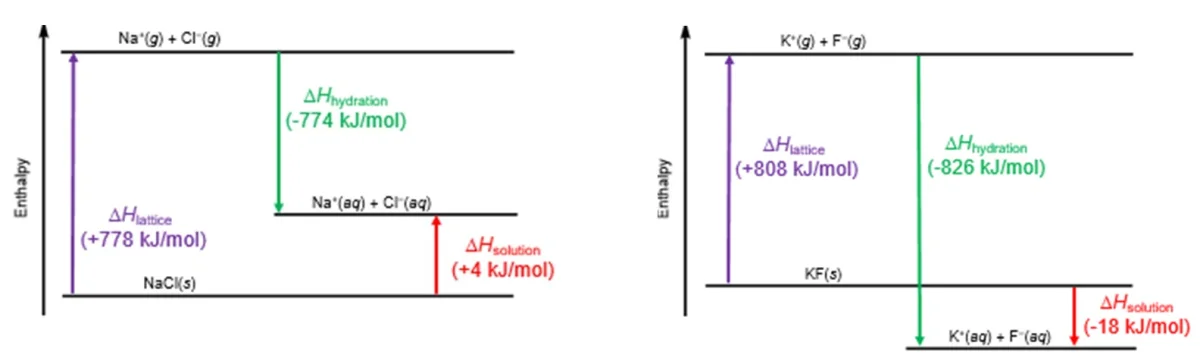
If ΔHsoln is positive (endothermic), the process is energetically uphill. Why would it happen at all?
Because entropy also drives dissolution. Dissolving a solid increases disorder - the organized crystal lattice breaks into randomly dispersed ions. The entropy increase (ΔS > 0) can make the overall free energy change favorable:
ΔG = ΔH - TΔS
Even if ΔH is positive (endothermic), a large positive TΔS can make ΔG negative (spontaneous). This is why NaCl dissolves in water even though the process absorbs a tiny amount of heat - the entropy increase from dispersing Na⁺ and Cl⁻ ions throughout the solution more than compensates.
Enthalpy of solution diagram comparing NaCl and KF dissolution. When hydration energy exceeds lattice energy, dissolution is exothermic (KF). When lattice energy exceeds hydration energy, dissolution is endothermic (NaCl). Credit: Lumen Learning / OpenStax Chemistry, CC BY 4.0
Hydration Shells
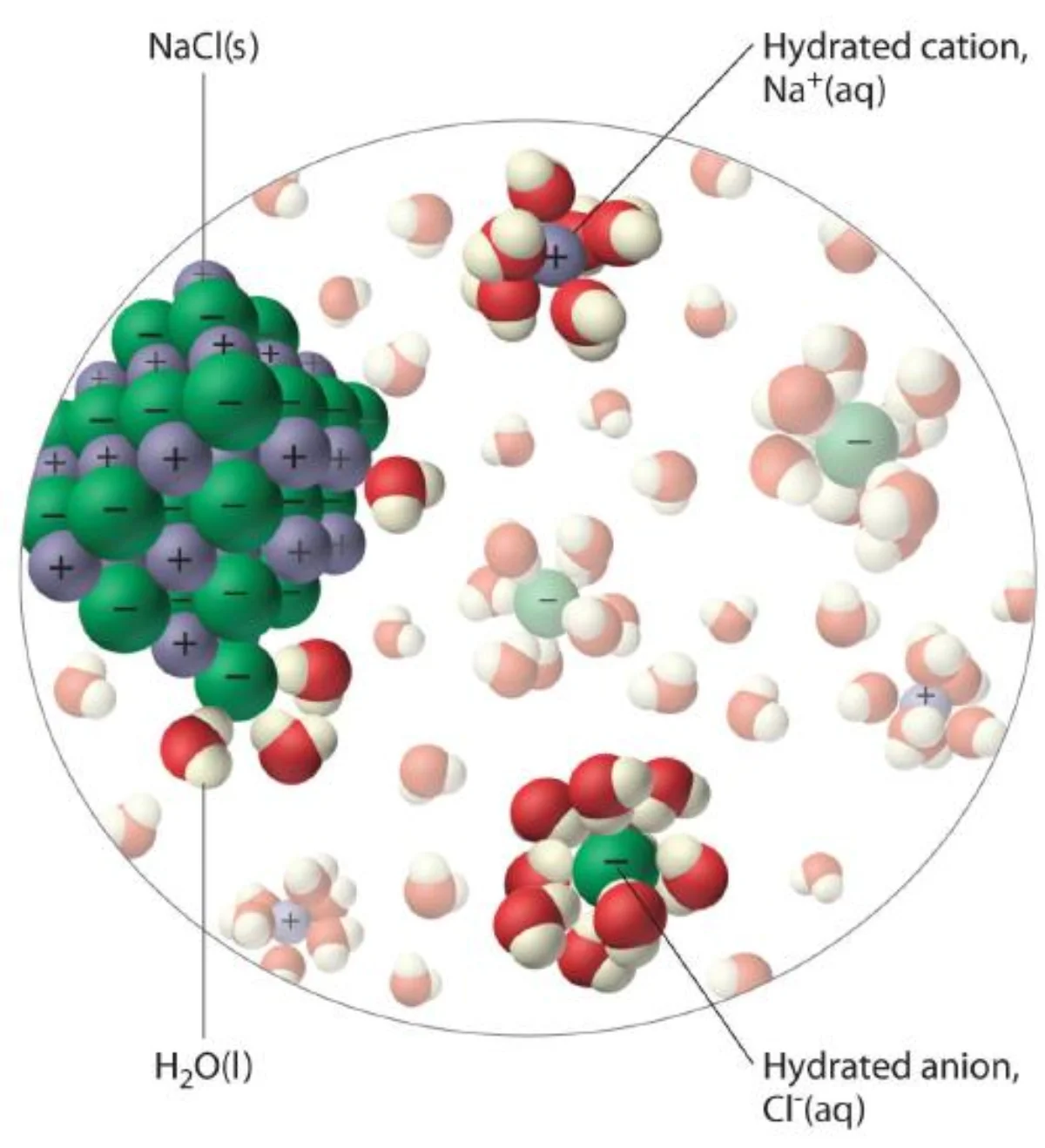
When ions dissolve, water molecules arrange themselves around each ion with specific orientations:
Around cations (like Na⁺): the oxygen end of water (partial negative) faces the positive ion
Around anions (like Cl⁻): the hydrogen end of water (partial positive) faces the negative ion
Hydration shells around Na⁺ and Cl⁻ ions. Water molecules orient with oxygen toward cations and hydrogen toward anions. The first layer (primary hydration shell) is the most tightly organized. Credit: LibreTexts Chemistry, CC BY 4.0
The first layer of water molecules is tightly organized - this is called the primary hydration shell. Beyond it, water molecules become progressively less ordered. Smaller, more highly charged ions (like Li⁺ or Mg²⁺) have larger, more tightly bound hydration shells than larger, less charged ions (like K⁺ or Cs⁺).
When NH₄NO₃ dissolves in water, the solution gets cold. Is the enthalpy of solution positive or negative? Which is larger - the lattice energy or the hydration energy?
Click to reveal answer
ΔHsoln is positive (endothermic). The lattice energy is larger than the hydration energy. The solution absorbs heat from surroundings (gets cold) because it takes more energy to break apart the crystal lattice than is released by hydrating the ions. The process still occurs spontaneously because the entropy increase (disorder) makes ΔG negative.
Predict: which has a higher lattice energy - NaCl or MgO? Why?
Click to reveal answer
MgO has a much higher lattice energy than NaCl. Lattice energy depends on charge and size. Mg²⁺ and O²⁻ have charges of +2 and -2 (vs. +1 and -1 for NaCl), and both ions are smaller than Na⁺ and Cl⁻. Higher charges and smaller radii mean much stronger electrostatic attraction, so MgO has a lattice energy roughly 4x greater than NaCl. This is why MgO is nearly insoluble in water - the hydration energy cannot overcome the enormous lattice energy.