
Clonal Selection and Memory
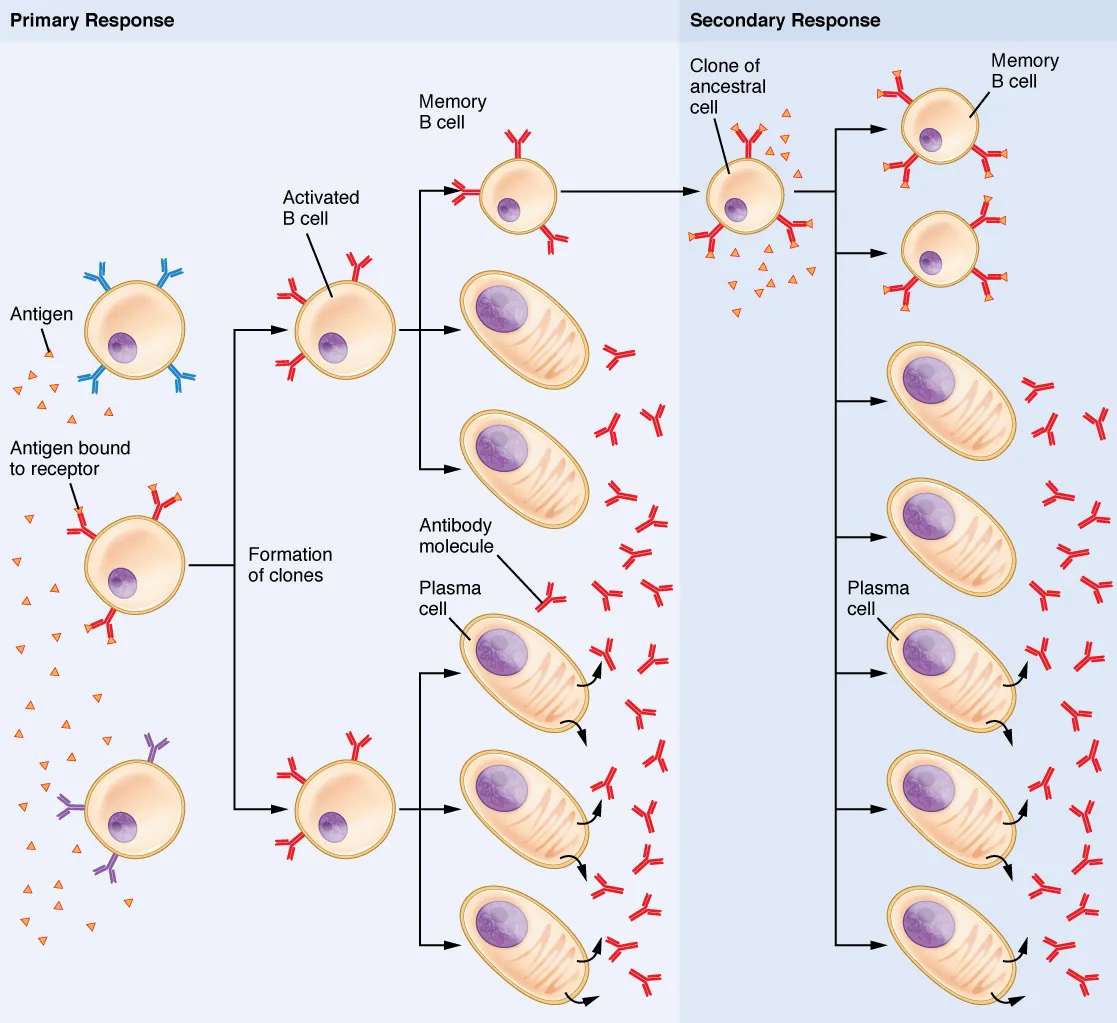
Your body contains millions of unique B and T cells, each recognizing a different antigen. When a pathogen arrives, only the tiny fraction of lymphocytes that match that specific antigen are activated. This process - selecting and amplifying the right cells - is called clonal selection, and it is the engine that drives the entire adaptive immune response.
Clonal Selection Theory
The core claims of the theory:
- Pre-existing diversity - Before any infection, the body already has millions of unique lymphocytes, each with a different antigen receptor (generated by somatic recombination during development).
- Antigen selects, not instructs - The pathogen does not teach the lymphocyte what shape to make. The matching receptor already exists. The antigen simply finds and activates the cell that already fits.
- Clonal expansion - The selected lymphocyte divides rapidly, producing a large population of identical clones, all specific to that one antigen.
- Differentiation - Clones differentiate into effector cells (which fight the current infection) and memory cells (which prepare for future encounters).
- Self-reactive clones are deleted - Lymphocytes that recognize self-antigens are eliminated during development (negative selection in the thymus for T cells, clonal deletion in the bone marrow for B cells).
The Steps of Clonal Selection
Step 1: Antigen encounter - A naive B or T cell encounters its matching antigen. For B cells, the antigen binds directly to the BCR. For T cells, the antigen must be presented on MHC by an APC.
Step 2: Activation - The lymphocyte receives activation signals (antigen binding + co-stimulation + helper T cell cytokines for B cells).
Step 3: Clonal expansion - The activated cell divides rapidly by mitosis, producing thousands of identical daughter cells (clones). All clones have the same antigen specificity.
Step 4: Differentiation - Clones differentiate into two populations:
- Effector cells - fight the current infection (plasma cells for B cells, armed cytotoxic T cells for CD8+)
- Memory cells - long-lived cells that persist after the infection is cleared
Step 5: Contraction - After the pathogen is eliminated, most effector cells undergo apoptosis (programmed death). The immune response winds down. Memory cells remain.
Affinity Maturation
During clonal expansion of B cells, something remarkable happens. Activated B cells in the germinal centers of lymph nodes undergo somatic hypermutation - random point mutations in the genes encoding the variable region of their antibodies.
Most of these mutations are useless or harmful. But some improve the antibody’s binding affinity for the antigen. B cells with higher-affinity antibodies receive stronger survival signals, while those with lower affinity die. This is essentially natural selection happening inside your lymph nodes.
The result: each round of mutation and selection produces antibodies that bind the antigen more tightly. This process is called affinity maturation, and it is why the secondary immune response produces higher-quality antibodies than the primary response.
Primary vs. Secondary Immune Response
The existence of memory cells creates a dramatically different response on re-exposure:
| Feature | Primary Response | Secondary Response |
|---|---|---|
| Timing | Slow (~7-10 days to peak) | Fast (~1-3 days to peak) |
| Antibody produced first | IgM | IgG (already class-switched) |
| Antibody levels | Lower | Much higher (10-100x) |
| Antibody affinity | Lower | Higher (affinity maturation) |
| Duration | Shorter | Longer |
| Cells involved | Naive lymphocytes | Memory lymphocytes |
The secondary response is faster because memory cells are already present in greater numbers than naive cells, they are pre-selected for the antigen, and they require less co-stimulation to activate. This is the entire basis of vaccination.
Memory Cells: The Long Game
Memory B cells and memory T cells can survive for decades - some persist for your entire life. They circulate through blood and lymph, residing in lymph nodes and the spleen, waiting.
When the same antigen appears again, memory cells:
- Activate much faster than naive cells
- Require less co-stimulation
- Are already present in larger numbers
- (For B cells) Already produce high-affinity, class-switched antibodies
This is why you only get chickenpox once. Your memory cells mount such a rapid and overwhelming response on re-exposure that the virus is destroyed before it can cause symptoms.