
Germ Layers
This is the section you will return to again and again. Knowing which germ layer produces which structure is one of the single highest-yield topics on the MCAT. The test loves to describe a disease, drug, or mutation affecting a specific tissue and then ask: “From which embryonic germ layer does this tissue derive?”
The good news? Germ layer derivatives follow a logical pattern. If you understand the pattern, you barely need to memorize anything.
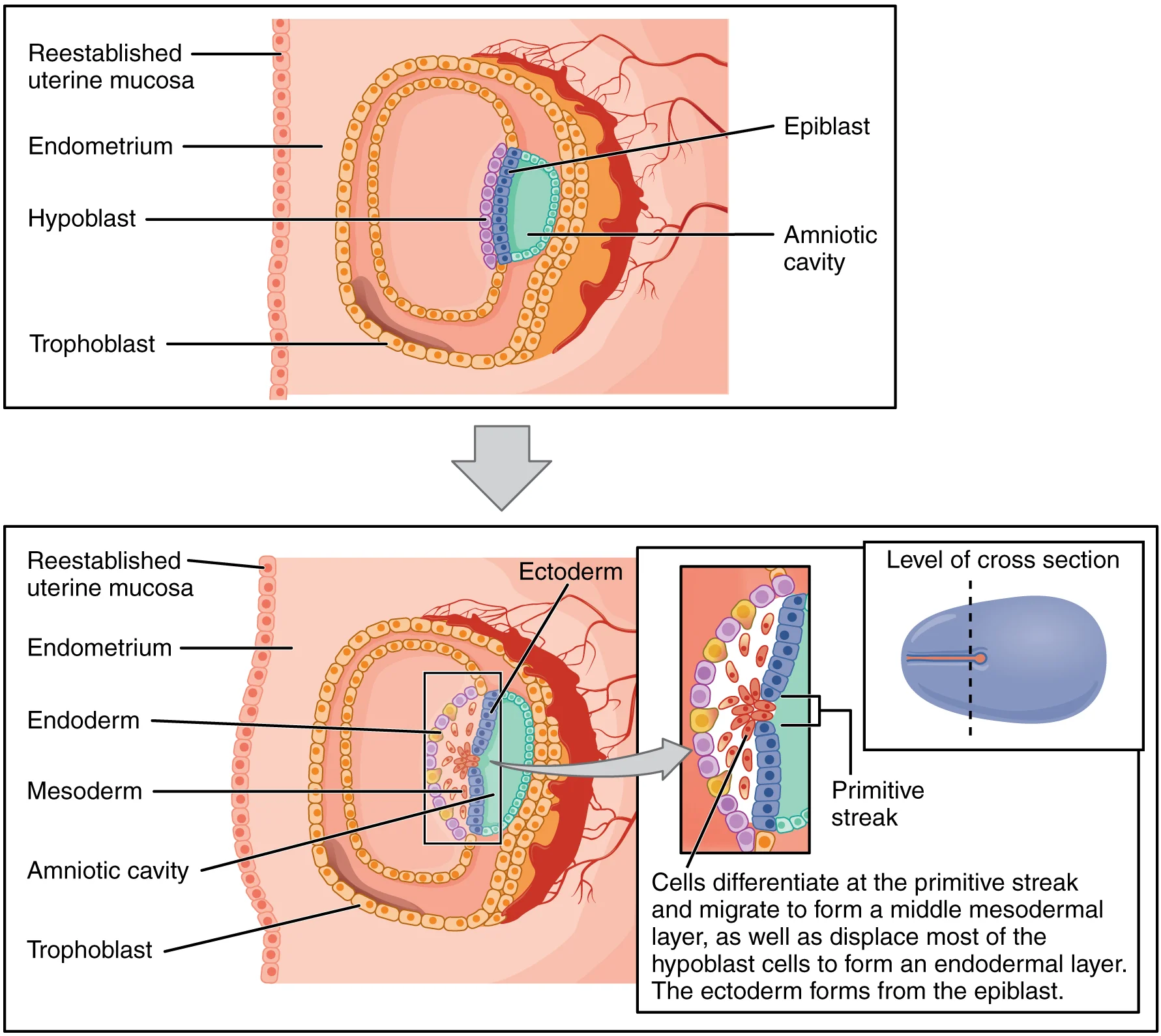
The Burrito Model: Understanding the Pattern
Think of the embryo as a burrito.
The tortilla on the outside is the ectoderm. It wraps around everything and covers the exterior surface. Just like the tortilla is the part you see and touch, the ectoderm makes the structures that interact with the outside world - skin, sensory organs, and the nervous system.
The filling in the center is the endoderm. It is tucked deep inside, forming the inner tube. Just like the rice, beans, and meat run through the core of the burrito, the endoderm lines the gut tube and everything that buds off from it - digestive organs, lungs, liver, pancreas.
The cheese, sour cream, and guacamole layered between the tortilla and the filling represent the mesoderm. This middle layer provides structural support and “plumbing” - muscle, bone, blood, heart, kidneys. It fills in all the space between the outer wrapper and the inner core.
Ectoderm Derivatives: The Outer Layer
The ectoderm is the outermost germ layer. Its derivatives fall into three categories: surface structures, neural tube structures, and neural crest structures.
Surface Ectoderm - everything at the body’s surface and openings:
| Structure | Notes |
|---|---|
| Epidermis (outermost skin) | NOT the dermis - that is mesoderm |
| Hair, nails, sweat glands, sebaceous glands | All skin appendages |
| Lens of the eye | The retina is neuroectoderm - different origin! |
| Inner ear | Sensory structures for hearing and balance |
| Epithelial lining of the mouth | The oral cavity is an ectodermal invagination |
| Epithelial lining of the anal canal | The distal anus is an ectodermal invagination |
| Epithelial lining of the nose | Another surface opening |
| Tooth enamel | Hardest substance in the body - ectoderm; dentin is neural crest |
| Anterior pituitary | From Rathke’s pouch - an upward ectodermal invagination from the mouth roof |
Neuroectoderm (from the neural tube) - the entire central nervous system:
| Structure | Notes |
|---|---|
| Brain | All regions |
| Spinal cord | Entire CNS |
| Retina | Outgrowth of the brain (diencephalon) |
| Posterior pituitary | Downward extension of the brain (infundibulum) |
| Pineal gland | Outgrowth of the diencephalon |
Neural Crest Cells (from the tips of the neural folds) - the “fourth germ layer”:
| Structure | Notes |
|---|---|
| PNS sensory ganglia (dorsal root ganglia) | Peripheral nervous system |
| Autonomic ganglia (sympathetic + parasympathetic) | Both divisions |
| Schwann cells | Myelinate PNS axons (NOT oligodendrocytes - those are neural tube) |
| Adrenal medulla | Chromaffin cells - essentially modified postganglionic sympathetic neurons |
| Melanocytes | Pigment cells; they migrate into the epidermis but originate from neural crest |
| Calcitonin-producing C cells (parafollicular cells) | In the thyroid gland |
| Craniofacial bones and cartilage | Facial skeleton |
| Odontoblasts | Make tooth dentin (enamel is surface ectoderm - one tooth, two origins!) |
| Enteric nervous system | ”Gut brain” - neurons in the wall of the GI tract |
| Smooth muscle of great vessels | Aorta, pulmonary artery |
| Aorticopulmonary septum | Divides the cardiac outflow tract |
Mesoderm Derivatives: The Middle Layer
The mesoderm is the middle germ layer, and it produces more different tissue types than either of the other two layers.
Musculoskeletal:
| Structure | Notes |
|---|---|
| All skeletal muscle | Every voluntary muscle |
| All smooth muscle | Gut wall, blood vessels, bronchi (except great vessel smooth muscle = neural crest) |
| Cardiac muscle | The heart’s working tissue |
| Bones and cartilage | All axial and appendicular skeleton (except craniofacial = neural crest) |
| Tendons and ligaments | Connective tissue that attaches muscle to bone and bone to bone |
| Dermis | The deep skin layer; the epidermis above it is ectoderm |
Circulatory and Blood:
| Structure | Notes |
|---|---|
| Heart | The first functional organ - beating by day 22 |
| All blood vessels | Arteries, veins, capillaries |
| All blood cells | Red blood cells, white blood cells, platelets |
| Spleen | Filters blood; mesodermal origin |
| Lymphatic system | Lymph nodes, lymph vessels |
| Bone marrow | Site of hematopoiesis |
Urogenital:
| Structure | Notes |
|---|---|
| Kidneys and ureters | Internal organs, but NOT endoderm |
| Gonads (testes and ovaries) | Mesodermal, even though they are internal |
| Adrenal cortex | The outer portion of the adrenal gland - NOT the medulla |
Connective Tissue and Serous Membranes:
| Structure | Notes |
|---|---|
| All connective tissue | Areolar, adipose, dense regular/irregular |
| Serous membranes | Pleura, peritoneum, pericardium |
| Muscular and connective tissue layers of the digestive and respiratory systems | The muscular wall of the gut is mesoderm; only the inner epithelial lining is endoderm |
Endoderm Derivatives: The Inner Layer
The endoderm is the innermost germ layer, and it follows one beautifully simple rule: the endoderm lines the gut tube and everything that buds off from it.
Digestive Tract Lining:
| Structure | Notes |
|---|---|
| Epithelial lining of the GI tract | Stomach, small intestine, large intestine |
| Exception: mouth and anal canal linings | These are ectoderm (surface openings) |
Organs That Bud from the Gut Tube:
| Structure | Notes |
|---|---|
| Liver and gallbladder | Bud off the foregut |
| Pancreas (exocrine and endocrine) | Buds off the foregut-midgut junction |
| Thyroid gland (follicular cells) | Buds off the floor of the pharynx (but C cells are neural crest!) |
| Parathyroid glands | Bud from pharyngeal pouches |
| Thymus | Buds from the third pharyngeal pouch |
Respiratory System:
| Structure | Notes |
|---|---|
| Epithelial lining of the trachea, bronchi, and lungs | The lungs bud off the foregut; the surrounding smooth muscle and cartilage are mesoderm |
Other Endoderm Derivatives:
| Structure | Notes |
|---|---|
| Urinary bladder lining | Endodermal; the muscular wall is mesoderm |
| Urethra lining | Distal portions |
| Epithelial lining of the auditory (Eustachian) tube | Connects middle ear to pharynx |
| Epithelial lining of the middle ear cavity | Derived from the first pharyngeal pouch |
The Complete Comparison Table
Here is the master reference table. Use it for quick review before the exam.
| Germ Layer | Position | Key Derivatives |
|---|---|---|
| Ectoderm (surface) | Outermost | Epidermis, hair, nails, lens of eye, inner ear, mouth/nose/anal epithelium, tooth enamel, anterior pituitary |
| Ectoderm (neuroectoderm) | Folds inward from surface | Brain, spinal cord, retina, posterior pituitary, pineal gland |
| Ectoderm (neural crest) | Migrates from neural fold tips | PNS ganglia, Schwann cells, melanocytes, adrenal medulla, craniofacial bones, odontoblasts, enteric NS, C cells of thyroid, smooth muscle of great vessels |
| Mesoderm | Middle | All muscle types, all bones/cartilage (except craniofacial), heart, blood vessels, blood cells, kidneys, gonads, spleen, adrenal cortex, dermis, connective tissue, serous membranes |
| Endoderm | Innermost | GI tract epithelium, liver, gallbladder, pancreas, thyroid (follicular cells), parathyroids, thymus, respiratory epithelium, bladder lining, Eustachian tube lining |
The Tricky Ones: Common MCAT Traps
These structures have germ layer origins that surprise students. Expect to see them on test day.
| Structure | Germ Layer | Why It Is Tricky |
|---|---|---|
| Adrenal cortex | Mesoderm | Same organ as the medulla, but different germ layer |
| Adrenal medulla | Ectoderm (neural crest) | The inner part of the adrenal gland comes from the outer germ layer |
| Anterior pituitary | Surface ectoderm (Rathke’s pouch) | It is inside the skull, so it seems like it should be endoderm |
| Posterior pituitary | Neuroectoderm | Outgrowth of the brain - same gland, two embryonic origins |
| Kidneys | Mesoderm | You might think “internal organ = endoderm,” but kidneys do NOT bud from the gut tube |
| Dermis | Mesoderm | The deep skin layer is mesoderm; only the superficial epidermis is ectoderm |
| Tooth enamel | Surface ectoderm | Enamel is ectoderm; dentin is neural crest (odontoblasts) - one tooth, two germ layers |
| Melanocytes | Ectoderm (neural crest) | They live in the epidermis but did NOT originate there - they migrated in from the neural crest |
| Lens of the eye | Surface ectoderm | The retina is neuroectoderm, but the lens is surface ectoderm - same organ, different origins |
| C cells of the thyroid | Neural crest | The follicular cells that make T3/T4 are endoderm; the C cells that make calcitonin are neural crest |
| Schwann cells | Neural crest | Oligodendrocytes (CNS myelin) are from the neural tube; Schwann cells (PNS myelin) are from neural crest |
One Last Rule of Thumb
When you are stuck on a germ layer question, use this decision tree:
- Does it line the gut tube or bud from the gut? —> Endoderm
- Does it cover the surface, sense the outside world, or conduct electrical signals? —> Ectoderm
- Is it structural, circulatory, or “in between”? —> Mesoderm
- Is it surprisingly derived from something that migrated from the neural folds? —> Neural crest (ectoderm)
If you know the burrito model and the tricky exceptions, you can reason through almost any germ layer derivative question.