
Tissue Types
Cells do not work alone. They organize into tissues - groups of similar cells that work together to perform a specific function. There are exactly four tissue types in the human body. Every structure in your body - every organ, every system - is made from some combination of these four.
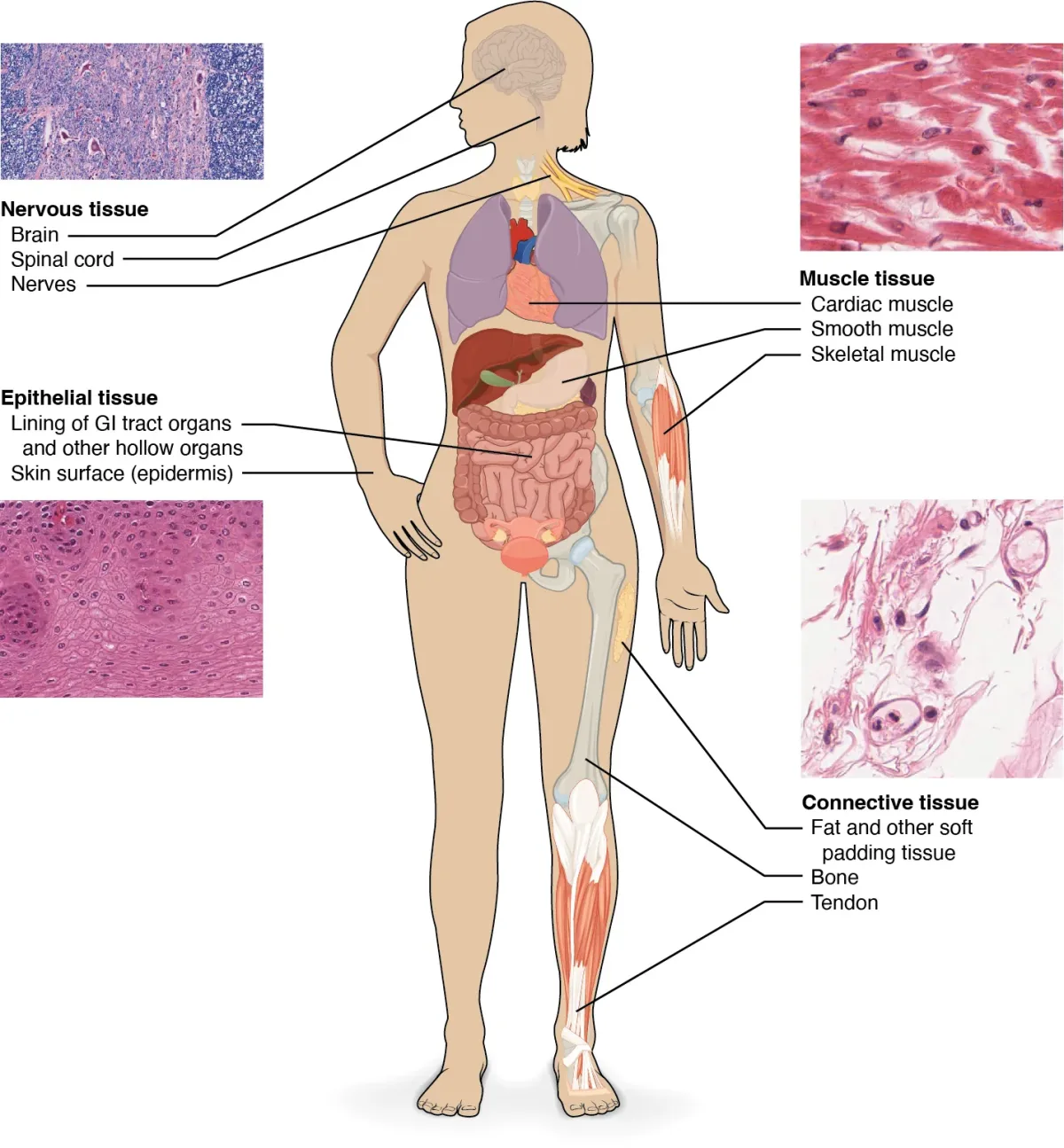
Epithelial Tissue - The Coverings and Linings
Epithelial tissue covers the body’s external surface (skin) and lines internal cavities (digestive tract, blood vessels, airways). It acts as a barrier - protecting against pathogens, preventing dehydration, and regulating absorption and secretion.
Epithelial cells sit on a basement membrane (a thin layer of extracellular matrix) that connects them to underlying connective tissue. They are polarized - the top surface (apical) faces a lumen or the external environment, while the bottom surface (basal) attaches to the basement membrane.
Classification by layers:
| Type | Description | Where Found |
|---|---|---|
| Simple | Single layer of cells | Intestinal lining (absorption), lung alveoli (gas exchange) |
| Stratified | Multiple layers stacked | Skin (protection against abrasion) |
| Pseudostratified | Single layer, but cells of varying heights create the illusion of multiple layers | Respiratory tract (mucus movement) |
Classification by cell shape:
| Shape | Description | Key Locations |
|---|---|---|
| Squamous | Flat, like floor tiles | Blood vessel lining, lung alveoli (thin for diffusion) |
| Cuboidal | Cube-shaped | Kidney tubules, glands (secretion) |
| Columnar | Tall, column-shaped | Intestinal lining (absorption, secretion) |
You combine layer + shape to classify: simple squamous epithelium lines blood vessels, stratified squamous epithelium forms the outer layer of skin, simple columnar epithelium lines the intestine, pseudostratified columnar epithelium lines the trachea.
The functional cells of an organ (those that perform its core job) are called the parenchyma. In many organs, these are epithelial cells: hepatocytes in the liver, nephrons in the kidney, acid-producing cells in the stomach.
Connective Tissue - The Structural Support
Connective tissue is the architectural framework of the body. While epithelial cells are the “doers” (parenchyma), connective tissue forms the stroma - the support structure that holds everything together.
Key components:
- Fibroblasts - the main cell type, responsible for producing the extracellular matrix fibers
- Collagen fibers - strong, rope-like fibers that provide tensile strength (resistance to stretching). Collagen is the most abundant protein in the human body.
- Elastic fibers - stretchy, rubber band-like fibers that allow tissues to recoil after being stretched (found in lungs, blood vessels, skin)
- Reticular fibers - thin, branching fibers that form a delicate net-like framework supporting organs like the spleen and lymph nodes
- Extracellular matrix (ECM) - a mix of proteins (fibers) and ground substance (polysaccharides, water, minerals) that surrounds and supports the cells
Types of connective tissue:
Loose connective tissue - flexible packing material found beneath the skin and around organs. Provides cushioning and support.
Dense connective tissue - tightly packed collagen fibers. Found in tendons (connect muscle to bone), ligaments (connect bone to bone), and the dermis of the skin.
Cartilage - firm but flexible tissue. Three types:
- Hyaline cartilage - smooth, glassy, found at joint surfaces and in the trachea. Reduces friction during movement.
- Elastic cartilage - flexible, found in the ears and epiglottis
- Fibrocartilage - tough, shock-absorbing, found in intervertebral discs and the meniscus of the knee
Bone - rigid connective tissue providing structural support and protection for internal organs. Also serves as a mineral reservoir (calcium, phosphate).
Blood - yes, blood is classified as connective tissue. Its “matrix” is plasma (liquid), and its “cells” include red blood cells, white blood cells, and platelets.
Adipose tissue - fat. Stores energy, insulates the body, cushions organs.
Muscle Tissue
Muscle tissue is specialized for contraction. Three types:
- Skeletal muscle - voluntary, striated (striped appearance), multinucleated. Attached to bones for movement.
- Cardiac muscle - involuntary, striated, uninucleated (or binucleated). Found only in the heart. Connected by intercalated discs (desmosomes + gap junctions).
- Smooth muscle - involuntary, non-striated, uninucleated. Found in walls of blood vessels, digestive tract, bladder, and airways. Responsible for peristalsis and vasoconstriction.
Nervous Tissue
Nervous tissue is specialized for transmitting electrical signals. It consists of two main cell types:
- Neurons - the electrically excitable cells that generate and transmit nerve impulses (action potentials). Each neuron has a cell body, dendrites (receive signals), and an axon (sends signals).
- Glial cells (neuroglia) - supporting cells that nourish, insulate, and protect neurons. Examples include Schwann cells (form myelin in PNS), oligodendrocytes (form myelin in CNS), and astrocytes (maintain the blood-brain barrier).