
Evolution
Evolution is the change in allele frequencies in a population over time. That is it. It is not “progress” or “improvement” - it is simply that some alleles become more or less common from one generation to the next. The mechanisms that drive these changes include natural selection, genetic drift, gene flow, and mutation.
Natural Selection
Natural selection is the process by which organisms with traits better suited to their environment survive and reproduce more successfully. Over generations, the alleles responsible for those advantageous traits increase in frequency.
Four conditions are required for natural selection:
- Variation exists in the population (different alleles for a trait)
- The variation is heritable (genetically based, not just environmental)
- There is a differential in reproductive success (some individuals produce more offspring)
- The variation affects fitness (the ability to survive and reproduce in a given environment)
Fitness in evolution does not mean “strongest” or “fastest.” It means reproductive success - how many viable, fertile offspring an organism produces. A scrawny bird that raises six chicks has higher fitness than a powerful bird that raises one.
Three Types of Natural Selection
Natural selection does not always push a population in one direction. Depending on the environment, it can act in three different patterns:
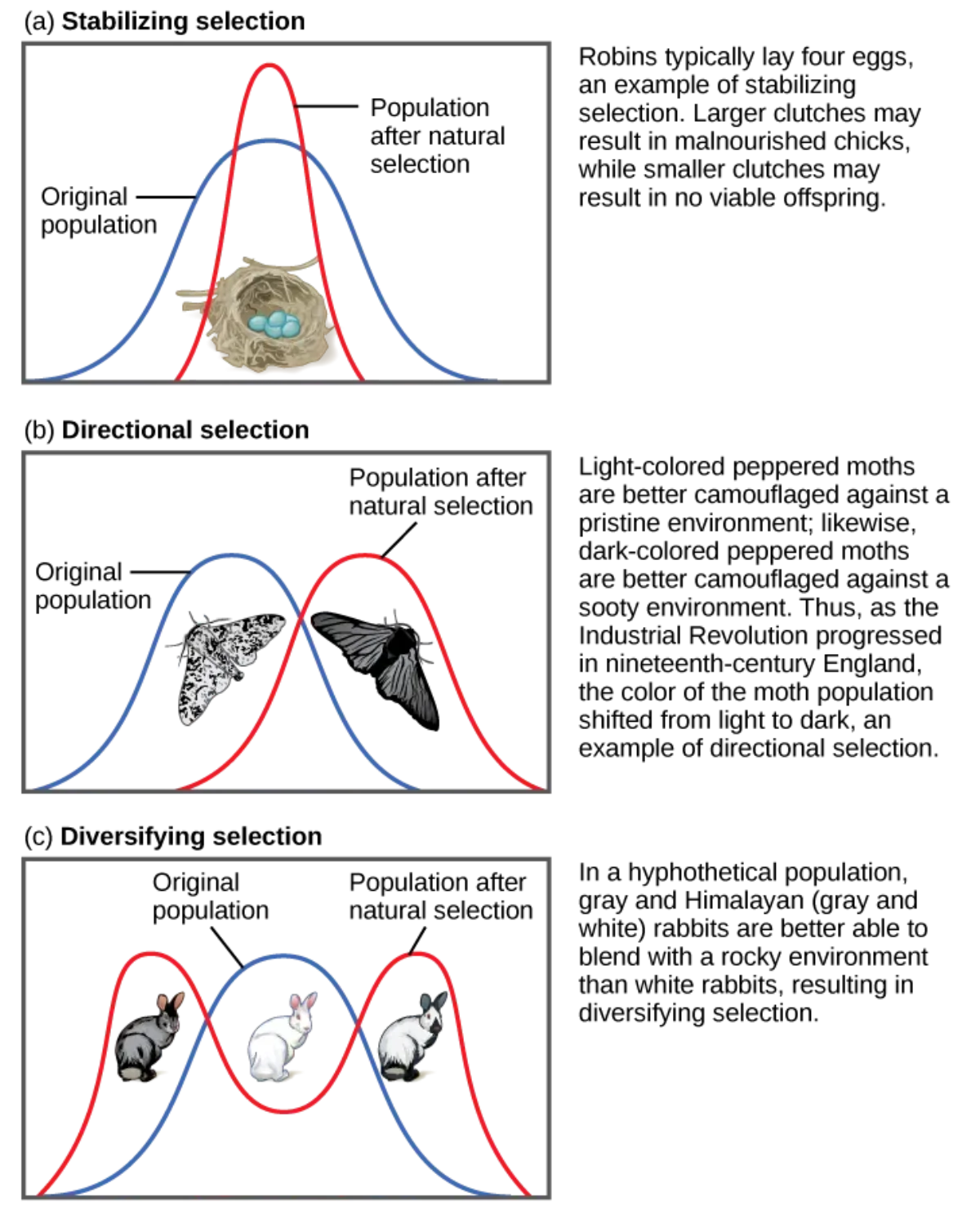
Stabilizing selection favors the average phenotype and selects against extremes. The bell curve becomes narrower. Example: human birth weight - babies that are too small or too large have lower survival rates.
Directional selection favors one extreme phenotype. The bell curve shifts in one direction. Example: antibiotic resistance in bacteria - the most resistant individuals survive, shifting the population toward higher resistance.
Disruptive (diversifying) selection favors both extremes and selects against the average. The bell curve splits into two peaks. Example: beak size in certain finch populations where medium beaks are less efficient than either very large or very small beaks.
Sexual Selection
Sexual selection is selection driven by mate choice, not survival. Traits that improve reproductive access (bright plumage, antlers, courtship songs) can spread even when they make survival harder, because the fitness payoff comes from extra offspring. Peacock tails are the classic example: the tail is a metabolic burden, but it wins mates.
Two flavors show up in passages:
- Intersexual selection: one sex (usually females) chooses mates based on a trait.
- Intrasexual selection: members of one sex compete directly with each other for access to mates (e.g., males fighting for a harem).
Hardy-Weinberg Equilibrium
The Hardy-Weinberg principle describes a theoretical population where evolution is NOT occurring. It is the null hypothesis of population genetics. If a population is in Hardy-Weinberg equilibrium, allele frequencies remain constant from generation to generation.
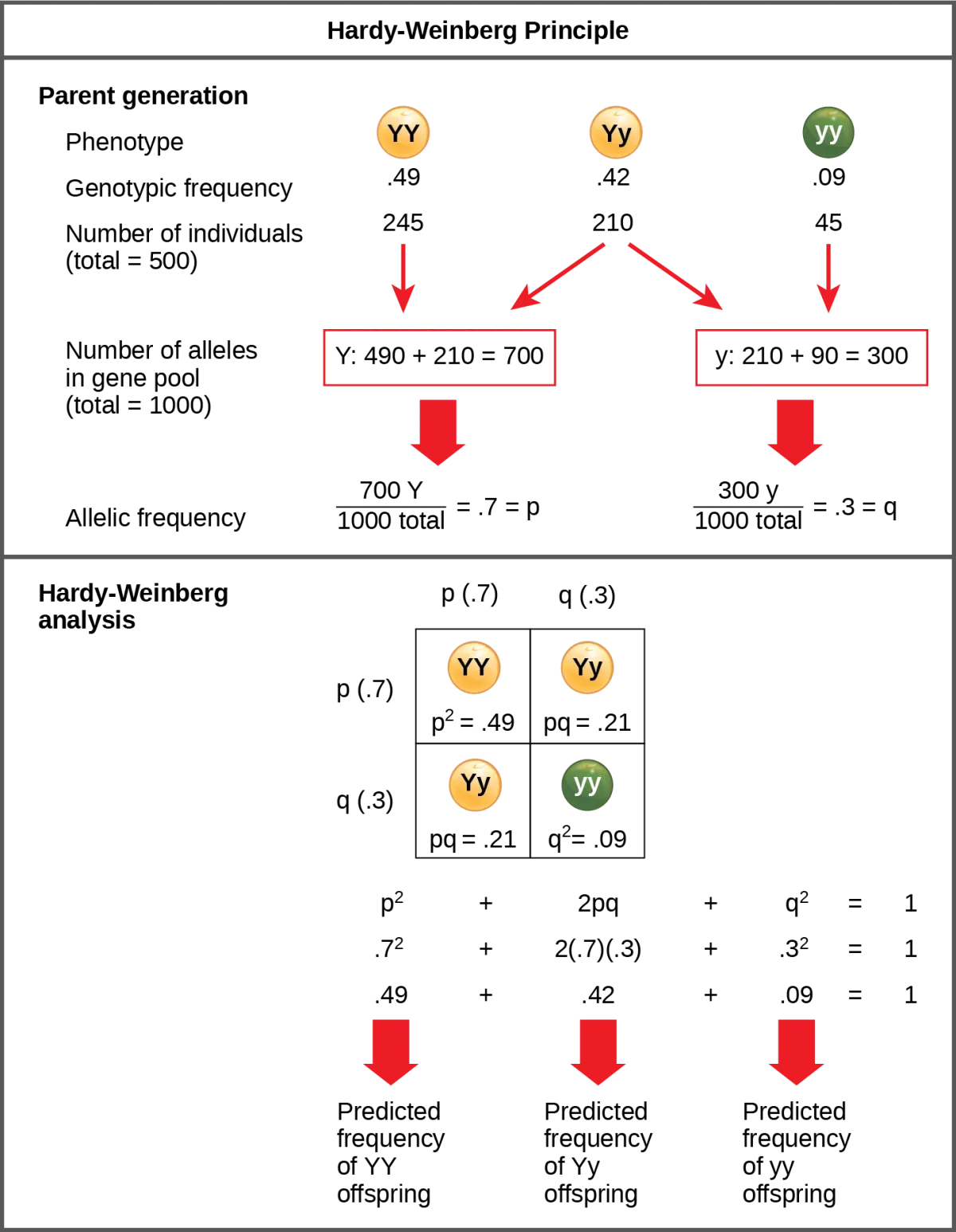
Five conditions must be met for Hardy-Weinberg equilibrium:
- No mutation (no new alleles being created)
- No natural selection (all genotypes are equally fit)
- No gene flow (no migration into or out of the population)
- Large population (no genetic drift)
- Random mating (no sexual selection or assortative mating)
Using Hardy-Weinberg on the MCAT
The most common MCAT application: you are given the frequency of a recessive phenotype and asked to find carrier frequency.
Example: 1 in 2,500 people has cystic fibrosis (autosomal recessive).
Step 1: , so
Step 2: p = 1 - q = 1 - 0.02 = 0.98
Step 3: Carrier frequency (2pq) = 2(0.98)(0.02) = 0.0392, or approximately 1 in 25 people
Speciation
Speciation is the formation of new species. It occurs when populations become reproductively isolated - they can no longer interbreed to produce viable, fertile offspring.
Speciation is closely related to polymorphism - the existence of two or more distinct phenotypes in a population. Polymorphism provides the raw variation that speciation acts upon. For example, a polymorphic population of finches with large and small beaks may eventually split into two species if the intermediate beak size is selected against.
Allopatric speciation: Geographic separation (a river, mountain range, or migration to an island) divides a population. Over time, the isolated groups accumulate genetic differences until they can no longer interbreed even if reunited.
Sympatric speciation: A new species arises within the same geographic area, without physical separation. This can occur through polyploidy (common in plants - an organism gains an extra set of chromosomes) or habitat isolation (different groups within the same area specialize in different niches).
Reproductive Isolation Mechanisms
| Type | When It Acts | Example |
|---|---|---|
| Temporal isolation | Pre-zygotic | Two species breed in different seasons |
| Habitat isolation | Pre-zygotic | Two species occupy different microhabitats |
| Behavioral isolation | Pre-zygotic | Different mating calls or courtship rituals |
| Mechanical isolation | Pre-zygotic | Reproductive organs are physically incompatible |
| Gametic isolation | Pre-zygotic | Sperm cannot fertilize the egg of another species |
| Hybrid inviability | Post-zygotic | Hybrid embryos fail to develop |
| Hybrid sterility | Post-zygotic | Hybrids are viable but infertile (e.g., mule) |
| Hybrid breakdown | Post-zygotic | F1 hybrids are fertile, but F2 offspring are weak or infertile |
Adaptive Radiation
Adaptive radiation occurs when a single ancestral species rapidly diversifies into many species, each adapted to a different ecological niche. The classic example is Darwin’s finches on the Galapagos Islands - a single ancestor species diversified into over a dozen species with different beak shapes suited to different food sources.
Convergent vs Divergent Evolution
Divergent evolution: a single ancestor splits into lineages that become more different over time (Darwin’s finches, mammalian forelimbs). The shared structures are homologous - same embryonic origin, different function. Human arm, whale flipper, and bat wing all use the same bone plan.
Convergent evolution: unrelated lineages independently evolve similar traits because they face similar selective pressures. The shared structures are analogous - different embryonic origin, same function. Bird wings and insect wings both fly, but evolved from completely different tissues.
Phylogenetic Trees
A phylogenetic tree diagrams evolutionary relationships. Each branch point (node) is a common ancestor; each tip is a species. Two species are most closely related when their nearest shared node is the most recent, not when their tips happen to be drawn next to each other. Rotating a branch around a node does not change the relationships.
The Molecular Clock
A molecular clock uses the rate of neutral mutations to estimate how long ago two species diverged. The more DNA differences between two species, the longer ago they shared a common ancestor. The logic: neutral mutations are not filtered by selection, so they accumulate at a roughly constant rate.
Clocks are calibrated against the fossil record. Different genes tick at different rates - highly conserved genes (e.g., ribosomal RNA) are slow clocks good for deep splits, while less constrained genes (mitochondrial DNA) tick faster and resolve recent divergences.