
Punnett Squares
A Punnett square is nothing more than a multiplication table for alleles. One parent’s possible gametes go across the top. The other parent’s gametes go down the side. Each box represents one possible offspring genotype. If you can multiply, you can do genetics.
The Monohybrid Cross
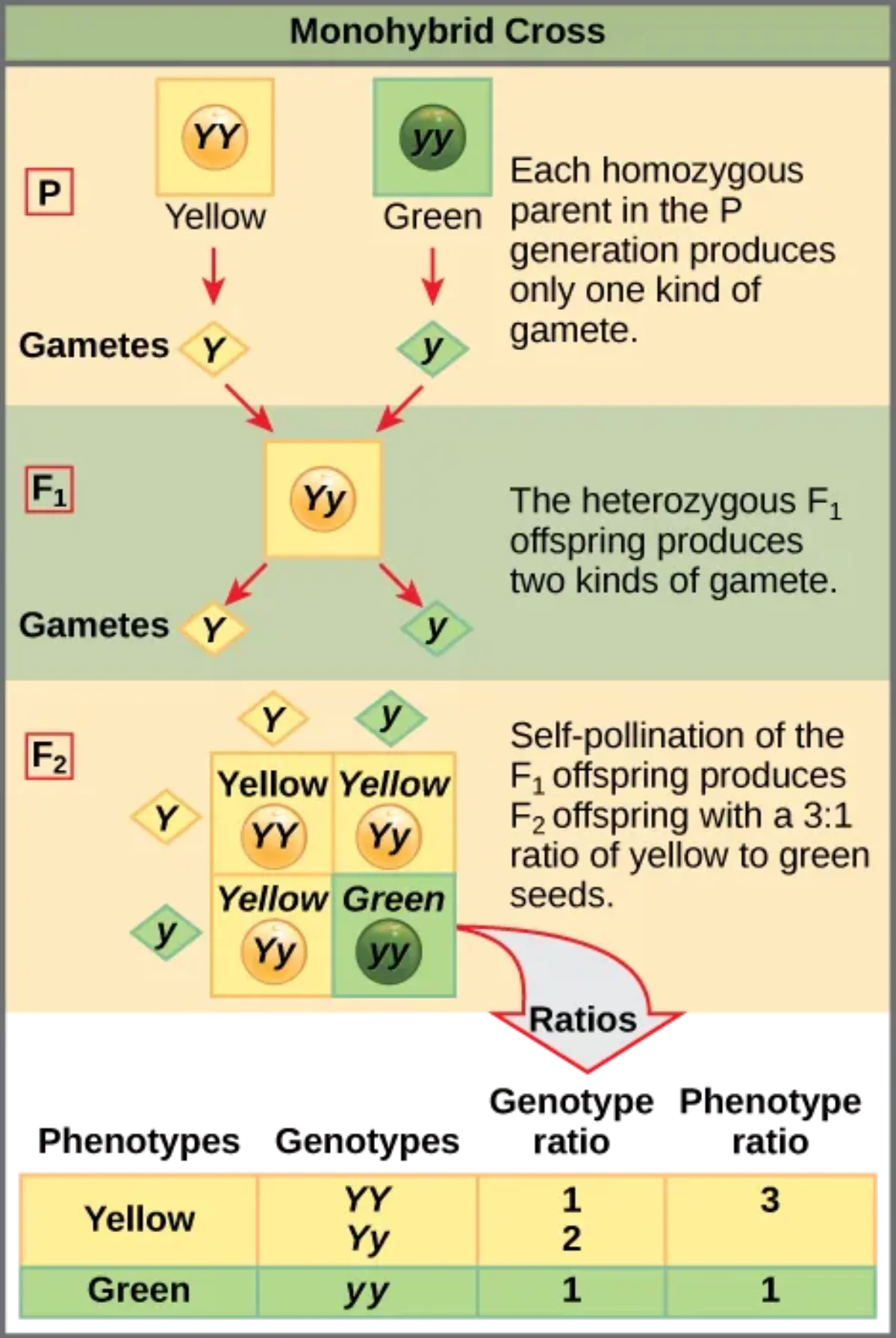
A monohybrid cross examines the inheritance of a single trait. The classic example is Mendel’s flower color cross.
Cross: Pp x Pp (two heterozygous purple flowers)
| P | p | |
|---|---|---|
| P | PP | Pp |
| p | Pp | pp |
- Genotypic ratio: 1 PP : 2 Pp : 1 pp (1:2:1)
- Phenotypic ratio: 3 purple : 1 white (3:1)
The 3:1 ratio appears whenever two heterozygotes for a completely dominant trait are crossed. Memorize this ratio - it shows up constantly on the MCAT.
The Test Cross
What if you see a tall pea plant but do not know whether its genotype is TT or Tt? Both look the same. To find out, you perform a test cross - crossing the unknown genotype with a homozygous recessive individual (tt).
- If the unknown is TT: all offspring are Tt (100% tall)
- If the unknown is Tt: offspring are 50% Tt (tall) and 50% tt (short) - a 1:1 ratio
A 1:1 phenotypic ratio in a test cross tells you the unknown parent was heterozygous. Test crosses are also called back crosses.
The Dihybrid Cross
A dihybrid cross tracks two traits simultaneously. This requires a 4x4 Punnett square (16 boxes) because each parent produces four types of gametes.
Example: Cross two plants heterozygous for both flower color (Pp) and plant height (Tt).
Each parent (PpTt) can produce four gamete types: PT, Pt, pT, pt.
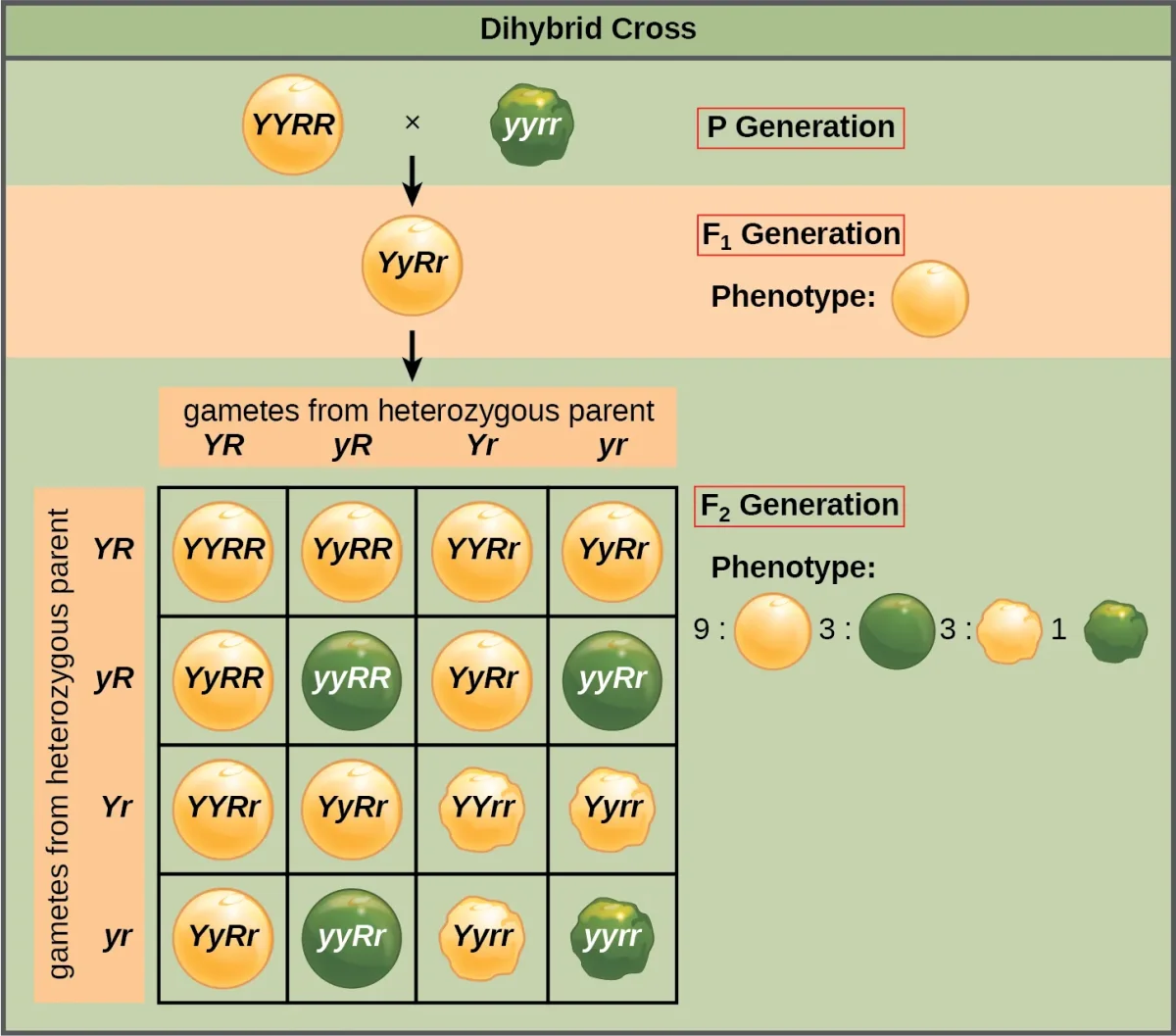
The resulting 16-box Punnett square gives the classic 9:3:3:1 phenotypic ratio:
- 9 purple, tall (at least one P and one T)
- 3 purple, short (at least one P, homozygous tt)
- 3 white, tall (homozygous pp, at least one T)
- 1 white, short (homozygous pp and tt)
Probability Rules
You do not always need to draw a Punnett square. Two probability rules let you solve genetics problems faster:
The Product Rule (AND): The probability of two independent events both occurring is the product of their individual probabilities.
What is the probability of a child being Pp AND Tt from a PpTt x PpTt cross?
- P(Pp) = =
- P(Tt) = =
- P(Pp AND Tt) = x =
The Sum Rule (OR): The probability of one event OR another mutually exclusive event occurring is the sum of their individual probabilities.
What is the probability of a child being homozygous (PP OR pp) from a Pp x Pp cross?
- P(PP) =
- P(pp) =
- P(PP OR pp) = + =
Modified Ratios to Recognize
When you see a ratio that deviates from the expected 9:3:3:1, 3:1, or 1:2:1, it signals non-Mendelian inheritance. We will cover those in the next section, but here are the key modified ratios to watch for:
| Observed Ratio | What It Signals |
|---|---|
| 3:1 | Standard monohybrid with complete dominance |
| 1:2:1 | Incomplete dominance or codominance (three distinct phenotypes) |
| 9:3:3:1 | Standard dihybrid with independent assortment |
| 9:3:4 | Recessive epistasis (one gene masks another) |
| 9:7 | Duplicate recessive epistasis |
| 12:3:1 | Dominant epistasis |
| 1:1 | Test cross (heterozygous x homozygous recessive) |
Chi-Squared: Does the Data Fit the Expected Ratio?
MCAT passages sometimes ask whether observed offspring match a predicted Mendelian ratio. The chi-squared (χ²) goodness-of-fit test is the tool.
You will rarely compute a full χ² on the MCAT, but you may be asked to interpret a p-value. The convention: p < 0.05 rejects the predicted ratio (something non-Mendelian is going on, like linkage or selection); p ≥ 0.05 says the data fit.