
Mendelian Genetics
In the 1860s, an Augustinian friar named Gregor Mendel spent eight years crossbreeding pea plants in a monastery garden. He tracked seven traits - flower color, seed shape, plant height, and others - across thousands of offspring. What he discovered became the foundation of modern genetics.
Before Mendel, people assumed inheritance was like mixing paint. A tall parent and a short parent should produce medium-height children. Mendel proved this was wrong. Traits do not blend - they are passed as discrete units that we now call genes.
The Language of Genetics
Before diving into Mendel’s laws, you need the vocabulary. Every genetics question on the MCAT uses these terms.
| Term | Definition |
|---|---|
| Gene | A segment of DNA that codes for a protein or functional RNA |
| Allele | A specific version of a gene (e.g., “brown eyes” vs. “blue eyes”) |
| Locus | The physical location of a gene on a chromosome |
| Genotype | The combination of alleles an individual carries (e.g., Bb) |
| Phenotype | The observable trait (e.g., brown eyes) |
| Homozygous | Both alleles are the same (BB or bb) |
| Heterozygous | The two alleles differ (Bb) |
| Hemizygous | Only one allele is present (e.g., X-linked genes in males) |
| Dominant | An allele that determines the phenotype when heterozygous (B in Bb) |
| Recessive | An allele that is masked in heterozygotes; only expressed when homozygous (bb) |
| Wild-type | The “normal” allele in a population, often written as + |
Mendel’s First Law: The Law of Segregation
Each organism carries two alleles for every gene - one from each parent. During gamete formation (meiosis), these two alleles segregate so that each gamete carries only one allele.
Think about it at the cellular level: homologous chromosomes separate during anaphase I of meiosis. Since each homolog carries one allele for a given gene, the alleles end up in different gametes.
When two gametes fuse at fertilization, the offspring receives one allele from each parent, restoring the pair.
Mendel’s Second Law: The Law of Independent Assortment
Genes on different chromosomes are inherited independently of each other. The allele you inherit for seed shape has no influence on which allele you inherit for flower color - as long as those genes are on separate chromosomes.
This happens because homologous chromosome pairs line up randomly at the metaphase plate during meiosis I. Which maternal chromosome goes to which pole is independent for each pair. With 23 chromosome pairs, there are (over 8 million) possible gamete combinations - and that is before crossing over adds even more variety.
Mendel’s Law of Dominance
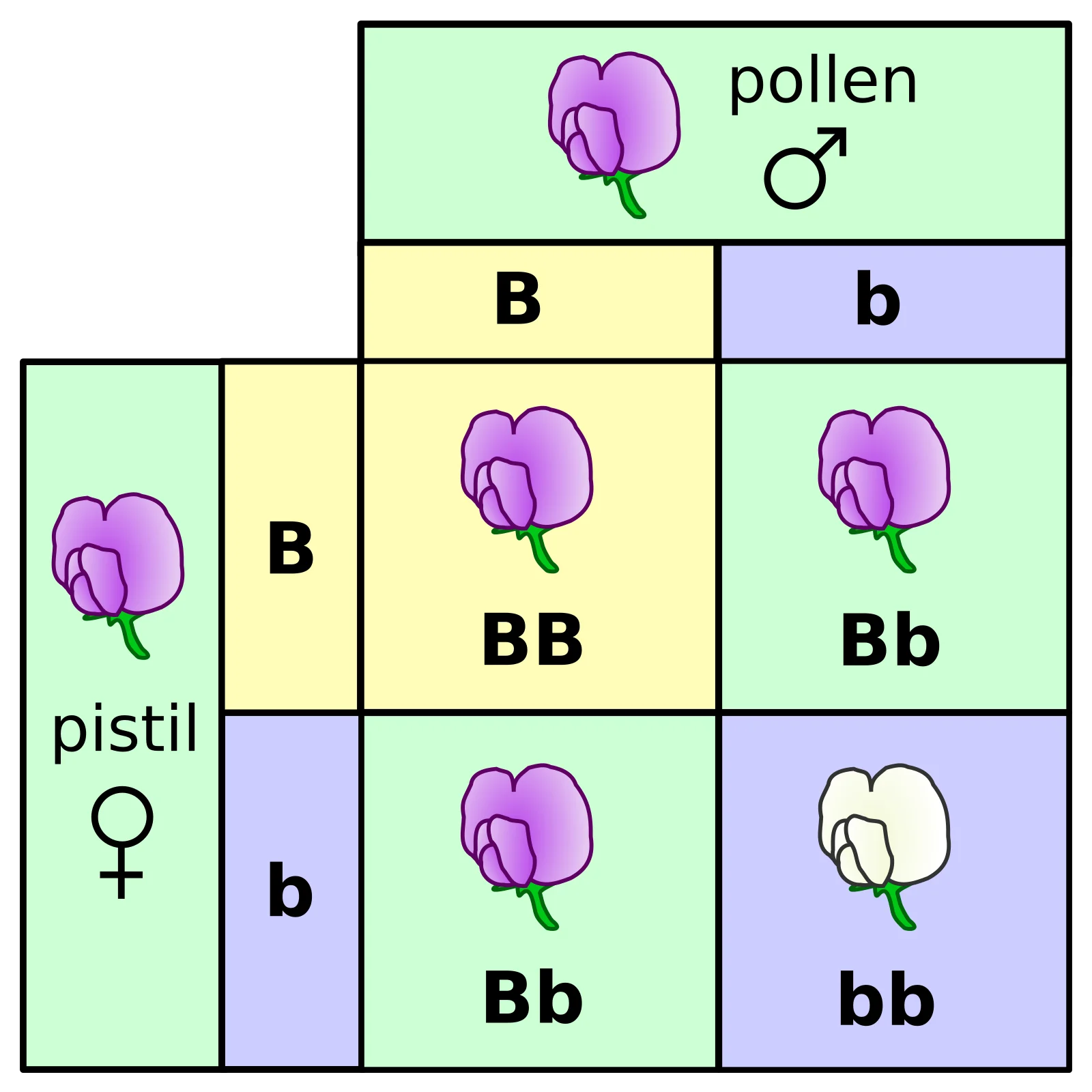
When Mendel crossed true-breeding purple flowers (PP) with true-breeding white flowers (pp), all F1 offspring were purple (Pp). The purple allele completely masked the white allele. He called purple “dominant” and white “recessive.”
When he allowed the F1 generation to self-pollinate (Pp x Pp), the F2 generation showed a 3:1 phenotypic ratio - three purple flowers for every one white flower. The white trait had not disappeared; it was simply hidden in the heterozygotes.
The underlying genotypic ratio in the F2 is 1:2:1 (1 PP : 2 Pp : 1 pp). Both PP and Pp look purple because P is dominant, giving the 3:1 phenotypic ratio.
DNA as Genetic Material
Mendel knew traits were inherited as discrete units, but he did not know what those units were made of. Three key experiments established DNA as the hereditary molecule:
Griffith’s Experiment (1928): Mixed heat-killed virulent (smooth) bacteria with live nonvirulent (rough) bacteria. The rough bacteria were “transformed” into virulent smooth bacteria. Something from the dead bacteria - a “transforming principle” - changed the living ones.
Avery-MacLeod-McCarty (1944): Identified the transforming principle as DNA. When they destroyed the DNA with enzymes, transformation stopped. Destroying proteins or RNA had no effect.
Hershey-Chase (1952): Used bacteriophages labeled with radioactive sulfur (for protein) and radioactive phosphorus (for DNA). Only the phosphorus-labeled DNA entered the bacterial cells and directed the production of new phages. This confirmed DNA - not protein - carries genetic information.