
Linkage & Recombination
Mendel’s law of independent assortment works perfectly - as long as the two genes are on different chromosomes. But what happens when two genes sit on the same chromosome? They tend to be inherited together, violating independent assortment. This is called genetic linkage.
Linked Genes and Parental Types
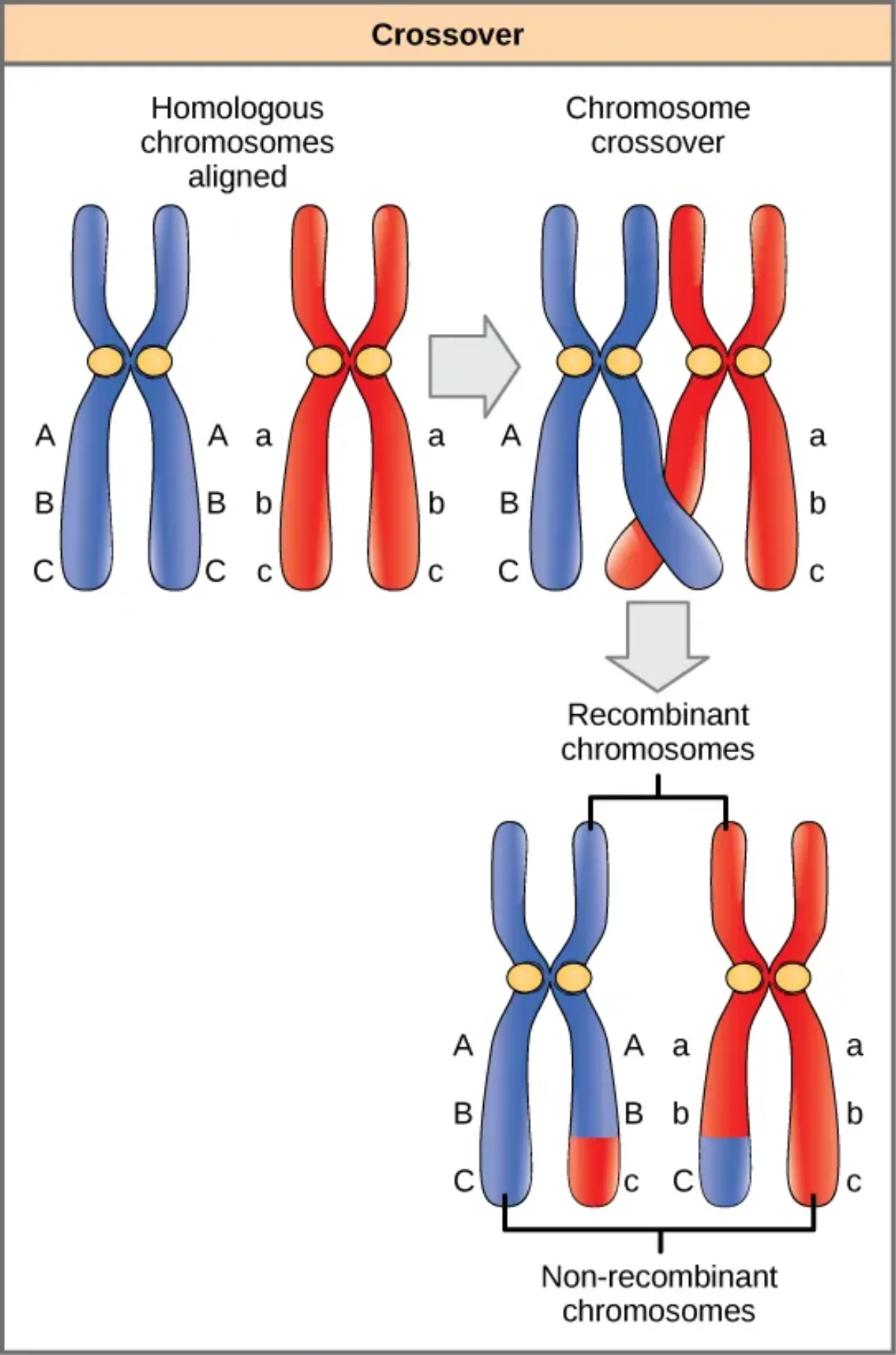
When two genes are linked (on the same chromosome), the allele combinations inherited from each parent tend to stay together. These original combinations are called parental types.
For example, if a parent has alleles AB on one chromosome and ab on the homolog, most gametes will be either AB or ab (parental types), not Ab or aB.
If genes were truly unlinked, a dihybrid test cross (AaBb x aabb) would produce offspring in a 1:1:1:1 ratio. Linked genes deviate from this ratio - parental types are overrepresented.
Crossing Over Creates Recombinants
During prophase I of meiosis, homologous chromosomes pair up and exchange segments of DNA. This is crossing over (recombination). If a crossover event occurs between two linked genes, it separates them into new allele combinations called recombinant types.
The closer two genes are on a chromosome, the less likely crossing over will occur between them. Genes that are far apart on the same chromosome are crossed over so frequently that they behave as if they are on different chromosomes.
Recombination Frequency
Recombination frequency measures how often crossover produces recombinant offspring. It is calculated as:
Key facts about recombination frequency:
- RF = 0% means the genes are completely linked (no crossover ever separates them)
- RF = 50% means the genes assort independently (either on different chromosomes or very far apart on the same chromosome)
- RF can never exceed 50% because at most, half the gametes from a single meiosis can be recombinant
Gene Mapping
By measuring recombination frequencies between pairs of genes, you can determine their relative positions on a chromosome. This is called gene mapping.
Example: Three genes - A, B, and C - have the following RFs:
- A-B: 8 cM
- B-C: 5 cM
- A-C: 13 cM
Since 8 + 5 = 13, the order must be A - B - C, with B in the middle.
If the numbers do not add up perfectly (e.g., A-C = 12 instead of 13), the discrepancy is due to double crossovers between A and C, which can restore the parental arrangement and make the apparent distance slightly smaller than the true distance.