
Mutations & Gene Pool
All genetic variation begins with mutations - changes to the DNA sequence. Some mutations are harmless. Some are lethal. A rare few are beneficial. Together, they provide the raw material for evolution and are the reason no two individuals (except identical twins) have the exact same genome.
The detailed molecular mechanisms of mutation, DNA repair, and replication are covered in the Biochemistry book (Chapters 6-7). Here we focus on the types of mutations, their consequences, and how they change the composition of a population’s gene pool - the total collection of alleles in a population.
Point Mutations
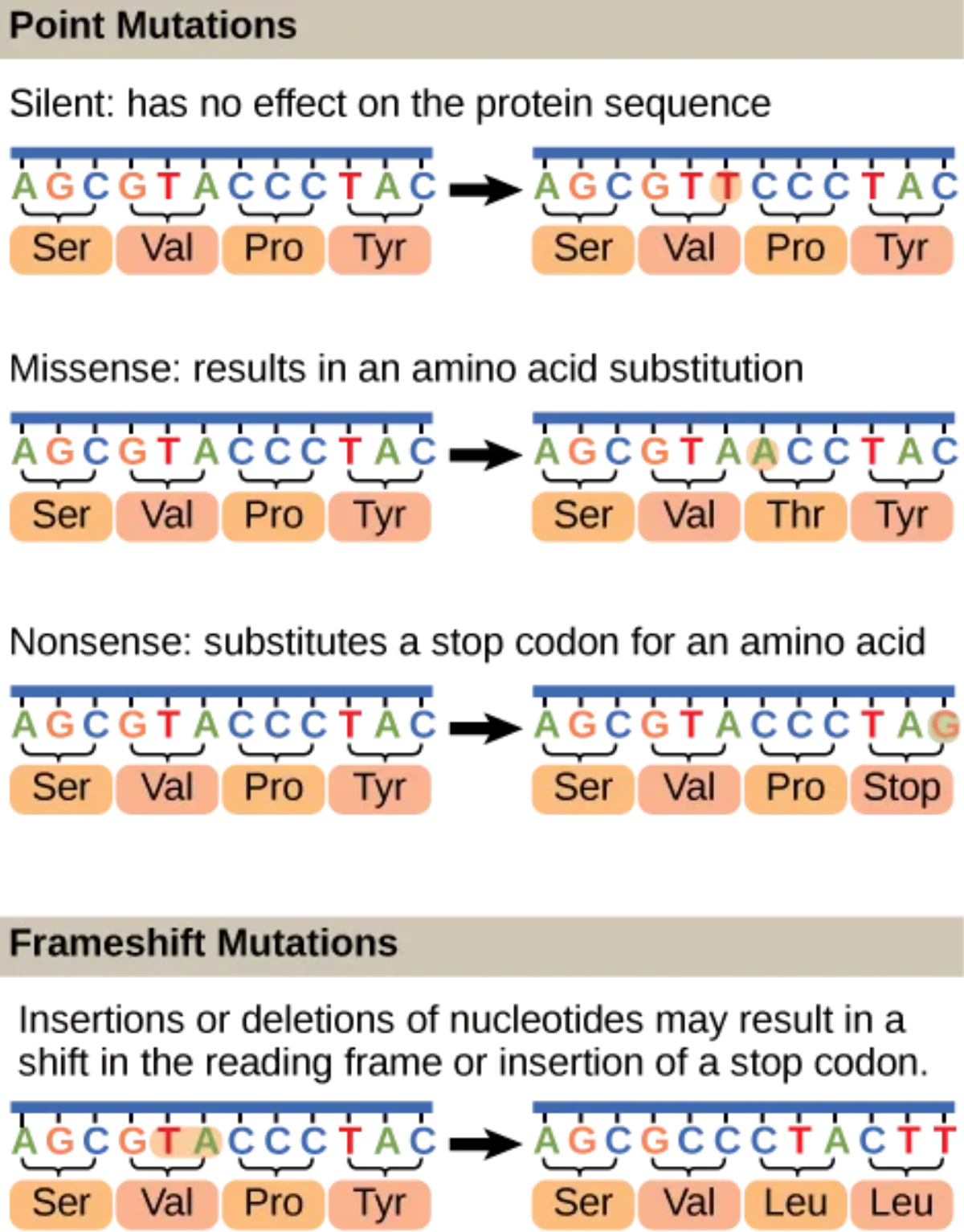
A point mutation changes a single nucleotide in the DNA sequence. There are three types:
Silent mutation: The nucleotide change does not alter the amino acid. This happens because the genetic code is degenerate - multiple codons code for the same amino acid, especially at the third (wobble) position.
Missense mutation: The change produces a different amino acid. The effect ranges from harmless (conservative substitution of a similar amino acid) to devastating. The classic example is sickle cell disease: a single A-to-T substitution changes glutamic acid to valine in hemoglobin, causing red blood cells to sickle.
Nonsense mutation: The change creates a premature stop codon, producing a truncated, usually nonfunctional protein.
Trinucleotide repeat expansion: A short DNA sequence (e.g., CAG) is repeated many extra times during replication. Each generation can add more repeats, so the disease often worsens or appears earlier (anticipation). Examples: Huntington’s disease (CAG) and fragile X syndrome (CGG).
Frameshift Mutations
Insertions or deletions of nucleotides (in numbers that are NOT multiples of 3) shift the reading frame of the mRNA. Every codon downstream of the mutation is read incorrectly, usually producing a completely nonfunctional protein.
Insertions and deletions that ARE multiples of 3 add or remove whole amino acids without disrupting the reading frame - these are non-frameshift insertions/deletions.
Chromosomal Mutations
Larger-scale changes can affect entire segments of chromosomes:
| Type | What Happens | Example |
|---|---|---|
| Deletion | A segment is lost | Cri du chat syndrome (5p deletion) |
| Duplication | A segment is copied | Some cancers (gene amplification) |
| Inversion | A segment is flipped 180 degrees | Usually silent but can affect fertility |
| Insertion | A segment moves to a new location | Some cancers |
| Translocation | Segments swap between non-homologous chromosomes | Philadelphia chromosome (CML) |
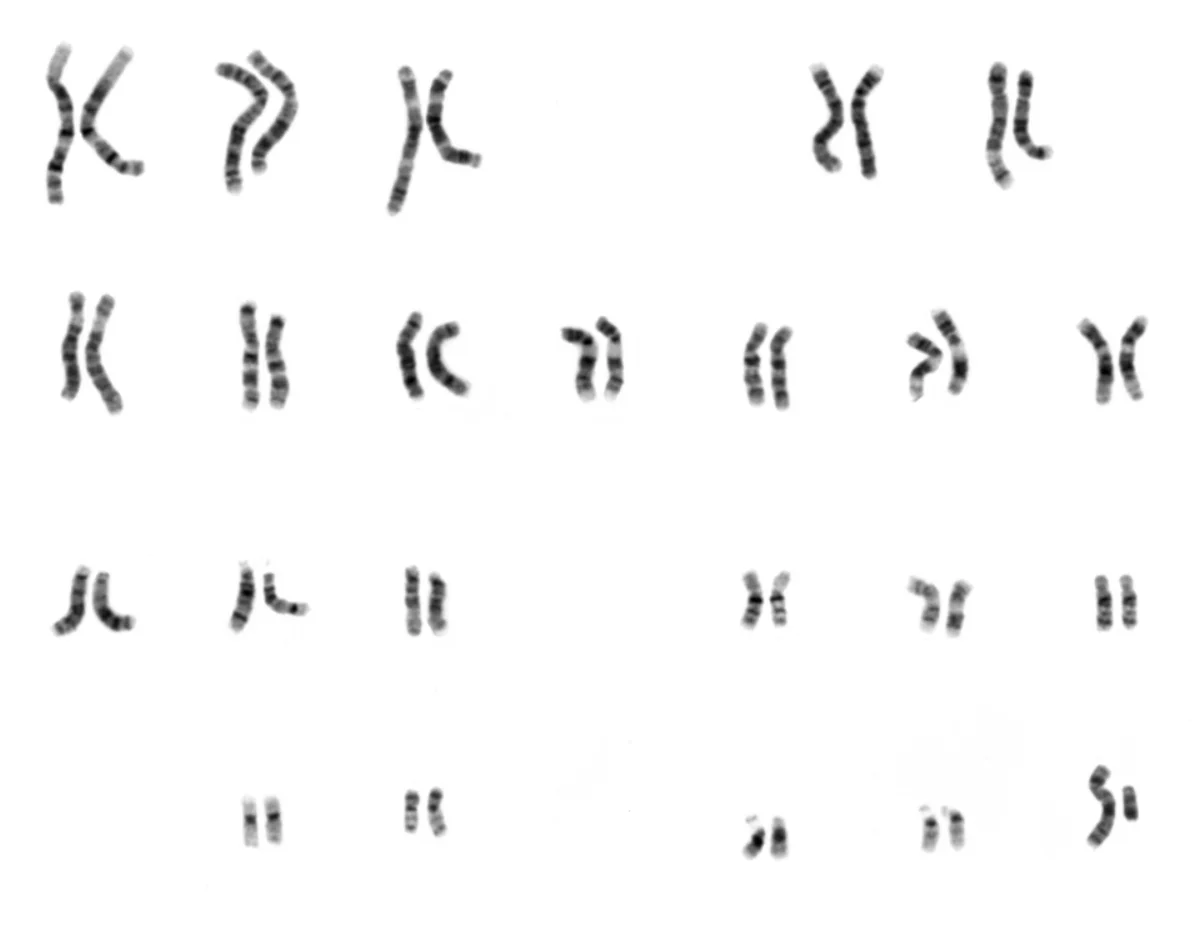
Aneuploidy - having an abnormal number of chromosomes - results from nondisjunction during meiosis. Homologous chromosomes (meiosis I) or sister chromatids (meiosis II) fail to separate properly.
| Condition | Chromosome Change | Features |
|---|---|---|
| Down syndrome | Trisomy 21 | Most common viable autosomal trisomy |
| Turner syndrome | Monosomy X (45,X) | Female, short stature, ovarian failure |
| Klinefelter syndrome | 47,XXY | Male, tall, possible infertility |
Consequences of Mutations
Mutations can be:
- Neutral - no effect on fitness (most mutations fall here, especially in non-coding DNA)
- Beneficial - confer a selective advantage (e.g., heterozygous sickle cell trait protects against malaria)
- Deleterious - reduce fitness or cause disease
Germline mutations occur in eggs or sperm and are passed to offspring. Somatic mutations occur in body cells and are NOT inherited but can cause diseases like cancer in the affected individual.
Mutagens
Mutagens are environmental agents that increase mutation rates:
- Chemical mutagens: Alkylating agents, base analogs, intercalating agents (e.g., benzopyrene in cigarette smoke)
- Radiation: UV light causes thymine dimers; ionizing radiation (X-rays, gamma rays) causes double-strand breaks
- Biological mutagens: Certain viruses insert into the host genome
All carcinogens are mutagens, but not all mutagens are carcinogens. A mutagen becomes a carcinogen when it causes mutations in genes controlling cell growth (proto-oncogenes, tumor suppressors).
Changes in the Gene Pool
The gene pool is the total collection of alleles in a population. Several forces change allele frequencies over time:
Genetic Drift
Genetic drift is a random change in allele frequencies, most significant in small populations. By chance, some alleles may become more or less common - not because they are beneficial or harmful, but simply due to random sampling.
Two special cases of genetic drift:
Bottleneck effect: A catastrophic event (natural disaster, epidemic) kills a large portion of the population at random. The surviving population’s gene pool may differ dramatically from the original.
Founder effect: A small group splits off from a larger population and starts a new colony. The founders carry only a subset of the original alleles, so rare alleles may be overrepresented. This explains why some rare diseases are unusually common in certain isolated communities.
Gene Flow (Genetic Leakage)
Gene flow is the movement of alleles between populations through migration. It tends to reduce genetic differences between populations. When individuals from one population breed with another population, they introduce new alleles.
Inbreeding
Inbreeding is mating between close relatives. It does not change allele frequencies, but it increases homozygosity. This can expose harmful recessive alleles, leading to inbreeding depression - reduced fitness in a population with high levels of inbreeding.
The opposite - outbreeding (mating between unrelated individuals) - increases heterozygosity and can increase a population’s fitness.