
Sex-Linked & Pedigrees
Humans have 22 pairs of autosomes (non-sex chromosomes) and one pair of sex chromosomes. Females are XX. Males are XY. This unequal setup creates unique inheritance patterns for genes on the X and Y chromosomes.
Sex Determination
The SRY gene on the Y chromosome is the master switch for male development. It triggers testis formation, which leads to testosterone production and male sex characteristics. Without SRY, the default developmental pathway is female.
X-Linked Recessive Inheritance
The X chromosome carries hundreds of genes. Males have only one X, so they express whatever allele is on it - they are hemizygous for X-linked genes. Females have two X chromosomes, so they can be carriers (heterozygous) without showing symptoms.
Key features of X-linked recessive traits:
- Affected individuals are almost always male (one bad copy is enough)
- Carrier females ( ) are usually unaffected but can pass the allele to sons
- Affected fathers cannot pass the trait to sons (fathers give Y to sons, not X)
- All daughters of an affected father are at least carriers (they inherit his X)
Classic examples: hemophilia A, red-green color blindness, Duchenne muscular dystrophy.
X-Linked Dominant Inheritance
X-linked dominant traits are expressed in both males AND females who carry even one copy. However, because females have two X chromosomes and X-inactivation occurs randomly, affected females may show milder or more variable symptoms than affected males.
Key features:
- Affected fathers pass the trait to ALL daughters (they all get his X) but NO sons (they get Y)
- Affected mothers pass the trait to approximately half of all children regardless of sex
- Both males and females are affected, but females may show variable expressivity
Y-Linked Inheritance
The Y chromosome is small and carries very few genes (about 50-60 protein-coding genes). Y-linked traits pass exclusively from father to son.
The most important Y-linked gene is SRY (sex-determining region Y). Y-linked traits are rare and always appear in all male descendants of an affected father.
X-Inactivation and Barr Bodies
Females have twice as many X-linked genes as males. To balance gene dosage, each female cell randomly inactivates one X chromosome early in embryonic development. The inactivated X condenses into a Barr body - a dark, inactive clump visible at the edge of the nucleus.
This process is random: in some cells the maternal X is active, in others the paternal X is active. The result is a mosaic of two cell populations.
The classic example is the calico cat. Coat color is X-linked, with one allele for orange and one for black. A heterozygous female ( ) randomly inactivates one X in each patch of skin, producing a patchwork of orange and black fur. Male cats (XY) can only be orange or black, never calico.
Pedigree Analysis
A pedigree is a family tree that tracks a trait across generations. The MCAT expects you to look at a pedigree and determine the most likely inheritance pattern.
Pedigree symbols:
- Circles = female, Squares = male
- Filled = affected, Open = unaffected
- Half-filled = carrier (for recessive traits)
- Horizontal line = mating pair
- Vertical line = parent-to-offspring connection
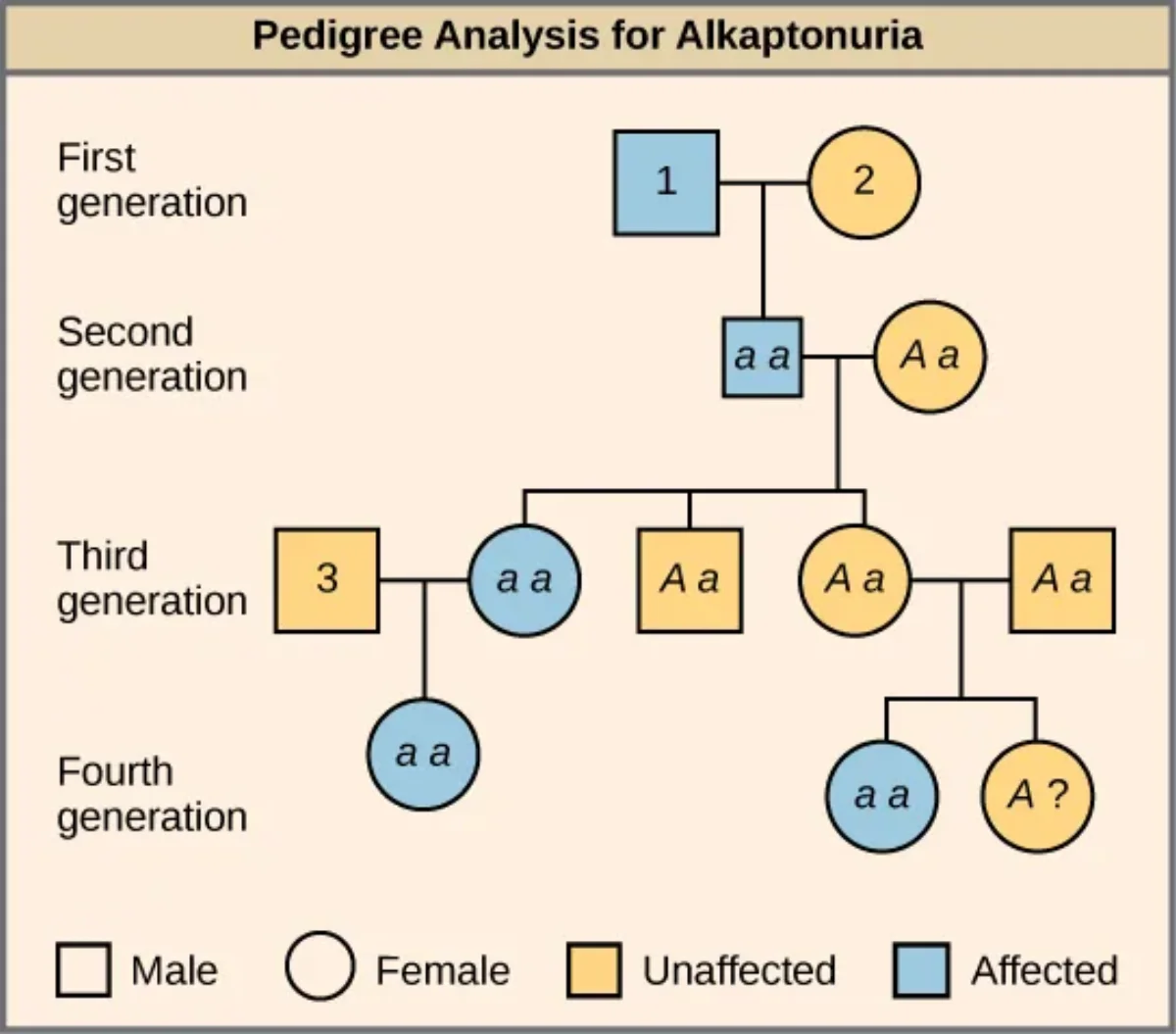
How to Read a Pedigree
Use this decision tree:
Step 1: Is it dominant or recessive?
- If two unaffected parents have an affected child, the trait is recessive (both parents must be carriers)
- If every affected individual has at least one affected parent, the trait is likely dominant
Step 2: Is it autosomal or X-linked?
- If affected fathers have affected sons, it is NOT X-linked (must be autosomal)
- If the trait appears much more frequently in males, consider X-linked recessive
- If an affected father passes the trait to ALL daughters, consider X-linked dominant
Quick Reference: Inheritance Pattern Clues
| Pattern | Key Clues |
|---|---|
| Autosomal Dominant | Affected in every generation; affected individual has at least one affected parent; males and females equally affected |
| Autosomal Recessive | Can skip generations; unaffected parents can have affected children; males and females equally affected |
| X-linked Recessive | More males affected; carrier mothers pass to sons; affected fathers have carrier daughters but unaffected sons |
| X-linked Dominant | Affected fathers pass to ALL daughters but NO sons; affected mothers pass to ~50% of children |
| Mitochondrial | Maternal inheritance only; affected mother passes to all children; affected father passes to none |