
Meiosis
Mitosis is the photocopier - it makes identical copies. Meiosis is the card shuffler. It takes a full deck (46 chromosomes), shuffles it in ways that guarantee every hand is unique, and deals out four half-decks (23 chromosomes each). That is how your body produces sperm and egg cells that are all genetically different from each other - and from you.
Why Meiosis Exists
The fundamental problem: if sperm and egg both had 46 chromosomes, the resulting embryo would have 92. Next generation: 184. This would double every generation. Meiosis solves this by halving the chromosome number, so that when sperm (23) meets egg (23), the result is a normal 46.
This halving is why Meiosis I is called the reduction division.
Key Vocabulary Before We Start
- Homologous chromosomes (homologs) - a matching pair of chromosomes, one from mom and one from dad. They carry the same genes at the same positions (loci) but may have different versions (alleles).
- Sister chromatids - the two identical copies of a chromosome produced by DNA replication, joined at the centromere.
- Tetrad (bivalent) - the structure formed when a pair of homologs lines up during meiosis I. Each homolog has two sister chromatids, so a tetrad has 4 chromatids total.
- Synapsis - the physical pairing of homologous chromosomes, held together by the synaptonemal complex.
- Chiasma (plural: chiasmata) - the X-shaped site where crossing over occurs between homologs.
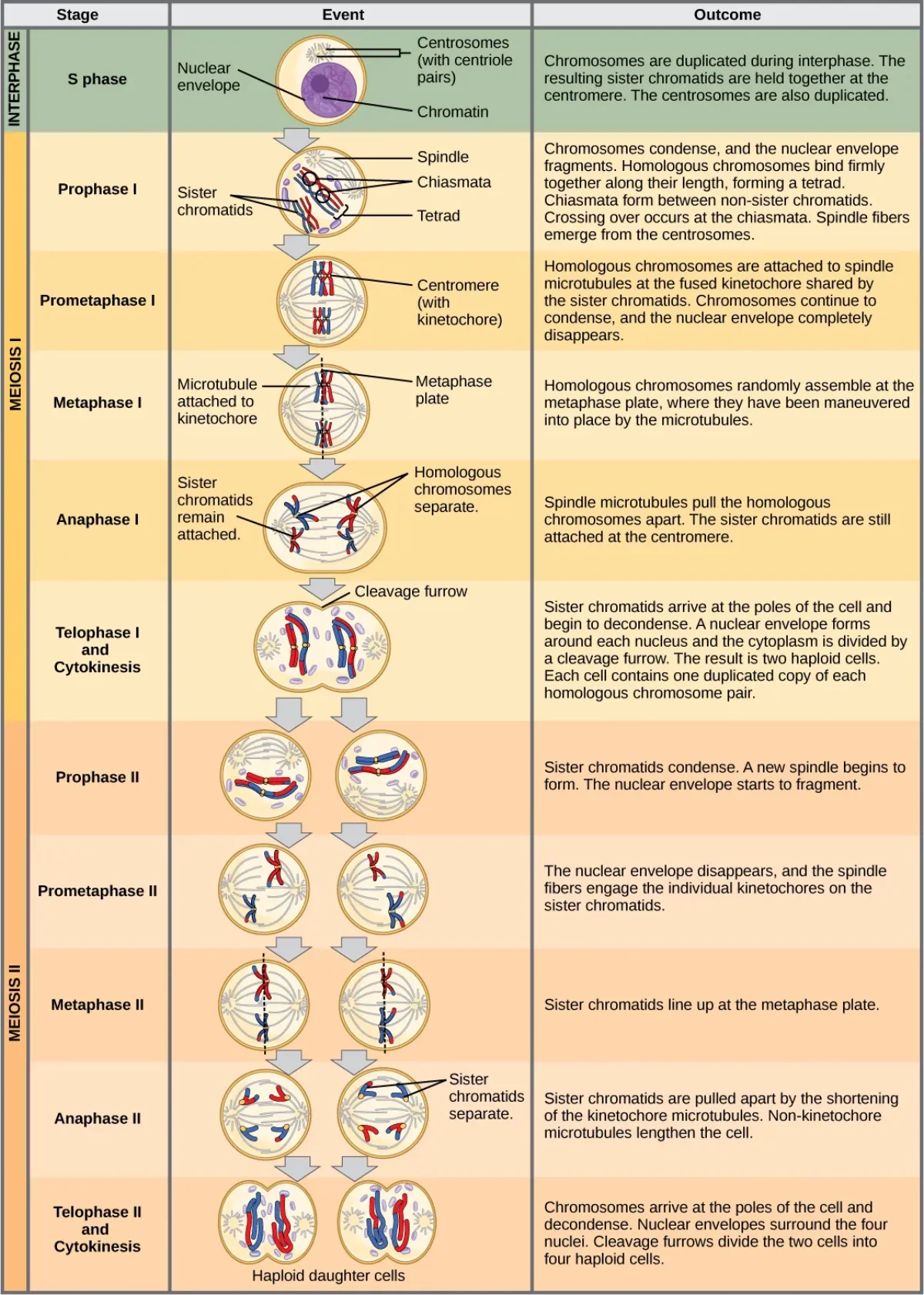
Meiosis I - The Reduction Division
Meiosis I is where the real action happens. This is the division that is fundamentally different from mitosis.
Prophase I - The longest and most complex phase of meiosis:
- Chromosomes condense.
- Synapsis occurs: homologous chromosomes pair up, forming tetrads held together by the synaptonemal complex.
- Crossing over happens at chiasmata - homologs swap segments of DNA. This is the major source of genetic recombination (covered in detail in Section 2.5).
- Nuclear envelope breaks down, spindle forms.
Metaphase I - Tetrads (paired homologs) align at the metaphase plate.
- Critical difference from mitosis: in mitosis, individual chromosomes line up. In meiosis I, pairs of homologs line up together.
- The orientation of each pair is random - mom’s chromosome could face either pole. This is independent assortment (Mendel’s Second Law), and it is a second major source of genetic variation.
Anaphase I - Homologous chromosomes are pulled to opposite poles.
- Critical difference from mitosis: in mitosis, sister chromatids separate. In meiosis I, homologs separate but sister chromatids stay together.
- This separation (disjunction) is what reduces the chromosome number from 2n to n.
Telophase I and Cytokinesis - Nuclear envelopes may reform. The cell divides into two cells, each with 23 chromosomes (but each chromosome still consists of 2 sister chromatids).
Meiosis II - The Equational Division
Meiosis II is essentially mitosis performed on haploid cells. There is no additional DNA replication between Meiosis I and Meiosis II (the brief pause is called interkinesis, not a full interphase).
Prophase II - Chromosomes condense again, nuclear envelope breaks down, spindle forms.
Metaphase II - Individual chromosomes (each still consisting of 2 sister chromatids) align at the metaphase plate.
Anaphase II - Sister chromatids finally separate and move to opposite poles.
Telophase II and Cytokinesis - Nuclear envelopes reform, cells divide. The end result is 4 haploid cells, each with 23 chromosomes (single chromatids).
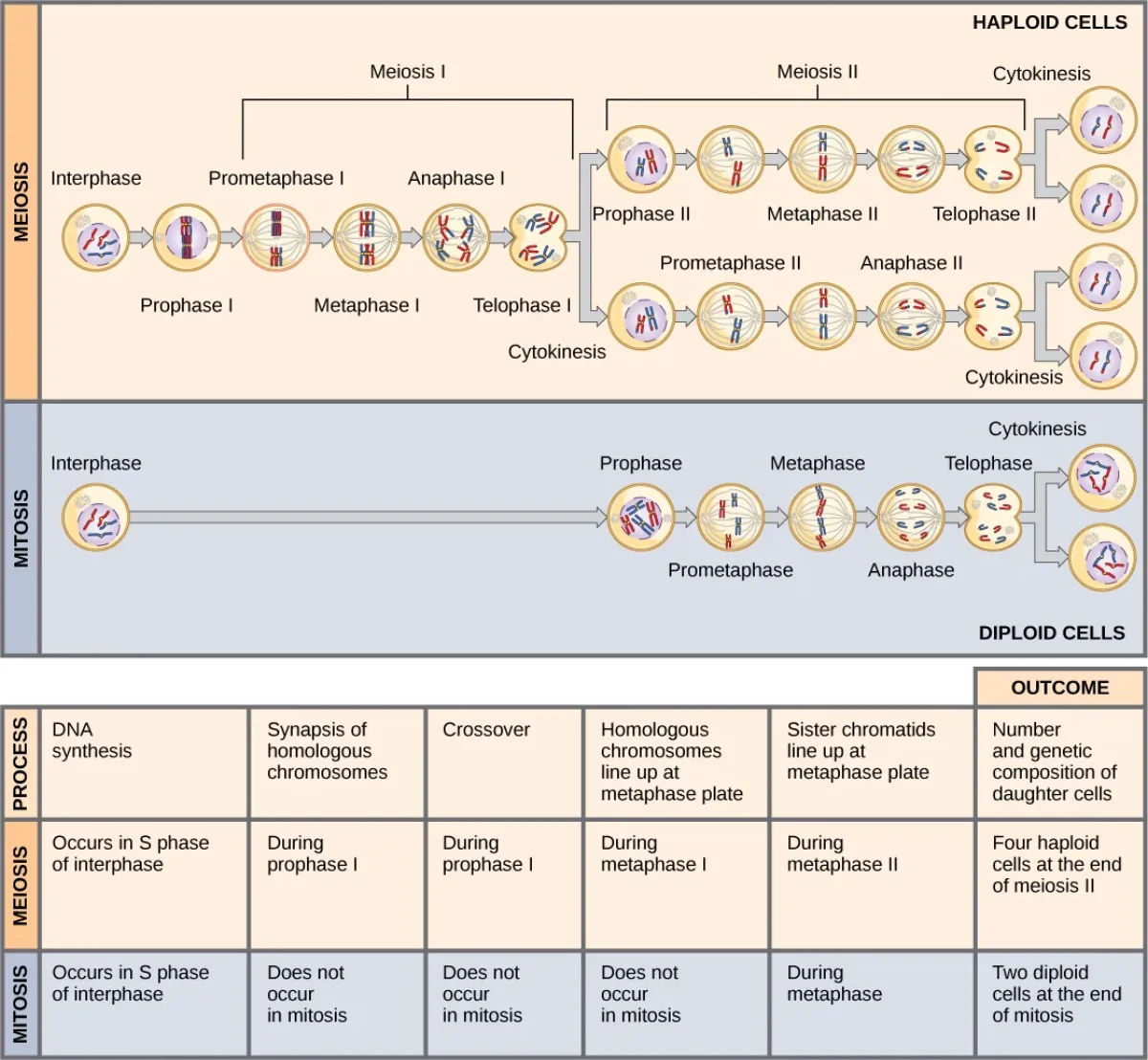
Meiosis vs. Mitosis - Side by Side
| Feature | Mitosis | Meiosis |
|---|---|---|
| Number of divisions | 1 | 2 |
| Daughter cells produced | 2 | 4 |
| Genetic result | Identical to parent | Genetically unique |
| Chromosome number in daughters | 2n (diploid) | n (haploid) |
| Crossing over? | No | Yes (Prophase I) |
| Synapsis/tetrads? | No | Yes (Prophase I) |
| Independent assortment? | No | Yes (Metaphase I) |
| What separates in division I? | Sister chromatids | Homologs |
| Purpose | Growth, repair | Gamete production |
| Where it occurs | Somatic cells | Germ cells (gonads) |
Sources of Genetic Variation in Meiosis
Meiosis generates genetic diversity through three mechanisms:
- Crossing over (Prophase I) - homologs swap DNA segments, creating new allele combinations on each chromosome.
- Independent assortment (Metaphase I) - each homologous pair orients randomly, giving = 8,388,608 possible chromosome combinations per gamete.
- Random fertilization - any one of millions of genetically unique sperm can fertilize any one of millions of genetically unique eggs.
Together, these three mechanisms ensure that no two gametes - and no two offspring (except identical twins) - are ever genetically identical.
Nondisjunction - When Meiosis Goes Wrong
Nondisjunction is the failure of chromosomes to separate properly during meiosis. It can occur in:
- Meiosis I - homologs fail to separate. Both members of a homologous pair go to the same pole. Result: two gametes with an extra chromosome (n+1) and two gametes missing a chromosome (n-1).
- Meiosis II - sister chromatids fail to separate. Result: one gamete with n+1, one with n-1, and two normal (n) gametes.
When an n+1 gamete is fertilized by a normal gamete, the resulting embryo has trisomy (2n+1 = 47 chromosomes). The most commonly tested example is Trisomy 21 (Down syndrome) - three copies of chromosome 21. Nondisjunction can also affect sex chromosomes, such as XXY (Klinefelter syndrome) or XO (Turner syndrome).