
Crossing Over
Imagine you have two decks of cards - one red (from your mother) and one blue (from your father). If you just randomly assigned whole decks to your gametes, each gamete would get either the full red deck or the full blue deck. But that is not what happens. During meiosis, individual cards get swapped between the decks. A red 7 of hearts trades places with a blue 7 of hearts. A red queen of spades swaps with a blue queen of spades. Now each deck is a unique mosaic of red and blue cards. That swap is crossing over.
How Crossing Over Works
Crossing over occurs during Prophase I of meiosis, after homologous chromosomes have paired up through synapsis.
- Homologous chromosomes align precisely, gene for gene, forming a tetrad (4 chromatids total).
- Non-sister chromatids (one from each homolog) physically overlap at points called chiasmata.
- At each chiasma, the DNA strands are cut by enzymes and reconnected to the other homolog.
- The result: each chromatid now carries a new combination of alleles - some originally from the maternal chromosome, some from the paternal chromosome.
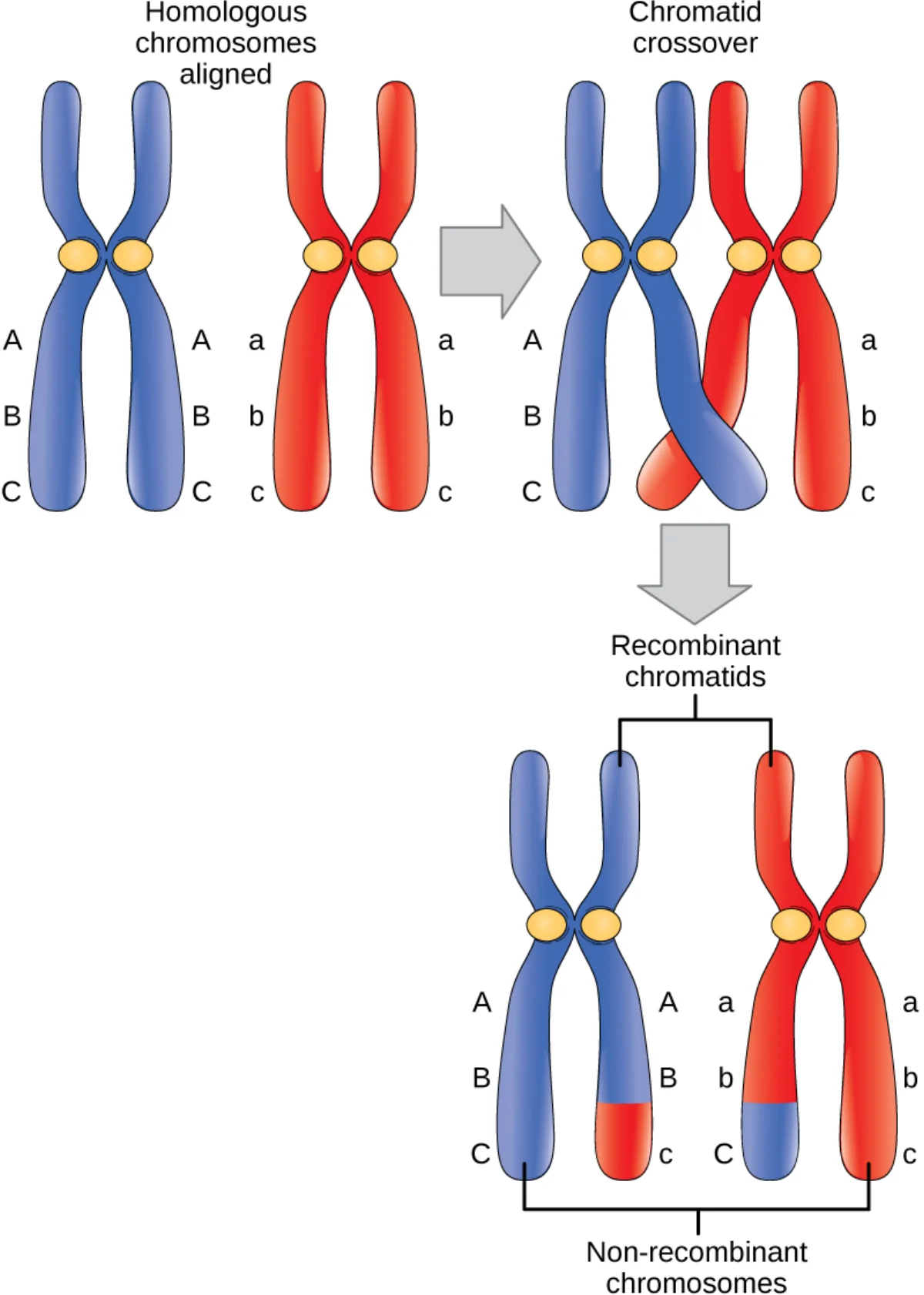
What Gets Swapped
Crossing over swaps corresponding segments between non-sister chromatids of homologous chromosomes. It does NOT occur between:
- Sister chromatids of the same chromosome (they are identical, so swapping would change nothing)
- Non-homologous chromosomes (chromosome 1 does not swap with chromosome 15)
The exchange is always reciprocal - if chromatid A gives a segment to chromatid B, chromatid B gives the equivalent segment back to chromatid A.
Recombinant vs. Parental Chromatids
After crossing over in a tetrad:
- 2 chromatids are recombinant - they carry new allele combinations that did not exist in either parent
- 2 chromatids are parental - they retain the original allele combinations
This means that of the four gametes produced by a single meiosis, some will be recombinant and some will be parental.
Gene Linkage
Genes located on the same chromosome are said to be linked. Linked genes tend to be inherited together because they travel on the same physical piece of DNA. However, crossing over can break this linkage.
The key principle: the further apart two genes are on a chromosome, the more likely crossing over will occur between them. If two genes are very close together, the chance that a chiasma will form between them is low, so they stay linked. If they are far apart, there are many potential chiasma sites between them, so they are frequently separated by crossing over.
Genes on the same chromosome but far apart behave almost as if they are on different chromosomes (they assort nearly independently). Genes very close together are tightly linked and rarely separated.
Recombination Frequency
Recombination frequency is the percentage of offspring that show recombinant (non-parental) phenotypes. It directly reflects the distance between two genes on a chromosome.
- 0% recombination = genes are so close they are never separated = completely linked
- 50% recombination = genes behave as if they are on different chromosomes = unlinked (either very far apart on the same chromosome or on different chromosomes entirely)
- Anything between 0% and 50% = partially linked
Recombination frequency is measured in centimorgans (cM) or map units. 1 cM = 1% recombination frequency.
| Recombination Frequency | Interpretation |
|---|---|
| 0% | Completely linked (always inherited together) |
| 1-49% | Partially linked (on same chromosome, some crossing over) |
| 50% | Unlinked (different chromosomes or very far apart) |
Independent Assortment and Crossing Over Together
Mendel’s Law of Independent Assortment states that alleles of different genes sort into gametes independently. This law is perfectly true for genes on different chromosomes. For genes on the same chromosome, it only holds if they are far enough apart that crossing over separates them frequently (recombination frequency approaching 50%).
The combination of independent assortment (random orientation of homologs in Metaphase I) and crossing over (physical swapping of DNA segments) produces a staggering number of unique gametes:
- Independent assortment alone: = 8,388,608 combinations
- With crossing over: the number is effectively infinite
This genetic diversity is the raw material for natural selection and evolution.
Why Genetic Diversity Matters
Crossing over is not just a molecular curiosity - it is an evolutionary necessity. Populations with greater genetic variation are better equipped to adapt to changing environments, resist new pathogens, and survive selective pressures. Without recombination, every individual would carry the exact same combination of alleles found in their parents, and evolution would be far slower.