
Cell Cycle Control
Imagine an airport with three security checkpoints. Before you board, you must pass through all three. At each one, guards check your passport, your ticket, and your bags. If anything is wrong, you are stopped until the problem is resolved. If the problem cannot be fixed, you are removed from the airport entirely.
The cell cycle works the same way. There are three major checkpoints where the cell pauses to verify that everything is in order before proceeding to the next phase. If conditions are not right, the cell stops. If the damage is unrepairable, the cell destroys itself (apoptosis). Cancer is what happens when someone sneaks past every checkpoint.
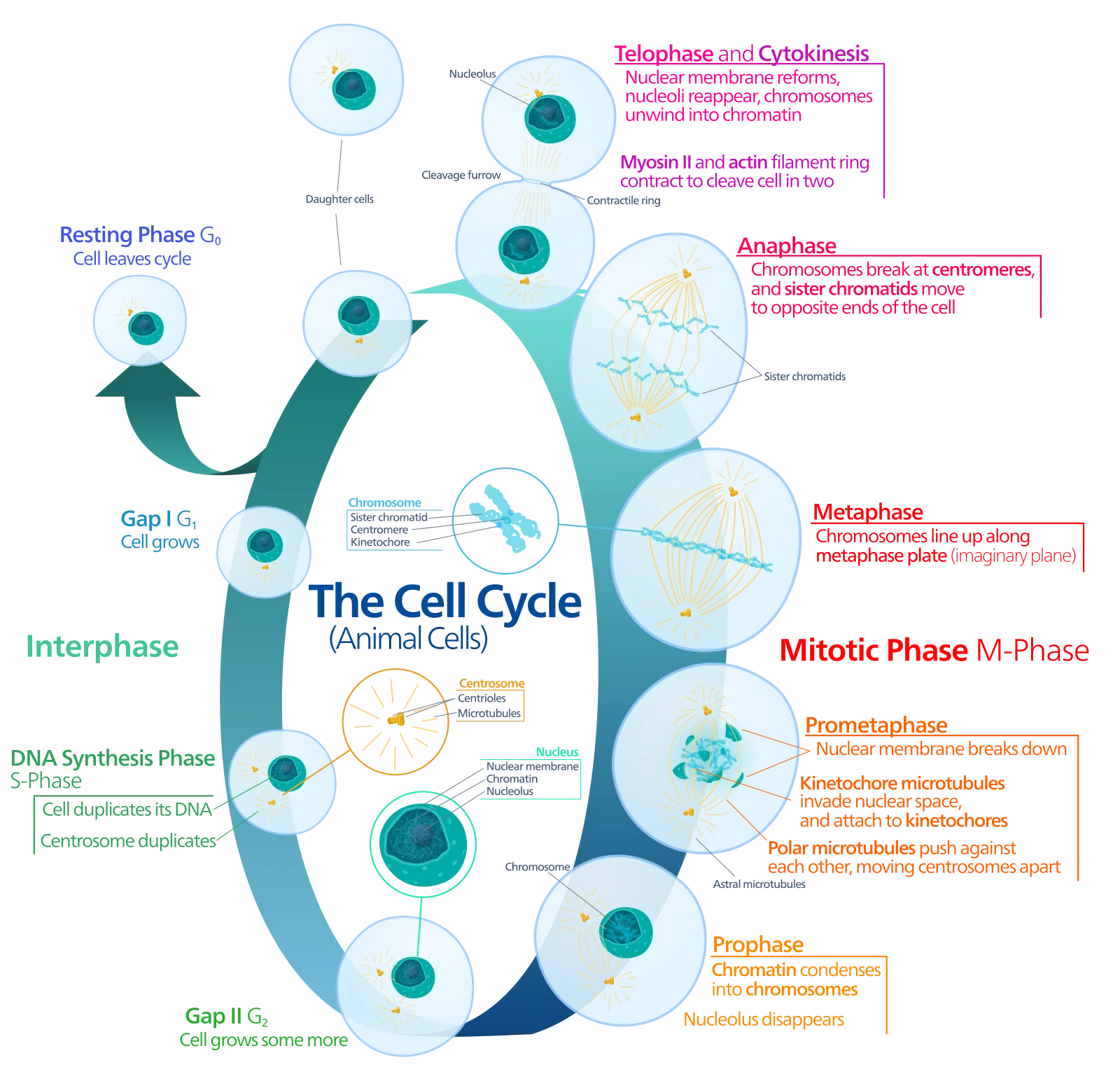
The Three Major Checkpoints
G1 Checkpoint (Restriction Point) - The most important decision point. The cell asks:
- Is the cell large enough to divide?
- Are there sufficient nutrients and energy?
- Is the DNA undamaged?
- Are growth factors present?
If conditions are favorable, the cell commits to division and enters S phase. If not, it enters G0 (quiescence). Once past the G1 checkpoint, the cell is committed - it will complete the cycle without needing additional external signals.
G2 Checkpoint - Before entering mitosis, the cell verifies:
- Was DNA replication completed successfully?
- Is there any remaining DNA damage?
- Are mitosis-promoting factors (MPF) present?
M Checkpoint (Spindle Assembly Checkpoint) - During metaphase, the cell checks:
- Are all chromosomes attached to spindle fibers from both poles?
- Is there proper tension on each kinetochore?
If even one chromosome is unattached, the checkpoint halts division. Failure at this checkpoint leads to nondisjunction - unequal chromosome distribution that causes conditions like Down syndrome (trisomy 21).
Cyclins and CDKs - The Molecular Engine
The cell cycle is driven forward by a partnership between two types of proteins:
- Cyclins - regulatory proteins whose concentrations rise and fall in a predictable pattern as the cell progresses through the cycle (hence the name “cyclin”)
- CDKs (cyclin-dependent kinases) - enzyme proteins that are always present in the cell but are inactive on their own
Here is the key: CDKs only become active when a cyclin binds to them. The cyclin-CDK complex then phosphorylates (adds phosphate groups to) target proteins that push the cell into the next phase.
Think of it this way: the CDK is the car engine (always there, always ready) and the cyclin is the ignition key (comes and goes). No key, no ignition. No cyclin, no cell cycle progression.
| Phase Transition | Cyclin | CDK Partner | Function |
|---|---|---|---|
| G1 to S | Cyclin D | CDK | Passes the restriction point |
| S phase entry | Cyclin E | CDK2 | Initiates DNA replication |
| S to G2 | Cyclin A | CDK2 | Completes DNA replication |
| G2 to M | Cyclin B | CDK1 | Triggers mitosis (MPF) |
The Cyclin B-CDK1 complex is also known as MPF (Maturation Promoting Factor) or M-phase promoting factor. It triggers the cascade of events that initiates mitosis: chromosome condensation, nuclear envelope breakdown, and spindle formation.
Growth Factors and External Signals
Cells do not just decide to divide on their own. They need permission from the body in the form of growth factors - signaling molecules that bind to cell surface receptors and activate signal transduction pathways leading to the production of cyclins.
Without growth factors, most normal cells remain in G0. This is why:
- Wound healing is localized (growth factors are released at the injury site)
- Cells in a dish stop dividing when they run out of growth factor in the media
Two additional controls on cell growth:
- Density-dependent inhibition (contact inhibition) - cells stop dividing when they become too crowded and physically touch neighboring cells
- Anchorage dependence - normal cells must be attached to a surface (extracellular matrix) to divide
Cancer cells ignore both of these signals.
Tumor Suppressors - The Brakes
Tumor suppressor genes encode proteins that slow down or stop cell division. They are the brakes on the cell cycle.
p53 - “The Guardian of the Genome”:
- Monitors DNA integrity
- If damage is detected, p53 halts the cell cycle at the G1 checkpoint to allow time for repair
- If repair fails, p53 triggers apoptosis (programmed cell death)
- p53 is the most commonly mutated gene in human cancers - when p53 is lost, damaged cells keep dividing instead of self-destructing
Rb (Retinoblastoma protein):
- Controls the G1 checkpoint by binding to and inhibiting the transcription factor E2F
- When Rb is phosphorylated by Cyclin D-CDK, it releases E2F, allowing the cell to enter S phase
- Loss of Rb removes the G1 brake, leading to uncontrolled entry into S phase
Proto-Oncogenes and Oncogenes - The Gas Pedal
Proto-oncogenes are normal genes that encode proteins promoting cell division (growth factors, receptors, signal transduction proteins, transcription factors). They are the gas pedal.
When a proto-oncogene is mutated into an oncogene, it becomes a stuck gas pedal - always on, driving cell division even without the proper signals. Unlike tumor suppressors, only one copy of a proto-oncogene needs to be mutated to cause problems (it is a gain-of-function mutation).
| Feature | Tumor Suppressors | Oncogenes |
|---|---|---|
| Normal function | Inhibit cell division (brakes) | Promote cell division (gas pedal) |
| Mutation type | Loss-of-function | Gain-of-function |
| Copies needed to cause cancer | Both (two-hit) | One (dominant) |
| Examples | p53, Rb | Ras |
How Cancer Develops
Cancer is not a single mutation - it is an accumulation of mutations in multiple regulatory genes. A typical cancer cell might have:
- Activated oncogenes (stuck gas pedal)
- Inactivated tumor suppressors (broken brakes)
- Loss of contact inhibition
- Loss of anchorage dependence
- Telomerase reactivation (immortality - can divide indefinitely)
- Ability to stimulate angiogenesis (growing new blood vessels to feed the tumor)