
Kinetic Molecular Theory
The gas laws tell you WHAT gases do. Kinetic molecular theory tells you WHY. KMT is a model that explains macroscopic gas behavior (pressure, temperature, volume) in terms of the microscopic motion of individual molecules. Understand these five postulates and you can derive every gas law from first principles.
The Five Postulates of KMT
1. Gas molecules are in constant, random, straight-line motion. They travel in all directions with a range of speeds. Between collisions, their paths are straight lines.
2. The volume of individual gas molecules is negligible compared to the container volume. Gas is mostly empty space. The actual volume occupied by the molecules themselves is essentially zero relative to the container.
3. Gas molecules exert no attractive or repulsive forces on each other. They are completely independent - no intermolecular forces. This is why gases mix uniformly and why each gas in a mixture behaves independently (Dalton’s law).
4. Collisions between gas molecules and with container walls are perfectly elastic. No kinetic energy is lost during collisions. Energy can transfer between molecules, but the total kinetic energy of the system is conserved.
5. The average kinetic energy of gas molecules is directly proportional to the absolute temperature. This is the most important postulate for the MCAT. It links the macroscopic quantity (temperature) to microscopic behavior (molecular motion).
Temperature and Kinetic Energy
The fifth postulate gives us one of the most important relationships in gas phase chemistry:
Critical insight: Average kinetic energy depends ONLY on temperature. It does NOT depend on the identity, mass, or molar mass of the gas. At the same temperature, helium atoms and xenon atoms have the same average kinetic energy. This seems surprising, but it means that heavier molecules must move more slowly to have the same kinetic energy as lighter ones (since KE = mv²).
Root Mean Square Speed
Since KE = mv², and KE(avg) = kT, we can solve for the speed of gas molecules:
From this equation:
- Higher temperature = faster speed (v increases with T)
- Lighter molecules = faster speed (v decreases with M)
- Speed is proportional to √T and inversely proportional to √M
How KMT Explains the Gas Laws
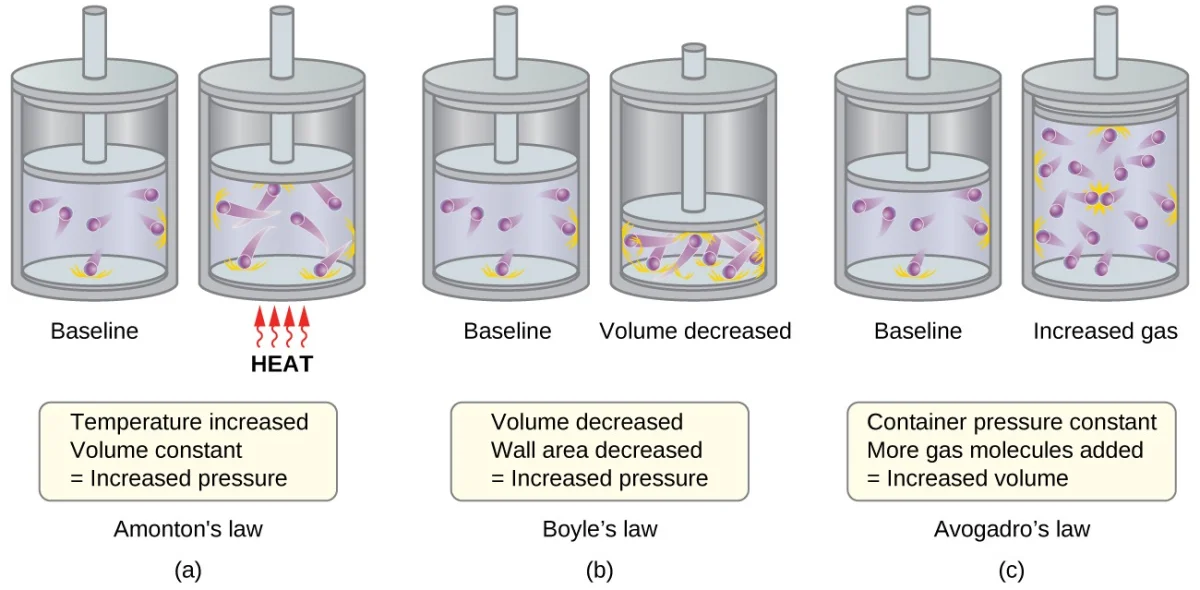
| Gas Law | KMT Explanation |
|---|---|
| Boyle’s (P ∝ 1/V) | Smaller volume = molecules hit walls more often = higher pressure |
| Charles’s (V ∝ T) | Higher T = faster molecules = they push walls outward = larger volume (at constant P) |
| Gay-Lussac’s (P ∝ T) | Higher T = faster molecules = harder, more frequent wall hits = higher pressure (at constant V) |
| Avogadro’s (V ∝ n) | More molecules = more collisions with walls = walls must expand to maintain constant P |
| Dalton’s (P = sum of partials) | Each gas acts independently (no IMFs) = each contributes its own collisions |
Heat Capacity of Gases: Cp vs. Cv
Kinetic molecular theory also explains why gases have two different heat capacities:
Cv (heat capacity at constant volume): All added heat goes into increasing molecular kinetic energy (translation, rotation, vibration). No work is done because the volume does not change.
Cp (heat capacity at constant pressure): Some added heat goes into kinetic energy, but some goes into doing expansion work (pushing the atmosphere back as the gas expands). Therefore, Cp > Cv for all gases.
Pressure at the Molecular Level
Pressure arises from the cumulative effect of molecular collisions with container walls. The pressure of a gas depends on:
- Number of molecules (more molecules = more collisions)
- Speed of molecules (faster = harder hits)
- Mass of molecules (heavier = harder hits)
- Frequency of collisions (depends on speed, number, and container size)
This is why P = nRT/V works: n counts molecules, T determines their speed, and 1/V determines how often they hit any given wall area.