Salt your pasta water and it boils at a slightly higher temperature. That tiny change demonstrates boiling point elevation - one of the four colligative properties and a straightforward MCAT calculation.
The Formula
Important details:
ΔTb is always positive (boiling point goes UP)
The new boiling point = normal boiling point + ΔTb
Kb for water = 0.512 C/m (usually given on the MCAT)
Use molality (m), not molarity (M)
Why Does This Happen?
At the normal boiling point of pure water (100 C), the vapor pressure equals 1 atm. But a solution has a lower vapor pressure at 100 C (thanks to Raoult’s law). So at 100 C, the solution’s vapor pressure is still below 1 atm - it is not boiling yet.
You need to heat it past 100 C to push the vapor pressure up to 1 atm. The extra temperature needed is ΔTb.
Worked Example
Problem: Calculate the boiling point of a solution containing 58.5 g of NaCl dissolved in 1.00 kg of water. (Kb for water = 0.512 C/m)
Solution:
Moles of NaCl: 58.5 g / 58.5 g/mol = 1.00 mol
Molality: 1.00 mol / 1.00 kg = 1.00 m
Van ‘t Hoff factor: NaCl → Na⁺ + Cl⁻, so i = 2
ΔTb = i × Kb × m = 2 × 0.512 × 1.00 = 1.024 C
New boiling point = 100.0 + 1.024 = 101.0 C
Phase Diagram View
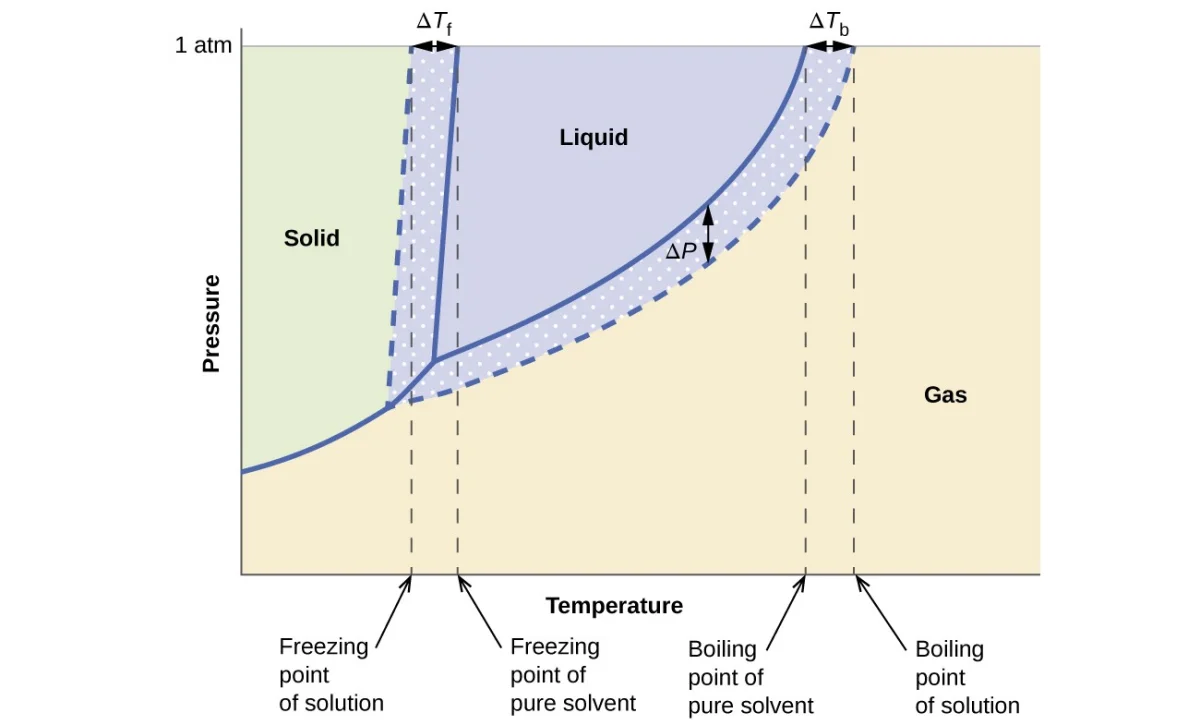
On a phase diagram, adding solute shifts the liquid-gas boundary to the right (higher temperature). The liquid phase region expands because the solution remains liquid at temperatures where pure water would have started boiling.
This shift is directly visible on the classic phase diagram that shows both boiling point elevation and freezing point depression - a favorite MCAT figure.
Phase diagram showing colligative effects: adding a nonvolatile solute shifts the boiling point higher and the freezing point lower, expanding the liquid region. The dashed lines represent the solution; solid lines represent pure water. Credit: OpenStax Chemistry 2e, CC BY 4.0
Which has a higher boiling point: 1 m glucose solution or 1 m NaCl solution? Why?
Click to reveal answer
1 m NaCl has the higher boiling point. Glucose does not dissociate (i = 1), so ΔTb = 1 × Kb × 1 = 0.512 C. NaCl dissociates into 2 ions (i = 2), so ΔTb = 2 × Kb × 1 = 1.024 C. NaCl produces twice as many dissolved particles, so it raises the boiling point twice as much. Colligative properties depend on particle COUNT.
A solution has a boiling point of 101.5 C in water (Kb = 0.512 C/m). If the solute is a nonelectrolyte (i = 1), what is the molality?
Click to reveal answer
m = 2.93 m. ΔTb = 101.5 - 100.0 = 1.5 C. Using ΔTb = iKbm: 1.5 = 1 × 0.512 × m. m = 0.5121.5 = 2.93 m. This reverse calculation is common on the MCAT - they give you the boiling point change and ask for concentration or molar mass.