Freezing point depression is the mirror image of boiling point elevation: adding solute makes it harder for the solvent to freeze. This is the reason cities dump salt on icy roads and why you add antifreeze to your car’s radiator.
The Formula
Important details:
ΔTf is the amount the freezing point drops (always positive as a magnitude)
New freezing point = normal freezing point minus ΔTf
Kf for water = 1.86 C/m (usually given)
Kf is larger than Kb (1.86 vs. 0.512), so freezing point changes are more dramatic than boiling point changes for the same concentration
Why Does This Happen?
Freezing requires solvent molecules to arrange into an ordered crystal lattice. Dissolved solute particles disrupt this ordering process - they physically occupy positions in the liquid and prevent the regular crystal structure from forming.
At the normal freezing point (0 C for water), a solution is still liquid because the solute particles keep interfering with crystallization. You must cool further to provide enough driving force for the crystal to form despite the solute interference.
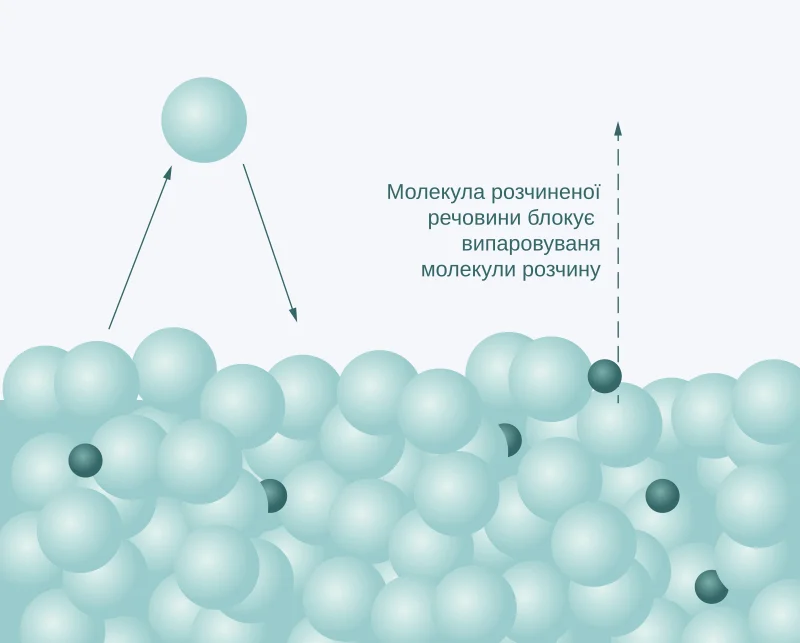
The molecular basis for colligative properties: solute particles (dark circles) occupy surface positions, blocking solvent molecules from evaporating. This reduces vapor pressure, which raises the boiling point and lowers the freezing point. Credit: Wikimedia Commons, CC0
Why Is Kf Larger Than Kb?
This is a subtle but testable point. Kf (1.86 C/m) is about 3.6 times larger than Kb (0.512 C/m) for water. The freezing point is more sensitive to dissolved particles than the boiling point.
The reason: freezing involves ordering molecules into a crystal (huge entropy decrease), so even small amounts of solute have a big disrupting effect. Boiling is less structurally dependent.
Worked Example
Problem: What is the freezing point of a solution containing 0.50 mol of CaCl₂ in 500 g of water? (Kf = 1.86 C/m)
Solution:
Molality: 0.50 mol / 0.500 kg = 1.00 m
CaCl₂ → Ca²⁺ + 2 Cl⁻, so i = 3
ΔTf = i × Kf × m = 3 × 1.86 × 1.00 = 5.58 C
New freezing point = 0.0 - 5.58 = -5.58 C
Real-World Applications
Application
How It Works
Road salt (NaCl or CaCl₂)
Depresses the freezing point of water on roads, preventing ice formation above the new freezing point
Antifreeze (ethylene glycol)
Mixed with car radiator water to lower the freezing point far below 0 C, preventing engine block cracking in winter
Salt on ice cream maker
Salt-ice mixture gets colder than 0 C, cold enough to freeze the cream mixture inside
Why is CaCl₂ more effective than NaCl at lowering the freezing point of water (per mole of compound)?
Click to reveal answer
CaCl₂ produces 3 particles per formula unit (Ca²⁺ + 2 Cl⁻, i = 3), while NaCl produces only 2 (Na⁺ + Cl⁻, i = 2). Since freezing point depression depends on particle count (ΔTf = iKfm), CaCl₂ at the same molality gives 50% more depression. More particles = more disruption of crystal formation = lower freezing point.
For the same solution, the ΔTf is 5.58 C and the ΔTb is 1.54 C. Why is ΔTf larger than ΔTb?
Click to reveal answer
Because Kf (1.86 C/m) is larger than Kb (0.512 C/m). Both use the same formula ΔT = iKm, so the difference comes entirely from the constant. Freezing is more sensitive to dissolved solute than boiling because crystal lattice formation is easily disrupted by any foreign particle. The ratio Kf/Kb for water is about 3.6, which matches ΔTf/ΔTb for the same solution.