
Colligative Properties
Here is the single most important idea in this chapter: colligative properties depend on how many particles are dissolved, not what those particles are. Dissolve 1 mole of glucose (1 particle per formula unit) or 1 mole of NaCl (2 particles per formula unit), and the colligative effects scale with particle count alone. Identity is irrelevant.
What Are Colligative Properties?
The word “colligative” comes from the Latin “colligare,” meaning “to bind together.” There are four colligative properties:
| Property | Effect of Adding Solute | Formula |
|---|---|---|
| Vapor pressure lowering | Decreases | Raoult’s law: P = χ_solvent × P° |
| Boiling point elevation | Increases | ΔTb = iKbm |
| Freezing point depression | Decreases | ΔTf = iKfm |
| Osmotic pressure | Increases | π = iMRT |
All four share the same underlying cause: dissolved particles interfere with the solvent’s ability to escape into the gas phase.
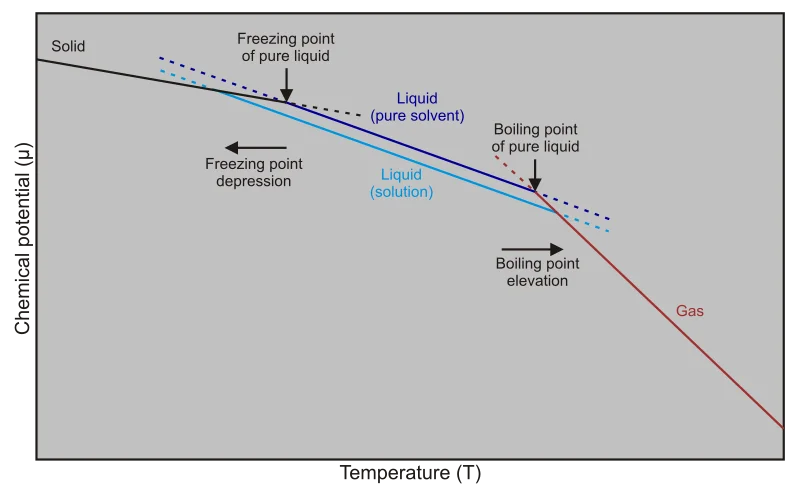
The Root Cause - Vapor Pressure Lowering
Every colligative property traces back to one phenomenon: a nonvolatile solute lowers the vapor pressure of the solvent.
Why? When solute particles dissolve, they occupy positions at the liquid surface. Fewer solvent molecules are at the surface, so fewer can escape into the gas phase per second. The rate of evaporation decreases, so the equilibrium vapor pressure drops.
This is purely a numbers game. Each solute particle blocks a surface site. More particles = more blocking = lower vapor pressure. It does not matter what the particles are - only how many are there.
How Vapor Pressure Lowering Creates the Other Three Properties
Once you understand that solute lowers vapor pressure, the other three properties follow logically:
Boiling point elevation: The liquid must reach a higher temperature before its vapor pressure equals atmospheric pressure (the definition of boiling). Lower vapor pressure at any given temperature means you need more heat to boil. Boiling point goes up.
Freezing point depression: At the normal freezing point, the solution’s vapor pressure is now lower than the solid’s vapor pressure. The solid melts to equalize. You must cool further to reach the new temperature where solid and liquid vapor pressures match. Freezing point goes down.
Osmotic pressure: When a solution and pure solvent are separated by a semipermeable membrane, solvent flows toward the solution (from high vapor pressure to low). The pressure needed to stop this flow is osmotic pressure. More particles = lower vapor pressure = greater driving force = higher osmotic pressure.
Nonvolatile vs. Volatile Solutes
Colligative property equations (ΔTb, ΔTf, π) assume the solute is nonvolatile - meaning the solute does not evaporate. Sugar, NaCl, and glucose are nonvolatile. They stay in the liquid phase and only the solvent contributes to vapor pressure.
If the solute IS volatile (like mixing ethanol and water), both components contribute to vapor pressure, and the simple colligative property formulas do not apply cleanly. The MCAT almost always uses nonvolatile solutes for these calculations.
Ranking Colligative Effects
To compare colligative effects between different solutions, count the total dissolved particles:
| Solute | Particles per formula unit | 1 M solution gives… |
|---|---|---|
| Glucose (C₆H₁₂O₆) | 1 (nonelectrolyte) | 1 mol particles |
| NaCl | 2 (Na⁺ + Cl⁻) | 2 mol particles |
| CaCl₂ | 3 (Ca²⁺ + 2 Cl⁻) | 3 mol particles |
| FeCl₃ | 4 (Fe³⁺ + 3 Cl⁻) | 4 mol particles |
A 1 M CaCl₂ solution has a higher boiling point, lower freezing point, and higher osmotic pressure than a 1 M NaCl solution - because it produces more particles.