The Dissolution Process
The most important rule in solubility is also the simplest: like dissolves like. Polar solvents dissolve polar solutes. Nonpolar solvents dissolve nonpolar solutes. Trying to dissolve a nonpolar substance in a polar solvent (or vice versa) is like trying to mix oil and water - it does not work.
Why Does “Like Dissolves Like” Work?
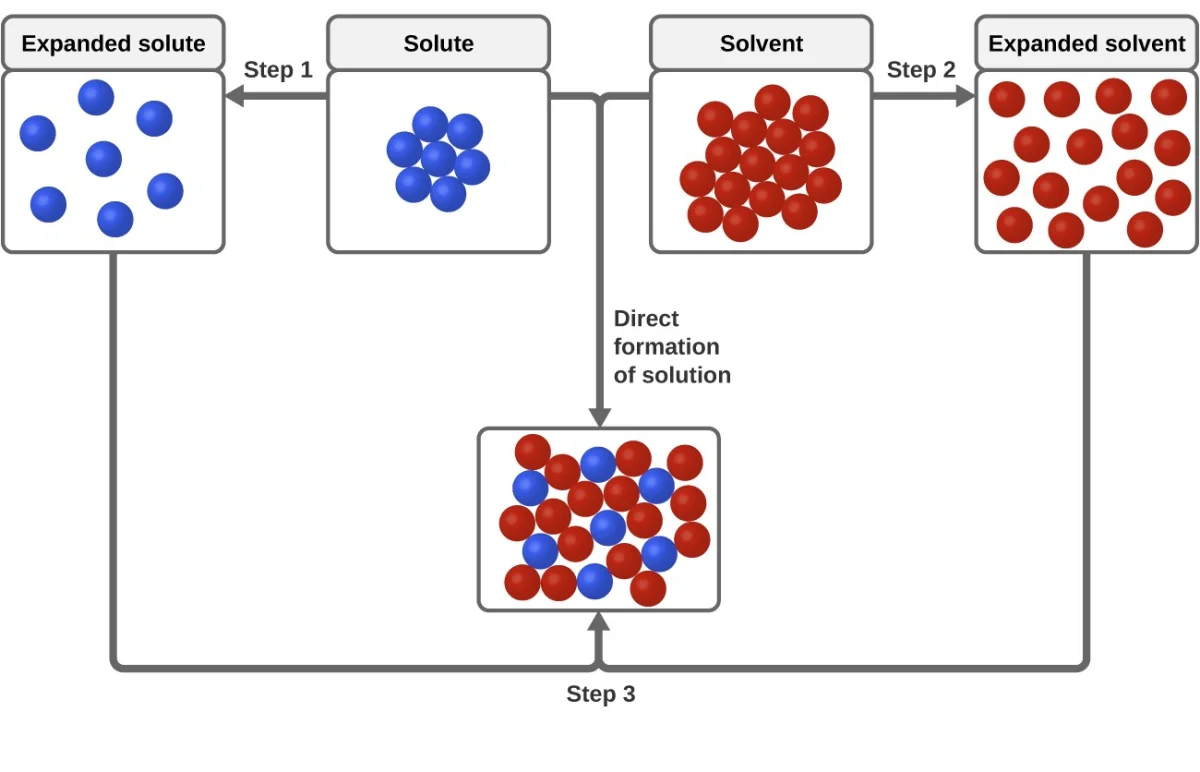
Dissolution happens when the solute-solvent interactions are strong enough to compensate for breaking apart solute-solute and solvent-solvent interactions. Think of it as a three-step process:
- Break apart the solute - separate solute molecules from each other (costs energy, endothermic)
- Break apart the solvent - make room in the solvent for the solute (costs energy, endothermic)
- Form solute-solvent interactions - the new attractions between solute and solvent (releases energy, exothermic)
If the energy released in step 3 roughly matches or exceeds the energy costs of steps 1 and 2, the substance dissolves. If step 3 is much weaker than steps 1 + 2, the substance is insoluble.
Polar dissolves polar because polar molecules form strong dipole-dipole and hydrogen bonding interactions with each other. When a polar solute enters a polar solvent, the new solute-solvent interactions (step 3) are comparable to the old solute-solute and solvent-solvent interactions.
Nonpolar fails in polar solvent because nonpolar solutes can only form weak London dispersion forces with polar solvent molecules. These weak new interactions (step 3) cannot compensate for the strong hydrogen bonds between water molecules that must be disrupted (step 2).
Water as a Solvent
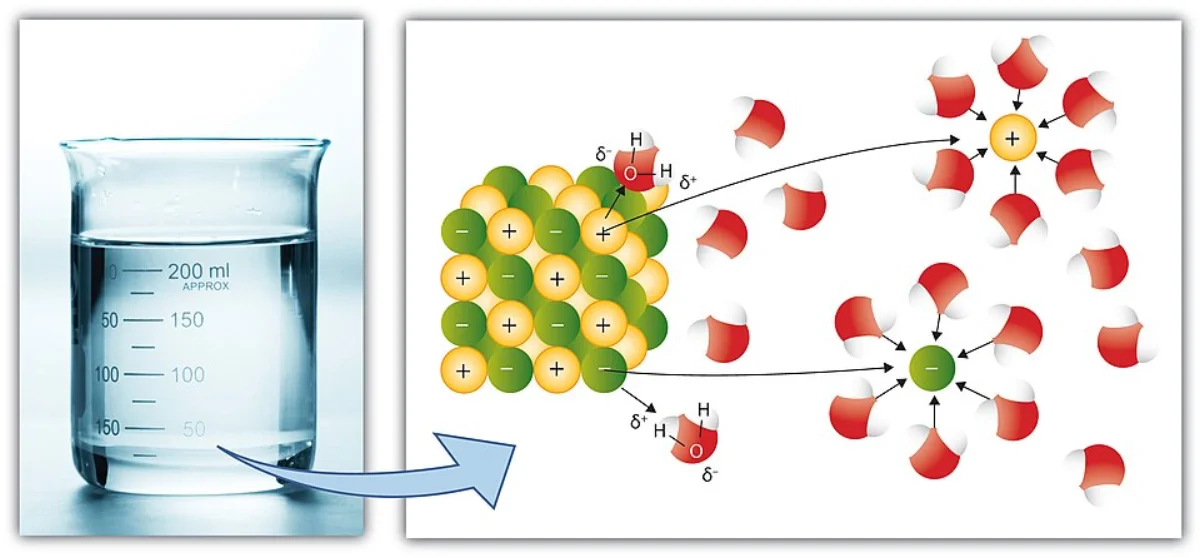
Water is called the “universal solvent” because its high polarity and ability to hydrogen bond let it dissolve an enormous range of substances. Water dissolves ionic compounds by surrounding each ion with a hydration shell - water molecules orient their partial charges toward the ion (oxygen faces cations, hydrogen faces anions).
This process is called hydration (or solvation if the solvent is not water). The ion-dipole interactions in the hydration shell are strong enough to overcome the ionic bonds in the crystal lattice - which is why NaCl dissolves in water.
Key Vocabulary
| Term | Meaning |
|---|---|
| Miscible | Two liquids that mix in all proportions (ethanol + water) |
| Immiscible | Two liquids that do not mix (oil + water) |
| Hydrophilic | ”Water-loving” - dissolves in or attracted to water (polar, ionic) |
| Hydrophobic | ”Water-fearing” - does not dissolve in water (nonpolar) |
| Amphiphilic | Has both hydrophilic and hydrophobic regions (soap, phospholipids) |
Ion-Dipole Interactions - The Force That Dissolves Salts
When ionic compounds dissolve in water, the driving force is ion-dipole interactions - the attraction between an ion’s full charge and water’s partial charges. This is the strongest intermolecular force (stronger than hydrogen bonding, dipole-dipole, or London dispersion).
The strength of ion-dipole interactions depends on:
- Charge density of the ion - smaller ions with higher charges have stronger interactions (Li⁺ > Na⁺ > K⁺)
- Polarity of the solvent - more polar solvents interact more strongly
This is why ionic compounds dissolve well in water (very polar) but not in hexane (nonpolar). The ion-dipole forces with water compensate for the lattice energy holding the crystal together.