Osmotic pressure is where solution chemistry meets biology. Every cell in your body is surrounded by a semipermeable membrane, and osmotic pressure determines whether that cell swells, shrinks, or stays the same size. This is one of the highest-yield topics in the entire solutions chapter.
Osmosis - The Driving Force
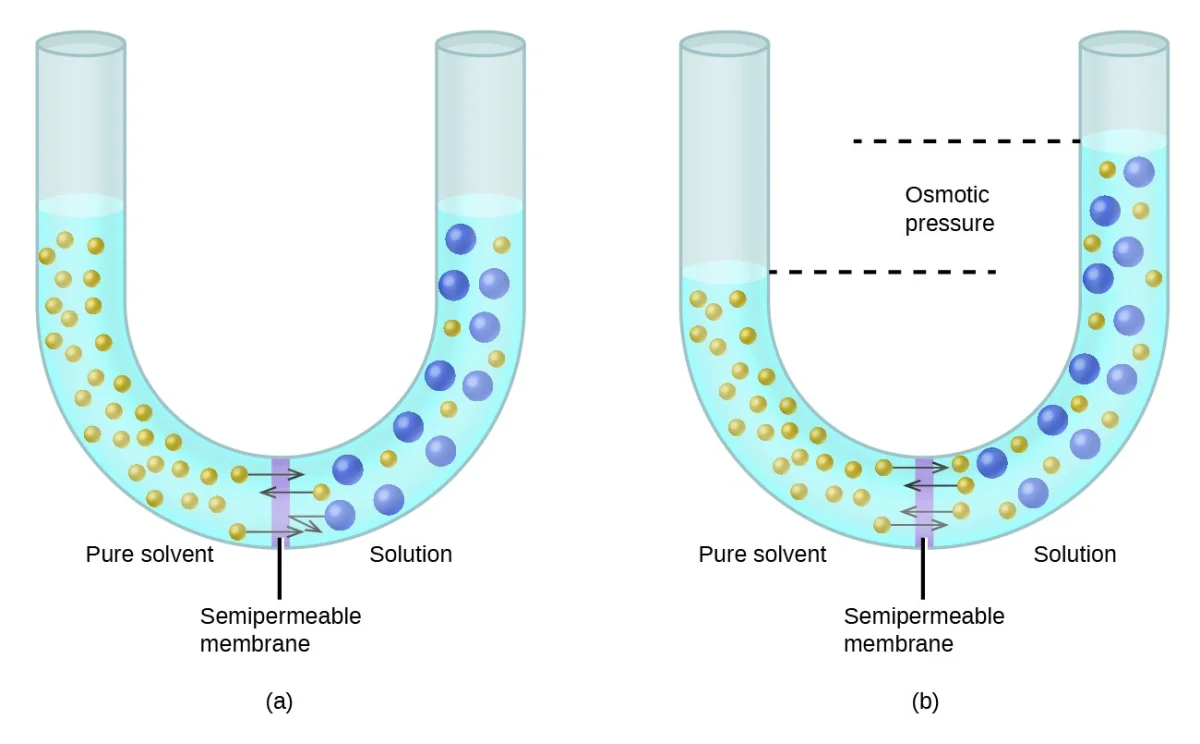
Osmosis is the net movement of solvent (usually water) through a semipermeable membrane from a region of lower solute concentration to higher solute concentration.
The membrane allows solvent molecules to pass but blocks solute particles. Solvent flows toward the more concentrated solution to equalize concentrations on both sides.
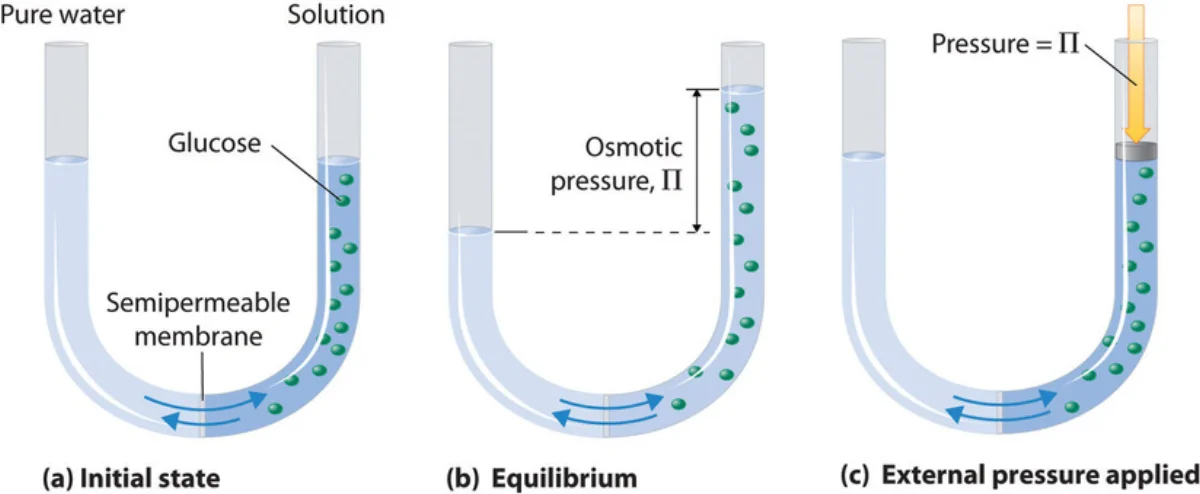
The osmotic pressure (π) is the minimum pressure that must be applied to the more concentrated side to prevent this solvent flow.
Osmosis: water moves through a semipermeable membrane from the dilute side to the concentrated side. The membrane allows solvent molecules to pass but blocks solute particles. Credit: OpenStax Chemistry 2e, CC BY 4.0
The Formula
Tonicity - The Biological Connection
This is where chemistry meets biology. The concepts below are explored in depth in the cell transport section - master them here, and you have already learned the biology.
When comparing two solutions separated by a membrane, we use three terms:
Term
Meaning
What Happens to the Cell
Hypertonic
Higher solute concentration (outside cell)
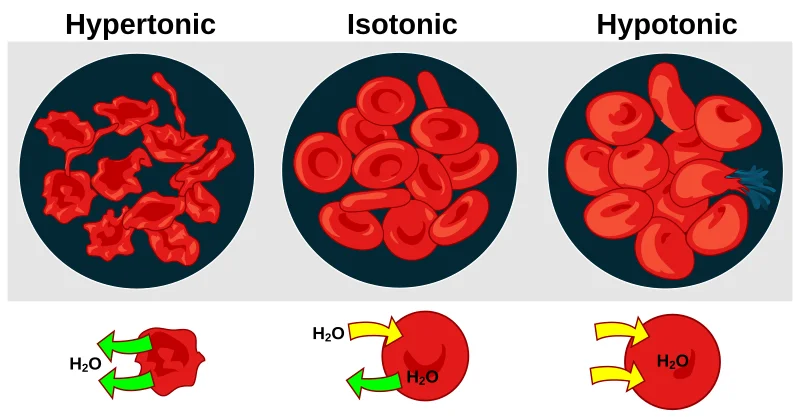
Water leaves the cell → cell shrinks (crenation in RBCs)
Hypotonic
Lower solute concentration (outside cell)
Water enters the cell → cell swells and may burst (lysis in RBCs)
Isotonic
Equal solute concentration
No net water movement → cell stays the same size
Osmotic effects on red blood cells. In hypertonic solution, water flows out and cells shrink (crenation). In isotonic solution (like 0.9% NaCl), water flow is balanced. In hypotonic solution, water rushes in and cells swell until they burst (lysis). This is why IV fluids must be isotonic. Credit: Wikimedia Commons, Public Domain
Why Osmotic Pressure Matters in Biology
Osmotic pressure explains:
IV fluids must be isotonic (0.9% NaCl) - hypertonic IV would shrink red blood cells, hypotonic IV would lyse them
Kidney function - the countercurrent multiplier creates an osmotic gradient in the medulla to concentrate urine
Plant turgor pressure - water entering plant cells by osmosis creates internal pressure that keeps the plant rigid
Edema - low blood protein (albumin) reduces osmotic pressure in capillaries, causing fluid to leak into tissues
Worked Example
Problem: What is the osmotic pressure of a 0.10 M NaCl solution at 37 C (body temperature)?
Solution:
i = 2 (NaCl → Na⁺ + Cl⁻)
M = 0.10 mol/L
R = 0.0821 L·atm/mol·K
T = 37 + 273 = 310 K
π = iMRT = 2 × 0.10 × 0.0821 × 310 = 5.09 atm
That is a substantial pressure - about 5 atmospheres from a relatively dilute solution. Osmotic pressure is highly sensitive to particle concentration.
Osmotic pressure measured in a U-tube. Solvent flows through the semipermeable membrane into the solution side, raising the liquid level. The height difference is proportional to osmotic pressure (π = iMRT). Credit: LibreTexts Chemistry, CC BY 4.0
A red blood cell is placed in a 2.0% NaCl solution (normal saline is 0.9%). What happens to the cell and why?
Click to reveal answer
The cell shrinks (crenates). 2.0% NaCl is hypertonic relative to the cell's interior (which is equivalent to about 0.9% NaCl). Water flows out of the cell by osmosis, moving from lower solute concentration (inside) to higher solute concentration (outside). The cell loses water and shrivels. This is crenation.
Why does the π = iMRT formula use molarity (M) instead of molality (m), unlike the other colligative property equations?
Click to reveal answer
Because osmotic pressure is a pressure, and the derivation parallels the ideal gas law (PV = nRT). Rearranging PV = nRT gives P = (n/V)RT = MRT. The osmotic pressure equation is derived by treating dissolved solute particles like gas molecules exerting pressure. The ideal gas law uses concentration as mol/volume (molarity), not mol/mass (molality), so π = iMRT naturally uses molarity.