Raoult’s law is the quantitative version of “adding solute lowers vapor pressure.” It tells you exactly how much the vapor pressure drops, and the math is beautifully simple.
The Law
Since χ_solvent is always less than 1 (there is always some solute present), Psolution is always less than P°_solvent. The vapor pressure drops.
This form is sometimes more convenient: the drop in vapor pressure equals the mole fraction of the solute times the pure solvent’s vapor pressure.
Worked Example
Problem: The vapor pressure of pure water at 25 C is 23.8 mmHg. What is the vapor pressure of a solution made by dissolving 0.50 mol of glucose in 2.0 mol of water?
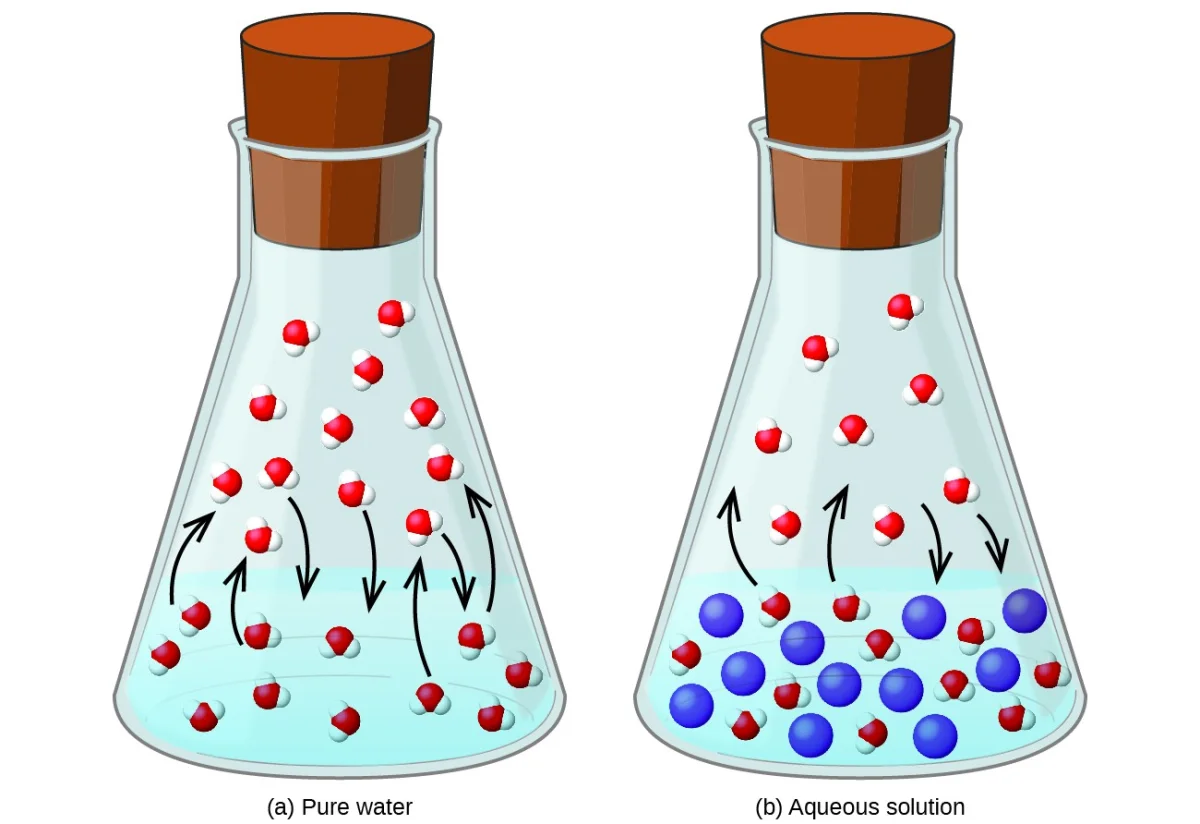
Vapor pressure lowering by a nonvolatile solute. Solute particles at the liquid surface block solvent molecules from escaping, reducing vapor pressure in direct proportion to the mole fraction of solute. Credit: OpenStax Chemistry 2e, CC BY 4.0
Ideal vs. Non-Ideal Solutions
Raoult’s law describes ideal solutions perfectly - solutions where solute-solvent interactions are identical to solute-solute and solvent-solvent interactions. In an ideal solution, every molecule “feels” the same regardless of its neighbors.
Positive deviations from Raoult’s law: The actual vapor pressure is HIGHER than Raoult predicts. This happens when solute-solvent interactions are weaker than the original pure-component interactions. The molecules escape more easily than expected.
Example: ethanol + hexane (breaking H-bonds in ethanol, replacing with weak LDF)
ΔHmix > 0 (endothermic mixing)
Negative deviations from Raoult’s law: The actual vapor pressure is LOWER than Raoult predicts. This happens when solute-solvent interactions are stronger than the pure-component interactions. The molecules are held in more tightly.
Example: acetone + chloroform (new H-bonding between them)
ΔHmix < 0 (exothermic mixing)
Deviation
Vapor Pressure
Intermolecular Forces
ΔHmix
Positive (higher P)
Above Raoult prediction
Solute-solvent weaker
Endothermic
Negative (lower P)
Below Raoult prediction
Solute-solvent stronger
Exothermic
Ideal (Raoult exact)
Matches prediction
Solute-solvent same
Zero
Two Volatile Components
When both the solute and solvent are volatile (e.g., mixing two liquids that both evaporate), both contribute to the total vapor pressure:
Ptotal = χ_A × P°_A + χ_B × P°_B
This is the extended form of Raoult’s law. The total vapor pressure is the sum of each component’s partial pressure.
When ethanol is mixed with hexane, the measured vapor pressure is higher than Raoult's law predicts. Is this a positive or negative deviation? What does it tell you about the intermolecular forces?
Click to reveal answer
Positive deviation. Higher-than-expected vapor pressure means molecules are escaping the solution more easily than predicted. This indicates that solute-solvent interactions (ethanol-hexane) are weaker than the pure component interactions (ethanol-ethanol H-bonds being disrupted). The mixing is endothermic (ΔHmix > 0) because you are breaking strong H-bonds and forming weaker LDF.
Pure water has a vapor pressure of 55.3 mmHg at 40 C. A solution containing 3.0 mol water and 1.0 mol of a nonvolatile solute is prepared. What is the vapor pressure of the solution?
Click to reveal answer
41.5 mmHg. χ_water = 3.0/(3.0 + 1.0) = 0.75. Psolution = χ_water × P°_water = 0.75 × 55.3 = 41.5 mmHg. The vapor pressure dropped by 25% because 25% of the particles are solute. This is straightforward Raoult's law with a nonvolatile solute.