Before you can understand colligative properties or solubility rules, you need the vocabulary. A solution is a homogeneous mixture of two or more substances - meaning the composition is uniform throughout. Unlike a salad (heterogeneous), a solution looks the same no matter which part you sample.
Solute and Solvent
Every solution has two components:
Solvent - the substance present in the greater amount (the “dissolver”). It determines the phase of the solution.
Solute - the substance present in the lesser amount (the “dissolved stuff”).
When water is the solvent, the solution is called an aqueous solution - by far the most common type on the MCAT. But solutions are not limited to liquids dissolving solids.
Types of Solutions
Solutions can exist in any combination of phases:
Solute Phase
Solvent Phase
Example
Gas
Gas
Air (O₂ and other gases dissolved in N₂)
Gas
Liquid
Carbonated water (CO₂ dissolved in H₂O)
Liquid
Liquid
Vodka (ethanol dissolved in water)
Solid
Liquid
Saltwater (NaCl dissolved in H₂O)
Solid
Solid
Brass (zinc dissolved in copper)
Solid-in-solid solutions are called alloys. Gas-in-liquid solutions are critical for biology - dissolved O₂ and CO₂ in blood are the reason you can breathe.
Concentration - How Much is Dissolved?
Concentration describes the amount of solute per amount of solution (or solvent). You already learned the main concentration units in Chapter 4 (molarity, molality, mole fraction), but here is a quick review since they show up constantly in solutions problems:
Unit
Formula
Temperature Dependent?
Molarity (M)
mol solute / L solution
Yes (volume changes with T)
Molality (m)
mol solute / kg solvent
No (mass does not change)
Mole fraction (χ)
mol solute / total mol
No
Mass percent (%)
(mass solute / mass solution) × 100
No
Saturation
When you dissolve sugar in water, at some point the water cannot hold any more. That limit is defined by three levels:
Unsaturated - less solute is dissolved than the maximum. More can dissolve.
Saturated - the maximum amount of solute is dissolved at that temperature. If you add more, it will not dissolve - it just sits at the bottom as undissolved solid (precipitate). A dynamic equilibrium exists between dissolving and precipitating.
Supersaturated - MORE solute is dissolved than the maximum. This is an unstable, metastable state. It is created by dissolving solute at a high temperature (where solubility is greater), then slowly cooling without disturbing. The tiniest disturbance - a scratch, a seed crystal, even a vibration - causes the excess solute to crash out of solution dramatically.
Electrolytes vs. Nonelectrolytes
This distinction matters enormously for colligative properties:
Strong electrolytes dissociate completely into ions in water. They conduct electricity well. Examples: NaCl, HCl, KOH, CaCl₂.
Nonelectrolytes do not dissociate at all. They dissolve as intact molecules. No ions, no conductivity. Examples: glucose (C₆H₁₂O₆), sucrose, urea.
Why does this matter? Because NaCl dissolves into 2 particles (Na⁺ + Cl⁻), but glucose dissolves into 1 particle. Two particles have twice the effect on colligative properties. This is exactly what the van ‘t Hoff factor (i) captures - but we will get to that in Section 11.
A student heats water to 80 C, dissolves the maximum amount of KNO₃, then slowly cools the solution to 20 C without disturbing it. What type of solution has been created?
Click to reveal answer
Supersaturated. The solubility of KNO₃ decreases dramatically as temperature drops. The solution now contains more dissolved KNO₃ than the solubility limit at 20 C allows. It is metastable - adding a seed crystal or scratching the container will cause the excess to crystallize out instantly.
Why do colligative property equations use molality (m) instead of molarity (M)?
Click to reveal answer
Because molality is temperature-independent. Molality is defined as moles of solute per kilogram of solvent. Mass does not change with temperature. Molarity (moles per liter of solution) changes with temperature because volume expands or contracts. Since colligative properties involve temperature changes (boiling, freezing), using a temperature-dependent unit would create circular errors.
The most important rule in solubility is also the simplest: like dissolves like. Polar solvents dissolve polar solutes. Nonpolar solvents dissolve nonpolar solutes. Trying to dissolve a nonpolar substance in a polar solvent (or vice versa) is like trying to mix oil and water - it does not work.
Why Does “Like Dissolves Like” Work?
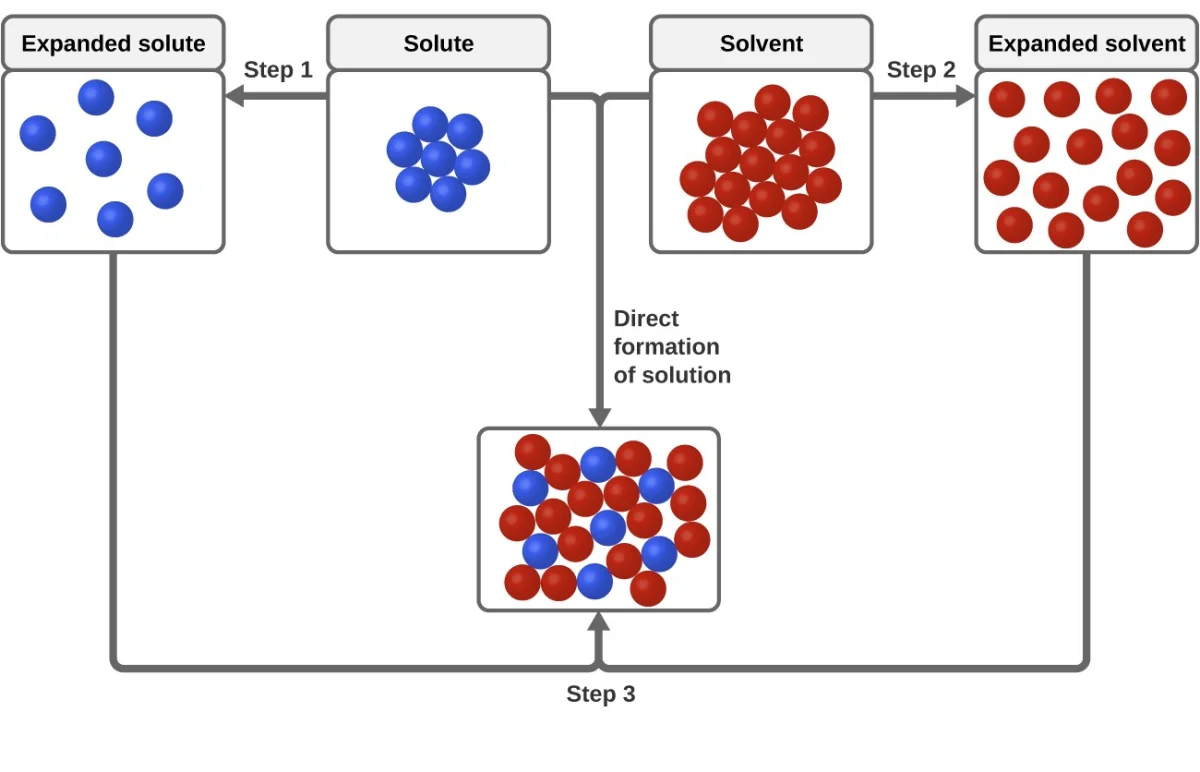
Dissolution happens when the solute-solvent interactions are strong enough to compensate for breaking apart solute-solute and solvent-solvent interactions. Think of it as a three-step process:
Break apart the solute - separate solute molecules from each other (costs energy, endothermic)
Break apart the solvent - make room in the solvent for the solute (costs energy, endothermic)
Form solute-solvent interactions - the new attractions between solute and solvent (releases energy, exothermic)
If the energy released in step 3 roughly matches or exceeds the energy costs of steps 1 and 2, the substance dissolves. If step 3 is much weaker than steps 1 + 2, the substance is insoluble.
Polar dissolves polar because polar molecules form strong dipole-dipole and hydrogen bonding interactions with each other. When a polar solute enters a polar solvent, the new solute-solvent interactions (step 3) are comparable to the old solute-solute and solvent-solvent interactions.
Nonpolar fails in polar solvent because nonpolar solutes can only form weak London dispersion forces with polar solvent molecules. These weak new interactions (step 3) cannot compensate for the strong hydrogen bonds between water molecules that must be disrupted (step 2).
Water as a Solvent
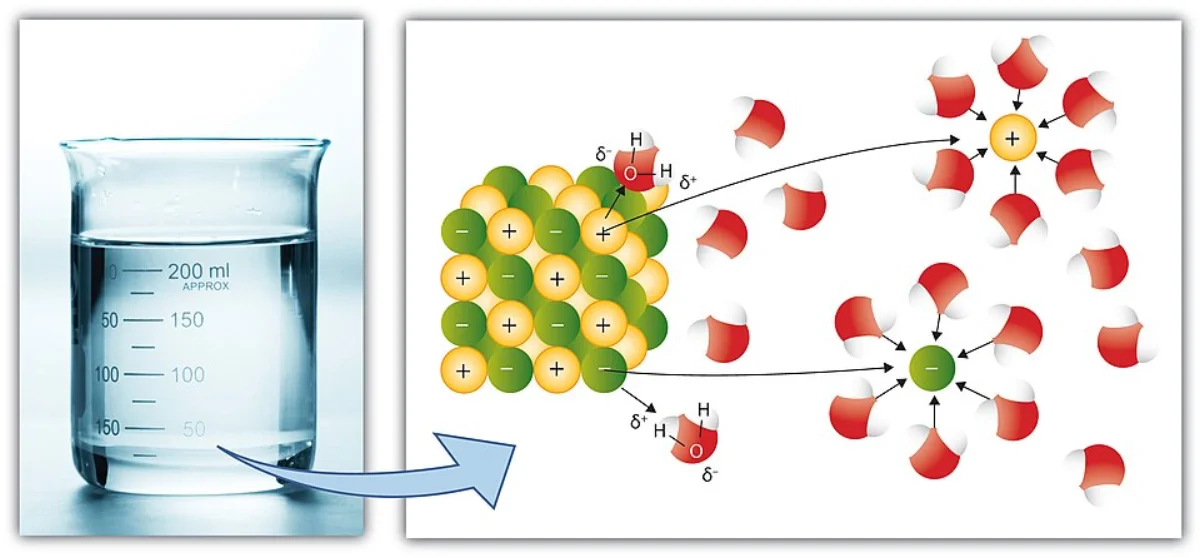
Water is called the “universal solvent” because its high polarity and ability to hydrogen bond let it dissolve an enormous range of substances. Water dissolves ionic compounds by surrounding each ion with a hydration shell - water molecules orient their partial charges toward the ion (oxygen faces cations, hydrogen faces anions).
This process is called hydration (or solvation if the solvent is not water). The ion-dipole interactions in the hydration shell are strong enough to overcome the ionic bonds in the crystal lattice - which is why NaCl dissolves in water.
Key Vocabulary
Term
Meaning
Miscible
Two liquids that mix in all proportions (ethanol + water)
Immiscible
Two liquids that do not mix (oil + water)
Hydrophilic
”Water-loving” - dissolves in or attracted to water (polar, ionic)
Hydrophobic
”Water-fearing” - does not dissolve in water (nonpolar)
Amphiphilic
Has both hydrophilic and hydrophobic regions (soap, phospholipids)
The dissolution process in three steps: breaking apart the solute, making room in the solvent, and forming new solute-solvent interactions. The overall enthalpy of solution depends on which steps dominate. Credit: OpenStax Chemistry 2e, CC BY 4.0
Ion-Dipole Interactions - The Force That Dissolves Salts
When ionic compounds dissolve in water, the driving force is ion-dipole interactions - the attraction between an ion’s full charge and water’s partial charges. This is the strongest intermolecular force (stronger than hydrogen bonding, dipole-dipole, or London dispersion).
The strength of ion-dipole interactions depends on:
Charge density of the ion - smaller ions with higher charges have stronger interactions (Li⁺ > Na⁺ > K⁺)
Polarity of the solvent - more polar solvents interact more strongly
This is why ionic compounds dissolve well in water (very polar) but not in hexane (nonpolar). The ion-dipole forces with water compensate for the lattice energy holding the crystal together.
When NaCl dissolves, water molecules surround each ion: oxygen (partial negative) faces Na⁺, hydrogen (partial positive) faces Cl⁻. These ion-dipole interactions form the hydration shell. Credit: Wikimedia Commons, CC BY-SA 4.0
Vitamin A is a nonpolar, fat-soluble molecule. Vitamin C is a polar molecule with multiple hydroxyl groups. Which dissolves in water and which dissolves in fat?
Click to reveal answer
Vitamin C dissolves in water (polar in polar). Vitamin A dissolves in fat (nonpolar in nonpolar). This is why vitamin C is water-soluble (excreted in urine if you take too much) and vitamin A is fat-soluble (stored in adipose tissue and can accumulate to toxic levels). "Like dissolves like" directly explains why fat-soluble vitamins (A, D, E, K) can cause toxicity - they are not easily excreted.
Why does NaCl dissolve in water but not in hexane (C₆H₁₄)?
Click to reveal answer
Water is polar and forms strong ion-dipole interactions with Na⁺ and Cl⁻. Hexane is nonpolar and can only form weak London dispersion forces with the ions. The ion-dipole interactions with water are strong enough to overcome the lattice energy of NaCl. The weak LDF interactions with hexane are not. "Like dissolves like" - ionic/polar in polar, not in nonpolar.
We know that “like dissolves like,” but why do some polar substances dissolve easily while others barely dissolve at all? The answer is thermodynamics - specifically, the balance between the energy it takes to break apart the solute and the energy released when the solvent surrounds the solute particles.
The Three-Step Energy Model
Dissolving an ionic compound in water involves three energy changes:
Step 1: Break the crystal lattice (endothermic)
The lattice energy (U) is the energy required to completely separate all ions in a solid ionic compound into gaseous ions. This is always endothermic - you must overcome the electrostatic attractions holding the crystal together.
Lattice energy depends on:
Charge - higher charges mean stronger attraction (MgO has much higher lattice energy than NaCl)
Water molecules must separate to make room for the incoming ions. This requires breaking some hydrogen bonds between water molecules.
Step 3: Form ion-dipole interactions (exothermic)
Water molecules surround each ion, forming a hydration shell. The energy released in this step is called the hydration energy (ΔHhydration). This is always exothermic - forming new attractions releases energy.
Hydration energy depends on charge density:
Higher charge = stronger ion-dipole interactions = more energy released
Smaller radius = higher charge density = more energy released
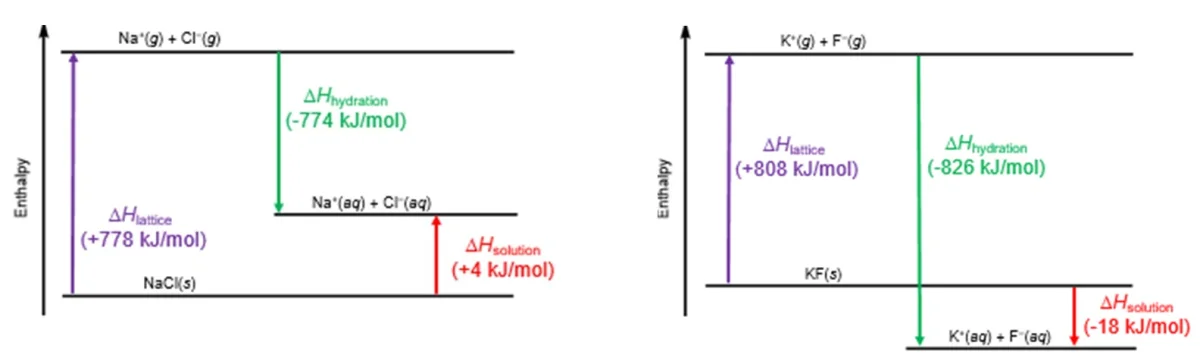
If ΔHsoln is positive (endothermic), the process is energetically uphill. Why would it happen at all?
Because entropy also drives dissolution. Dissolving a solid increases disorder - the organized crystal lattice breaks into randomly dispersed ions. The entropy increase (ΔS > 0) can make the overall free energy change favorable:
ΔG = ΔH - TΔS
Even if ΔH is positive (endothermic), a large positive TΔS can make ΔG negative (spontaneous). This is why NaCl dissolves in water even though the process absorbs a tiny amount of heat - the entropy increase from dispersing Na⁺ and Cl⁻ ions throughout the solution more than compensates.
Enthalpy of solution diagram comparing NaCl and KF dissolution. When hydration energy exceeds lattice energy, dissolution is exothermic (KF). When lattice energy exceeds hydration energy, dissolution is endothermic (NaCl). Credit: Lumen Learning / OpenStax Chemistry, CC BY 4.0
Hydration Shells
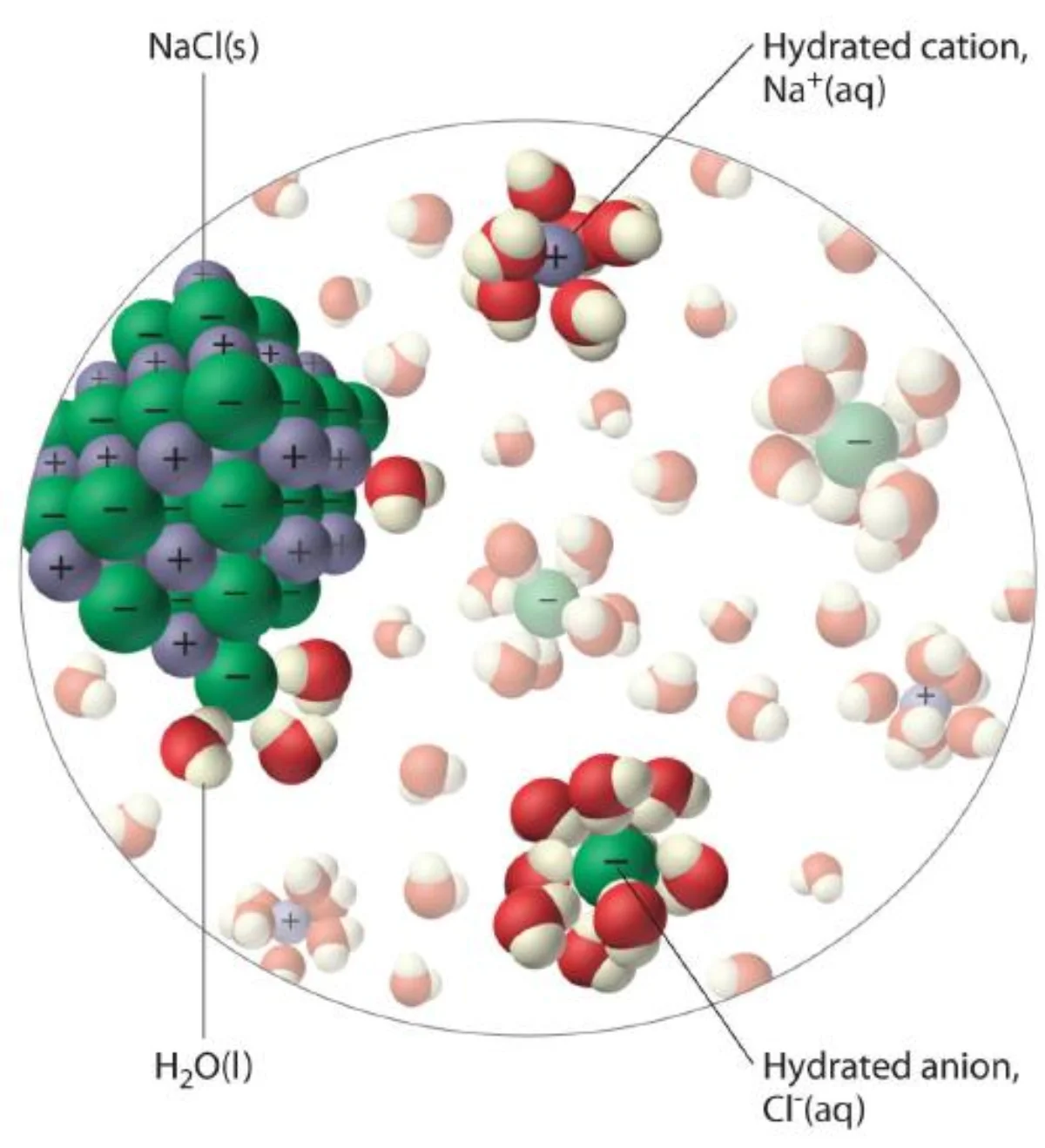
When ions dissolve, water molecules arrange themselves around each ion with specific orientations:
Around cations (like Na⁺): the oxygen end of water (partial negative) faces the positive ion
Around anions (like Cl⁻): the hydrogen end of water (partial positive) faces the negative ion
Hydration shells around Na⁺ and Cl⁻ ions. Water molecules orient with oxygen toward cations and hydrogen toward anions. The first layer (primary hydration shell) is the most tightly organized. Credit: LibreTexts Chemistry, CC BY 4.0
The first layer of water molecules is tightly organized - this is called the primary hydration shell. Beyond it, water molecules become progressively less ordered. Smaller, more highly charged ions (like Li⁺ or Mg²⁺) have larger, more tightly bound hydration shells than larger, less charged ions (like K⁺ or Cs⁺).
When NH₄NO₃ dissolves in water, the solution gets cold. Is the enthalpy of solution positive or negative? Which is larger - the lattice energy or the hydration energy?
Click to reveal answer
ΔHsoln is positive (endothermic). The lattice energy is larger than the hydration energy. The solution absorbs heat from surroundings (gets cold) because it takes more energy to break apart the crystal lattice than is released by hydrating the ions. The process still occurs spontaneously because the entropy increase (disorder) makes ΔG negative.
Predict: which has a higher lattice energy - NaCl or MgO? Why?
Click to reveal answer
MgO has a much higher lattice energy than NaCl. Lattice energy depends on charge and size. Mg²⁺ and O²⁻ have charges of +2 and -2 (vs. +1 and -1 for NaCl), and both ions are smaller than Na⁺ and Cl⁻. Higher charges and smaller radii mean much stronger electrostatic attraction, so MgO has a lattice energy roughly 4x greater than NaCl. This is why MgO is nearly insoluble in water - the hydration energy cannot overcome the enormous lattice energy.
How much of a substance dissolves depends on more than just “like dissolves like.” Two physical conditions dramatically affect solubility: temperature and pressure. Understanding these factors is essential for interpreting solubility curves and predicting when gases come out of solution - both high-yield MCAT topics.
Effect of Temperature on Solid Solubility
For most solid solutes, solubility increases as temperature increases. Heating provides energy to break apart the crystal lattice, allowing more solute to dissolve.
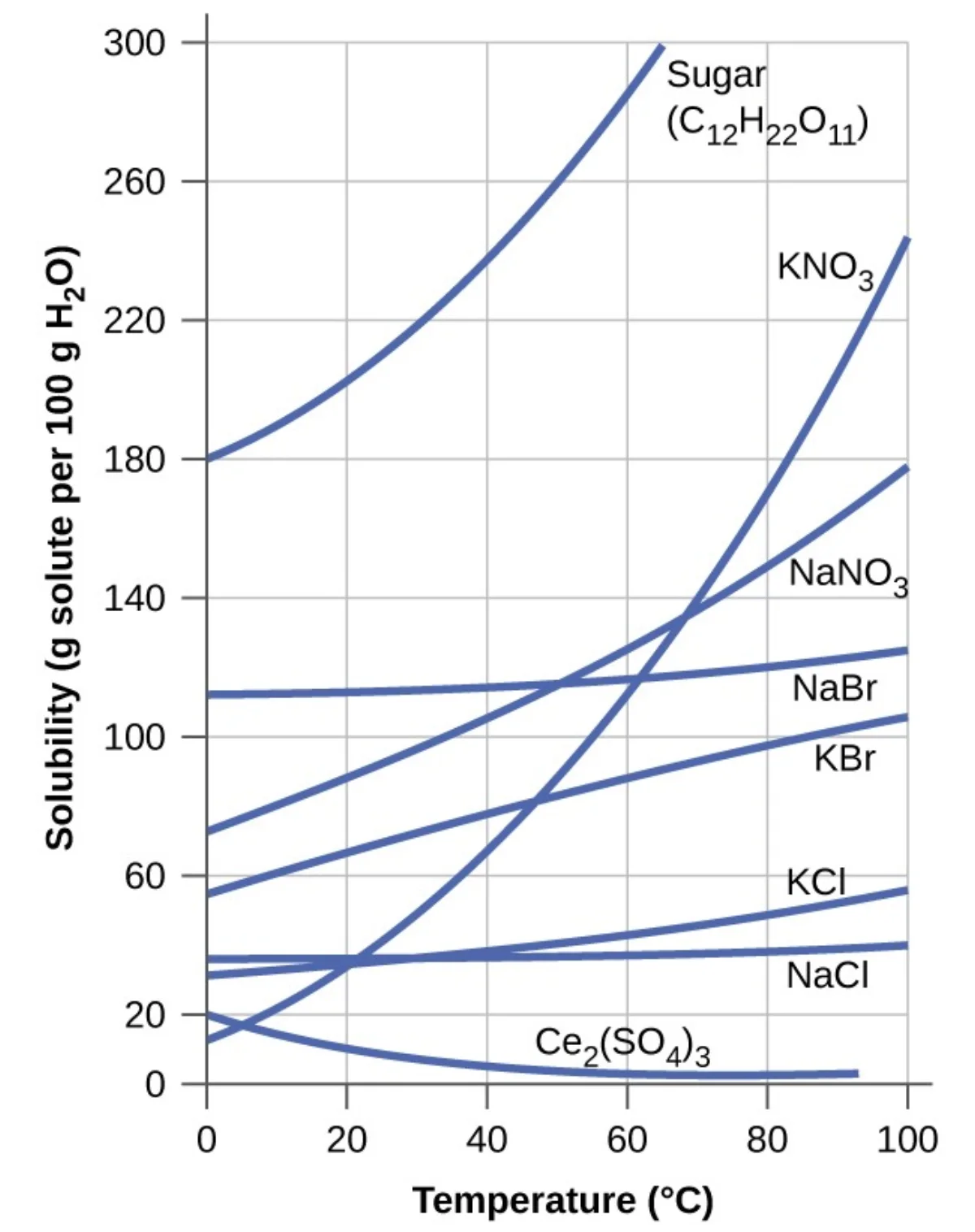
But there are exceptions. A few compounds, like Ce₂(SO₄)₃ and CaSO₄, have solubility that decreases with increasing temperature. Their dissolution is exothermic, so by Le Chatelier’s principle, adding heat (increasing temperature) shifts the equilibrium toward the undissolved solid.
The key to remembering which direction:
Endothermic dissolution (most solids): heat is a “reactant,” so adding heat shifts equilibrium toward more dissolving. Solubility increases with T.
Exothermic dissolution (some solids): heat is a “product,” so adding heat shifts equilibrium toward less dissolving. Solubility decreases with T.
Solubility Curves
A solubility curve plots the maximum amount of solute (in grams per 100 g water) that dissolves at each temperature. These graphs are MCAT favorites.
How to read them:
Points ON the curve represent saturated solutions
Points BELOW the curve represent unsaturated solutions (more could dissolve)
Points ABOVE the curve represent supersaturated solutions (unstable - more dissolved than the limit)
Solubility curves for common ionic compounds. Most solids become more soluble at higher temperatures (KNO₃ increases steeply), but a few like Ce₂(SO₄)₃ decrease. Points on the curve = saturated, below = unsaturated, above = supersaturated. Credit: OpenStax Chemistry 2e, CC BY 4.0
Effect of Temperature on Gas Solubility
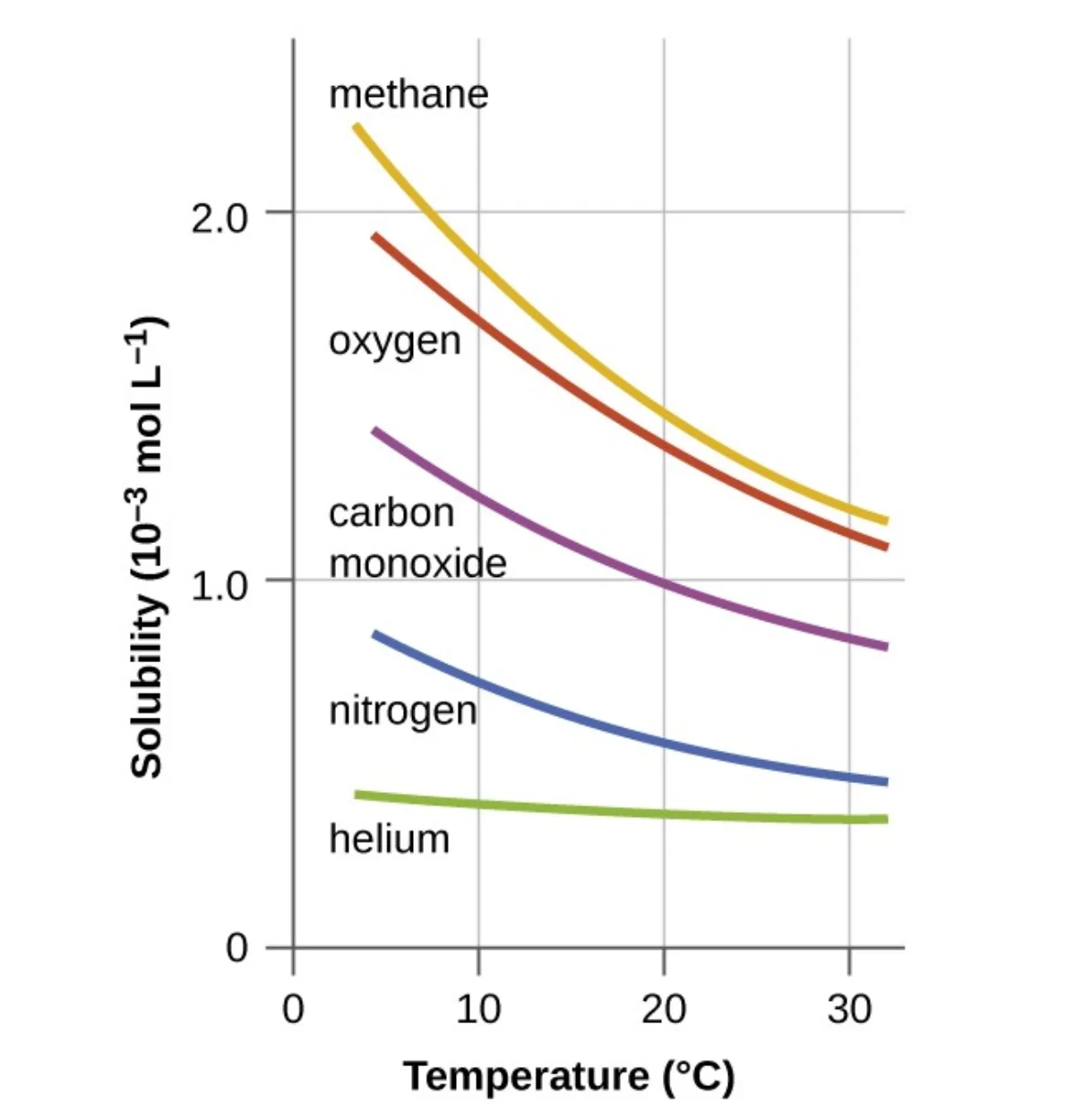
Gases are the opposite of solids: gas solubility decreases as temperature increases.
Think about it physically: gas molecules in solution are trapped by intermolecular forces with the solvent. Heating gives them more kinetic energy, making it easier to escape into the gas phase.
Gas solubility in water decreases as temperature increases - the opposite trend from most solids. This explains why warm lakes have less dissolved oxygen and why hot beverages lose carbonation faster. Credit: OpenStax Chemistry 2e, CC BY 4.0
Effect of Pressure on Gas Solubility - Henry’s Law
Pressure has virtually no effect on the solubility of solids and liquids (they are nearly incompressible). But for gases, pressure has a dramatic, direct effect.
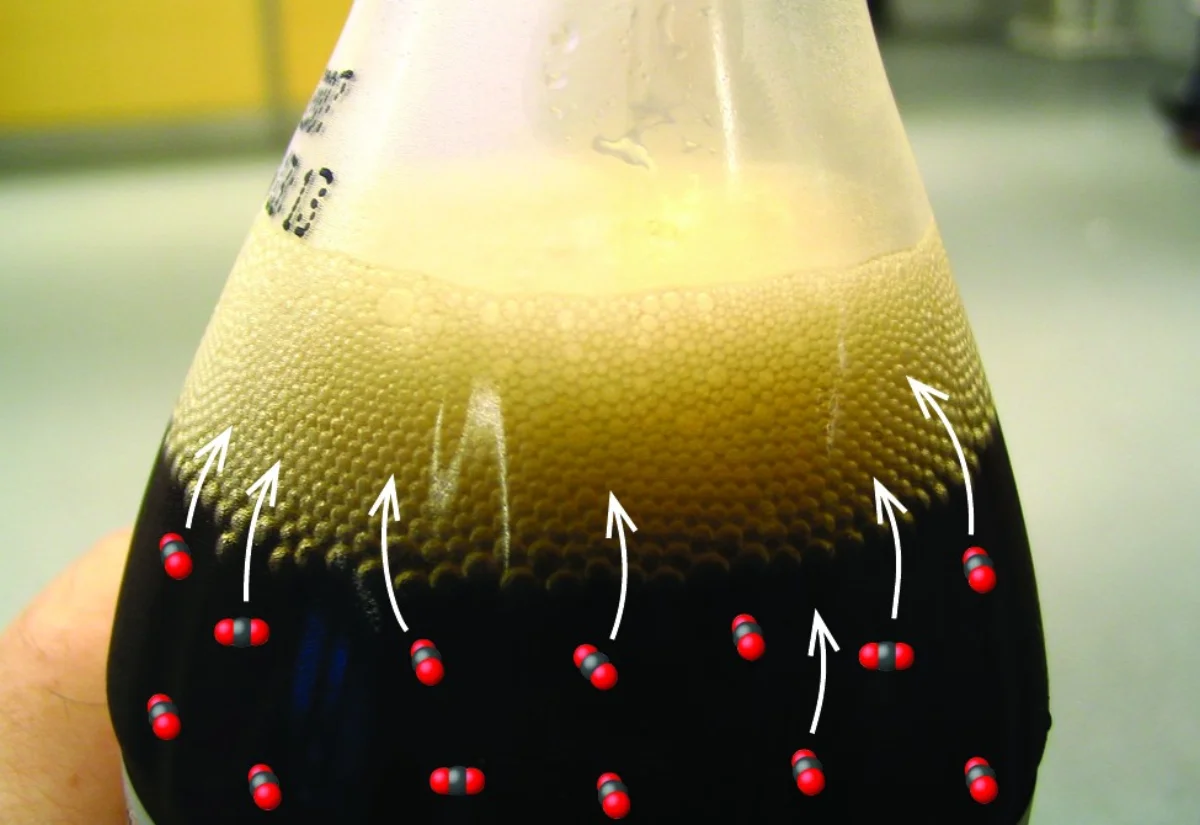
Double the pressure, double the amount of gas that dissolves. Halve the pressure, half the gas stays in solution - the rest escapes as bubbles.
Henry's law in action: CO₂ stays dissolved under high pressure in a sealed bottle. When the cap is removed, pressure drops and CO₂ escapes as bubbles because gas solubility is directly proportional to pressure (C = kH × P). Credit: OpenStax Chemistry 2e, CC BY 4.0
Summary: What Affects Solubility?
Factor
Effect on Solid Solubility
Effect on Gas Solubility
Increase temperature
Usually increases
Decreases
Increase pressure
No significant effect
Increases (Henry’s law)
Increase polarity match
Increases (“like dissolves like”)
Increases
A sealed container of carbonated water is opened at the top of a mountain (lower atmospheric pressure) versus at sea level. Where does the soda lose its fizz faster, and why?
Click to reveal answer
At the top of the mountain. Lower atmospheric pressure means lower partial pressure of CO₂ above the solution. By Henry's law (C = kH × P), lower pressure means lower gas solubility, so more CO₂ escapes from the solution. The soda goes flat faster at altitude.
The solubility of KNO₃ increases sharply with temperature, while the solubility of NaCl barely changes. Which one is more likely to form a supersaturated solution when cooled?
Click to reveal answer
KNO₃. Because its solubility changes dramatically with temperature, you can dissolve a large amount at high temperature and then cool the solution. The steep drop in solubility means the solution becomes supersaturated as it cools. NaCl's solubility barely changes with temperature, so cooling a saturated NaCl solution produces little excess dissolved solute and is unlikely to become supersaturated.
Not all ionic compounds dissolve in water. The MCAT expects you to know which salts are soluble and which form precipitates. The good news: the rules are straightforward, and a few simple patterns cover nearly every compound you will encounter.
The Rules - Soluble Compounds
Always soluble (no exceptions):
Ion
Rule
Na⁺, K⁺, Li⁺ (Group 1)
All Group 1 salts dissolve
NH₄⁺ (ammonium)
All ammonium salts dissolve
NO₃⁻ (nitrate)
All nitrates dissolve
CH₃COO⁻ (acetate)
All acetates dissolve
ClO₄⁻ (perchlorate)
All perchlorates dissolve
Usually soluble (with exceptions):
Ion
Soluble EXCEPT with…
Cl⁻, Br⁻, I⁻ (halides)
Ag⁺, Pb²⁺, Hg₂²⁺
SO₄²⁻ (sulfate)
Ba²⁺, Pb²⁺, Ca²⁺, Sr²⁺
The Rules - Insoluble Compounds
Usually insoluble (with exceptions):
Ion
Insoluble EXCEPT with…
OH⁻ (hydroxide)
Group 1, NH₄⁺, Ba²⁺, Ca²⁺ (slightly), Sr²⁺ (slightly)
CO₃²⁻ (carbonate)
Group 1, NH₄⁺
PO₄³⁻ (phosphate)
Group 1, NH₄⁺
S²⁻ (sulfide)
Group 1, NH₄⁺, Group 2
CrO₄²⁻ (chromate)
Group 1, NH₄⁺
How to Apply the Rules
When asked “Is this compound soluble?”:
Check the cation first. Is it Na⁺, K⁺, or NH₄⁺? If yes, it is soluble. Done.
Check the anion. Is it NO₃⁻ or CH₃COO⁻? If yes, it is soluble. Done.
Check for exceptions. Is it a halide with Ag⁺, Pb²⁺, or Hg₂²⁺? Then it is insoluble. Is it a sulfate with Ba²⁺ or Pb²⁺? Insoluble.
Default for carbonates, phosphates, hydroxides, sulfides: insoluble (unless paired with Group 1 or NH₄⁺).
Predicting Precipitation Reactions
When two aqueous solutions are mixed, a precipitate forms if any combination of the ions produces an insoluble compound:
Example: Mix AgNO₃(aq) and NaCl(aq)
Possible products: AgCl and NaNO₃
AgCl: Ag⁺ + Cl⁻ = insoluble (halide exception with Ag⁺)
NaNO₃: Na⁺ + NO₃⁻ = soluble (Na⁺ is always soluble)
Result: AgCl precipitates as a white solid
The net ionic equation shows only the ions that actually participate:
Ag⁺(aq) + Cl⁻(aq) → AgCl(s)
Na⁺ and NO₃⁻ are spectator ions - they remain dissolved and do not participate in the reaction.
Is lead(II) sulfate (PbSO₄) soluble or insoluble in water?
Click to reveal answer
Insoluble. Sulfates are generally soluble, BUT there are exceptions: Ba²⁺, Pb²⁺, Ca²⁺, and Sr²⁺ sulfates are insoluble or slightly soluble. PbSO₄ is one of the classic sulfate exceptions. If the MCAT gives you this compound, expect it to precipitate out of solution.
Solutions of Ba(NO₃)₂ and Na₂SO₄ are mixed. Write the net ionic equation for any precipitation reaction.
Click to reveal answer
Ba²⁺(aq) + SO₄²⁻(aq) → BaSO₄(s). Check possible products: BaSO₄ (insoluble - Ba²⁺ is a sulfate exception) and NaNO₃ (soluble - Na⁺ is always soluble). The Na⁺ and NO₃⁻ are spectator ions. BaSO₄ precipitates as a white solid.
Here is the single most important idea in this chapter: colligative properties depend on how many particles are dissolved, not what those particles are. Dissolve 1 mole of glucose (1 particle per formula unit) or 1 mole of NaCl (2 particles per formula unit), and the colligative effects scale with particle count alone. Identity is irrelevant.
What Are Colligative Properties?
The word “colligative” comes from the Latin “colligare,” meaning “to bind together.” There are four colligative properties:
Property
Effect of Adding Solute
Formula
Vapor pressure lowering
Decreases
Raoult’s law: P = χ_solvent × P°
Boiling point elevation
Increases
ΔTb = iKbm
Freezing point depression
Decreases
ΔTf = iKfm
Osmotic pressure
Increases
π = iMRT
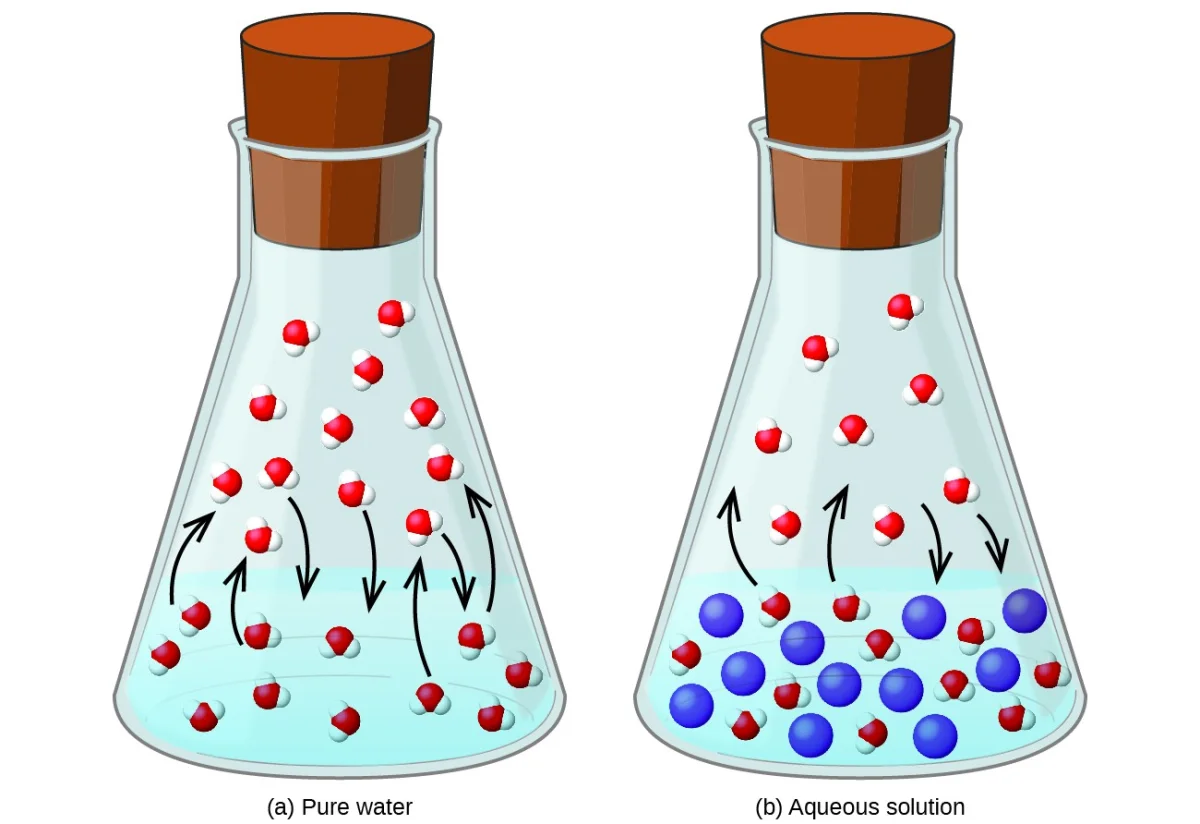
All four share the same underlying cause: dissolved particles interfere with the solvent’s ability to escape into the gas phase.
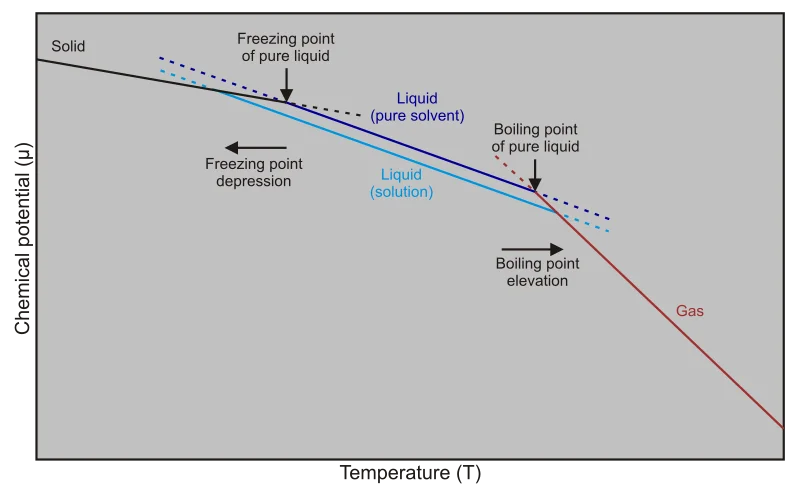
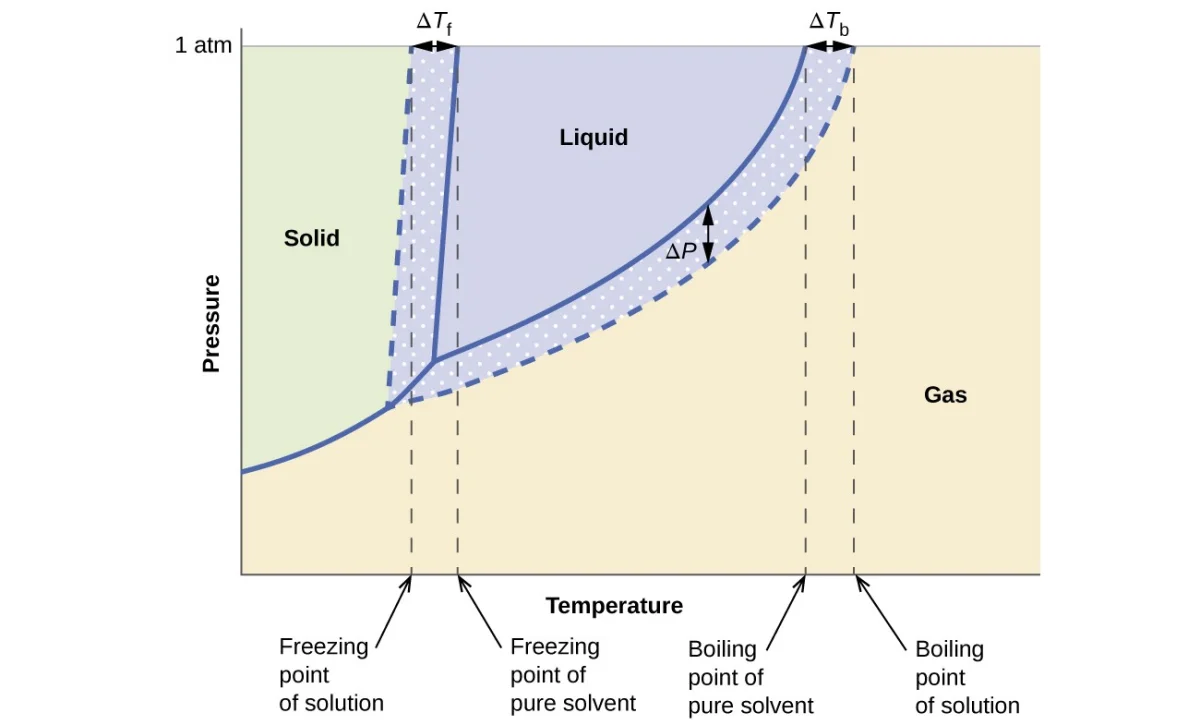
How a dissolved solute affects phase transitions. The solute lowers the chemical potential of the liquid phase (dashed line), causing the freezing point to decrease (ΔTf) and the boiling point to increase (ΔTb). Both effects stem from vapor pressure lowering. Credit: Wikimedia Commons, CC BY-SA 3.0
The Root Cause - Vapor Pressure Lowering
Every colligative property traces back to one phenomenon: a nonvolatile solute lowers the vapor pressure of the solvent.
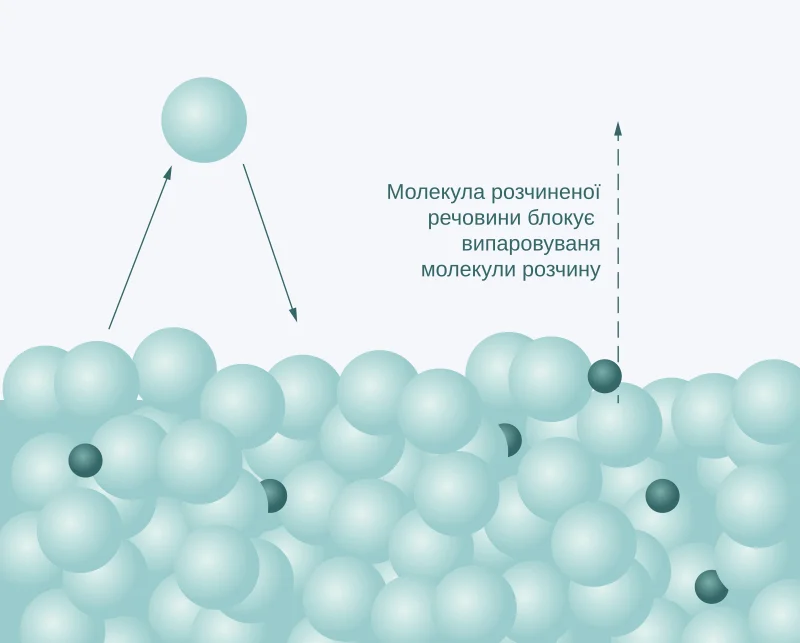
Why? When solute particles dissolve, they occupy positions at the liquid surface. Fewer solvent molecules are at the surface, so fewer can escape into the gas phase per second. The rate of evaporation decreases, so the equilibrium vapor pressure drops.
This is purely a numbers game. Each solute particle blocks a surface site. More particles = more blocking = lower vapor pressure. It does not matter what the particles are - only how many are there.
How Vapor Pressure Lowering Creates the Other Three Properties
Once you understand that solute lowers vapor pressure, the other three properties follow logically:
Boiling point elevation: The liquid must reach a higher temperature before its vapor pressure equals atmospheric pressure (the definition of boiling). Lower vapor pressure at any given temperature means you need more heat to boil. Boiling point goes up.
Freezing point depression: At the normal freezing point, the solution’s vapor pressure is now lower than the solid’s vapor pressure. The solid melts to equalize. You must cool further to reach the new temperature where solid and liquid vapor pressures match. Freezing point goes down.
Osmotic pressure: When a solution and pure solvent are separated by a semipermeable membrane, solvent flows toward the solution (from high vapor pressure to low). The pressure needed to stop this flow is osmotic pressure. More particles = lower vapor pressure = greater driving force = higher osmotic pressure.
Nonvolatile vs. Volatile Solutes
Colligative property equations (ΔTb, ΔTf, π) assume the solute is nonvolatile - meaning the solute does not evaporate. Sugar, NaCl, and glucose are nonvolatile. They stay in the liquid phase and only the solvent contributes to vapor pressure.
If the solute IS volatile (like mixing ethanol and water), both components contribute to vapor pressure, and the simple colligative property formulas do not apply cleanly. The MCAT almost always uses nonvolatile solutes for these calculations.
Ranking Colligative Effects
To compare colligative effects between different solutions, count the total dissolved particles:
Solute
Particles per formula unit
1 M solution gives…
Glucose (C₆H₁₂O₆)
1 (nonelectrolyte)
1 mol particles
NaCl
2 (Na⁺ + Cl⁻)
2 mol particles
CaCl₂
3 (Ca²⁺ + 2 Cl⁻)
3 mol particles
FeCl₃
4 (Fe³⁺ + 3 Cl⁻)
4 mol particles
A 1 M CaCl₂ solution has a higher boiling point, lower freezing point, and higher osmotic pressure than a 1 M NaCl solution - because it produces more particles.
Rank these 1 M aqueous solutions from lowest to highest boiling point: glucose, NaCl, CaCl₂.
Click to reveal answer
Glucose < NaCl < CaCl₂. Glucose produces 1 particle per formula unit (i = 1), NaCl produces 2 (i = 2), and CaCl₂ produces 3 (i = 3). More particles = greater boiling point elevation. CaCl₂ has the highest boiling point. This is purely a counting problem.
A student adds 1 mole of NaCl and 1 mole of glucose to separate beakers of water (same volume). Which solution has the lower vapor pressure?
Click to reveal answer
The NaCl solution. NaCl dissociates into 2 particles (Na⁺ + Cl⁻), giving 2 moles of particles. Glucose does not dissociate, giving only 1 mole of particles. More particles = more vapor pressure lowering. The NaCl solution has the lower vapor pressure, even though the same number of moles of solute was added.
Raoult’s law is the quantitative version of “adding solute lowers vapor pressure.” It tells you exactly how much the vapor pressure drops, and the math is beautifully simple.
The Law
Since χ_solvent is always less than 1 (there is always some solute present), Psolution is always less than P°_solvent. The vapor pressure drops.
This form is sometimes more convenient: the drop in vapor pressure equals the mole fraction of the solute times the pure solvent’s vapor pressure.
Worked Example
Problem: The vapor pressure of pure water at 25 C is 23.8 mmHg. What is the vapor pressure of a solution made by dissolving 0.50 mol of glucose in 2.0 mol of water?
Vapor pressure lowering by a nonvolatile solute. Solute particles at the liquid surface block solvent molecules from escaping, reducing vapor pressure in direct proportion to the mole fraction of solute. Credit: OpenStax Chemistry 2e, CC BY 4.0
Ideal vs. Non-Ideal Solutions
Raoult’s law describes ideal solutions perfectly - solutions where solute-solvent interactions are identical to solute-solute and solvent-solvent interactions. In an ideal solution, every molecule “feels” the same regardless of its neighbors.
Positive deviations from Raoult’s law: The actual vapor pressure is HIGHER than Raoult predicts. This happens when solute-solvent interactions are weaker than the original pure-component interactions. The molecules escape more easily than expected.
Example: ethanol + hexane (breaking H-bonds in ethanol, replacing with weak LDF)
ΔHmix > 0 (endothermic mixing)
Negative deviations from Raoult’s law: The actual vapor pressure is LOWER than Raoult predicts. This happens when solute-solvent interactions are stronger than the pure-component interactions. The molecules are held in more tightly.
Example: acetone + chloroform (new H-bonding between them)
ΔHmix < 0 (exothermic mixing)
Deviation
Vapor Pressure
Intermolecular Forces
ΔHmix
Positive (higher P)
Above Raoult prediction
Solute-solvent weaker
Endothermic
Negative (lower P)
Below Raoult prediction
Solute-solvent stronger
Exothermic
Ideal (Raoult exact)
Matches prediction
Solute-solvent same
Zero
Two Volatile Components
When both the solute and solvent are volatile (e.g., mixing two liquids that both evaporate), both contribute to the total vapor pressure:
Ptotal = χ_A × P°_A + χ_B × P°_B
This is the extended form of Raoult’s law. The total vapor pressure is the sum of each component’s partial pressure.
When ethanol is mixed with hexane, the measured vapor pressure is higher than Raoult's law predicts. Is this a positive or negative deviation? What does it tell you about the intermolecular forces?
Click to reveal answer
Positive deviation. Higher-than-expected vapor pressure means molecules are escaping the solution more easily than predicted. This indicates that solute-solvent interactions (ethanol-hexane) are weaker than the pure component interactions (ethanol-ethanol H-bonds being disrupted). The mixing is endothermic (ΔHmix > 0) because you are breaking strong H-bonds and forming weaker LDF.
Pure water has a vapor pressure of 55.3 mmHg at 40 C. A solution containing 3.0 mol water and 1.0 mol of a nonvolatile solute is prepared. What is the vapor pressure of the solution?
Click to reveal answer
41.5 mmHg. χ_water = 3.0/(3.0 + 1.0) = 0.75. Psolution = χ_water × P°_water = 0.75 × 55.3 = 41.5 mmHg. The vapor pressure dropped by 25% because 25% of the particles are solute. This is straightforward Raoult's law with a nonvolatile solute.
Salt your pasta water and it boils at a slightly higher temperature. That tiny change demonstrates boiling point elevation - one of the four colligative properties and a straightforward MCAT calculation.
The Formula
Important details:
ΔTb is always positive (boiling point goes UP)
The new boiling point = normal boiling point + ΔTb
Kb for water = 0.512 C/m (usually given on the MCAT)
Use molality (m), not molarity (M)
Why Does This Happen?
At the normal boiling point of pure water (100 C), the vapor pressure equals 1 atm. But a solution has a lower vapor pressure at 100 C (thanks to Raoult’s law). So at 100 C, the solution’s vapor pressure is still below 1 atm - it is not boiling yet.
You need to heat it past 100 C to push the vapor pressure up to 1 atm. The extra temperature needed is ΔTb.
Worked Example
Problem: Calculate the boiling point of a solution containing 58.5 g of NaCl dissolved in 1.00 kg of water. (Kb for water = 0.512 C/m)
Solution:
Moles of NaCl: 58.5 g / 58.5 g/mol = 1.00 mol
Molality: 1.00 mol / 1.00 kg = 1.00 m
Van ‘t Hoff factor: NaCl → Na⁺ + Cl⁻, so i = 2
ΔTb = i × Kb × m = 2 × 0.512 × 1.00 = 1.024 C
New boiling point = 100.0 + 1.024 = 101.0 C
Phase Diagram View
On a phase diagram, adding solute shifts the liquid-gas boundary to the right (higher temperature). The liquid phase region expands because the solution remains liquid at temperatures where pure water would have started boiling.
This shift is directly visible on the classic phase diagram that shows both boiling point elevation and freezing point depression - a favorite MCAT figure.
Phase diagram showing colligative effects: adding a nonvolatile solute shifts the boiling point higher and the freezing point lower, expanding the liquid region. The dashed lines represent the solution; solid lines represent pure water. Credit: OpenStax Chemistry 2e, CC BY 4.0
Which has a higher boiling point: 1 m glucose solution or 1 m NaCl solution? Why?
Click to reveal answer
1 m NaCl has the higher boiling point. Glucose does not dissociate (i = 1), so ΔTb = 1 × Kb × 1 = 0.512 C. NaCl dissociates into 2 ions (i = 2), so ΔTb = 2 × Kb × 1 = 1.024 C. NaCl produces twice as many dissolved particles, so it raises the boiling point twice as much. Colligative properties depend on particle COUNT.
A solution has a boiling point of 101.5 C in water (Kb = 0.512 C/m). If the solute is a nonelectrolyte (i = 1), what is the molality?
Click to reveal answer
m = 2.93 m. ΔTb = 101.5 - 100.0 = 1.5 C. Using ΔTb = iKbm: 1.5 = 1 × 0.512 × m. m = 0.5121.5 = 2.93 m. This reverse calculation is common on the MCAT - they give you the boiling point change and ask for concentration or molar mass.
Freezing point depression is the mirror image of boiling point elevation: adding solute makes it harder for the solvent to freeze. This is the reason cities dump salt on icy roads and why you add antifreeze to your car’s radiator.
The Formula
Important details:
ΔTf is the amount the freezing point drops (always positive as a magnitude)
New freezing point = normal freezing point minus ΔTf
Kf for water = 1.86 C/m (usually given)
Kf is larger than Kb (1.86 vs. 0.512), so freezing point changes are more dramatic than boiling point changes for the same concentration
Why Does This Happen?
Freezing requires solvent molecules to arrange into an ordered crystal lattice. Dissolved solute particles disrupt this ordering process - they physically occupy positions in the liquid and prevent the regular crystal structure from forming.
At the normal freezing point (0 C for water), a solution is still liquid because the solute particles keep interfering with crystallization. You must cool further to provide enough driving force for the crystal to form despite the solute interference.
The molecular basis for colligative properties: solute particles (dark circles) occupy surface positions, blocking solvent molecules from evaporating. This reduces vapor pressure, which raises the boiling point and lowers the freezing point. Credit: Wikimedia Commons, CC0
Why Is Kf Larger Than Kb?
This is a subtle but testable point. Kf (1.86 C/m) is about 3.6 times larger than Kb (0.512 C/m) for water. The freezing point is more sensitive to dissolved particles than the boiling point.
The reason: freezing involves ordering molecules into a crystal (huge entropy decrease), so even small amounts of solute have a big disrupting effect. Boiling is less structurally dependent.
Worked Example
Problem: What is the freezing point of a solution containing 0.50 mol of CaCl₂ in 500 g of water? (Kf = 1.86 C/m)
Solution:
Molality: 0.50 mol / 0.500 kg = 1.00 m
CaCl₂ → Ca²⁺ + 2 Cl⁻, so i = 3
ΔTf = i × Kf × m = 3 × 1.86 × 1.00 = 5.58 C
New freezing point = 0.0 - 5.58 = -5.58 C
Real-World Applications
Application
How It Works
Road salt (NaCl or CaCl₂)
Depresses the freezing point of water on roads, preventing ice formation above the new freezing point
Antifreeze (ethylene glycol)
Mixed with car radiator water to lower the freezing point far below 0 C, preventing engine block cracking in winter
Salt on ice cream maker
Salt-ice mixture gets colder than 0 C, cold enough to freeze the cream mixture inside
Why is CaCl₂ more effective than NaCl at lowering the freezing point of water (per mole of compound)?
Click to reveal answer
CaCl₂ produces 3 particles per formula unit (Ca²⁺ + 2 Cl⁻, i = 3), while NaCl produces only 2 (Na⁺ + Cl⁻, i = 2). Since freezing point depression depends on particle count (ΔTf = iKfm), CaCl₂ at the same molality gives 50% more depression. More particles = more disruption of crystal formation = lower freezing point.
For the same solution, the ΔTf is 5.58 C and the ΔTb is 1.54 C. Why is ΔTf larger than ΔTb?
Click to reveal answer
Because Kf (1.86 C/m) is larger than Kb (0.512 C/m). Both use the same formula ΔT = iKm, so the difference comes entirely from the constant. Freezing is more sensitive to dissolved solute than boiling because crystal lattice formation is easily disrupted by any foreign particle. The ratio Kf/Kb for water is about 3.6, which matches ΔTf/ΔTb for the same solution.
Osmotic pressure is where solution chemistry meets biology. Every cell in your body is surrounded by a semipermeable membrane, and osmotic pressure determines whether that cell swells, shrinks, or stays the same size. This is one of the highest-yield topics in the entire solutions chapter.
Osmosis - The Driving Force
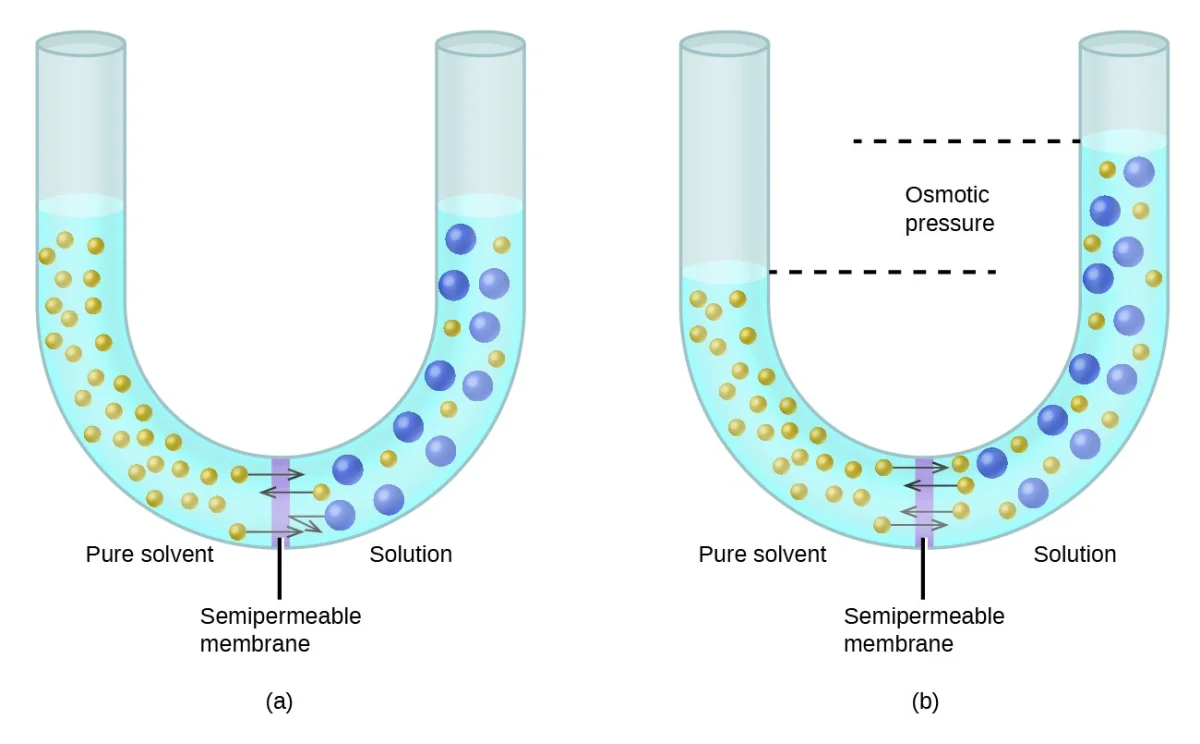
Osmosis is the net movement of solvent (usually water) through a semipermeable membrane from a region of lower solute concentration to higher solute concentration.
The membrane allows solvent molecules to pass but blocks solute particles. Solvent flows toward the more concentrated solution to equalize concentrations on both sides.
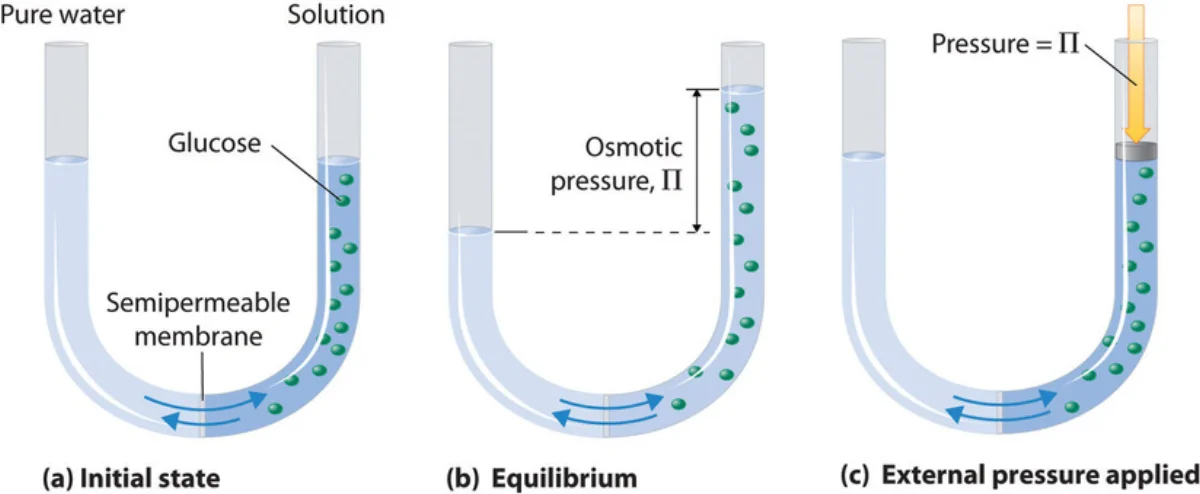
The osmotic pressure (π) is the minimum pressure that must be applied to the more concentrated side to prevent this solvent flow.
Osmosis: water moves through a semipermeable membrane from the dilute side to the concentrated side. The membrane allows solvent molecules to pass but blocks solute particles. Credit: OpenStax Chemistry 2e, CC BY 4.0
The Formula
Tonicity - The Biological Connection
This is where chemistry meets biology. The concepts below are explored in depth in the cell transport section - master them here, and you have already learned the biology.
When comparing two solutions separated by a membrane, we use three terms:
Term
Meaning
What Happens to the Cell
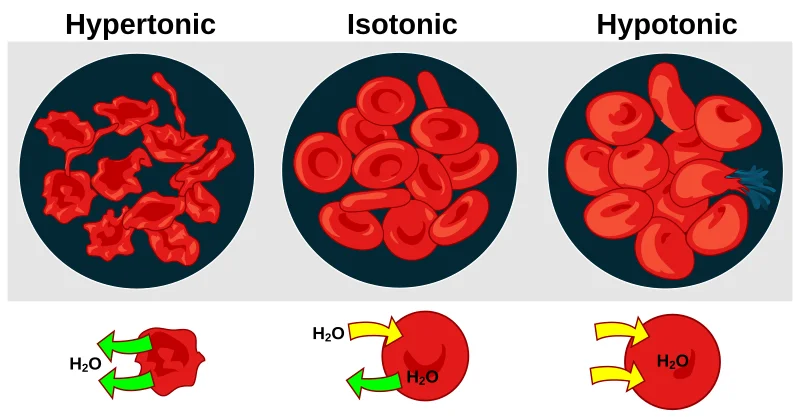
Hypertonic
Higher solute concentration (outside cell)
Water leaves the cell → cell shrinks (crenation in RBCs)
Hypotonic
Lower solute concentration (outside cell)
Water enters the cell → cell swells and may burst (lysis in RBCs)
Isotonic
Equal solute concentration
No net water movement → cell stays the same size
Osmotic effects on red blood cells. In hypertonic solution, water flows out and cells shrink (crenation). In isotonic solution (like 0.9% NaCl), water flow is balanced. In hypotonic solution, water rushes in and cells swell until they burst (lysis). This is why IV fluids must be isotonic. Credit: Wikimedia Commons, Public Domain
Why Osmotic Pressure Matters in Biology
Osmotic pressure explains:
IV fluids must be isotonic (0.9% NaCl) - hypertonic IV would shrink red blood cells, hypotonic IV would lyse them
Kidney function - the countercurrent multiplier creates an osmotic gradient in the medulla to concentrate urine
Plant turgor pressure - water entering plant cells by osmosis creates internal pressure that keeps the plant rigid
Edema - low blood protein (albumin) reduces osmotic pressure in capillaries, causing fluid to leak into tissues
Worked Example
Problem: What is the osmotic pressure of a 0.10 M NaCl solution at 37 C (body temperature)?
Solution:
i = 2 (NaCl → Na⁺ + Cl⁻)
M = 0.10 mol/L
R = 0.0821 L·atm/mol·K
T = 37 + 273 = 310 K
π = iMRT = 2 × 0.10 × 0.0821 × 310 = 5.09 atm
That is a substantial pressure - about 5 atmospheres from a relatively dilute solution. Osmotic pressure is highly sensitive to particle concentration.
Osmotic pressure measured in a U-tube. Solvent flows through the semipermeable membrane into the solution side, raising the liquid level. The height difference is proportional to osmotic pressure (π = iMRT). Credit: LibreTexts Chemistry, CC BY 4.0
A red blood cell is placed in a 2.0% NaCl solution (normal saline is 0.9%). What happens to the cell and why?
Click to reveal answer
The cell shrinks (crenates). 2.0% NaCl is hypertonic relative to the cell's interior (which is equivalent to about 0.9% NaCl). Water flows out of the cell by osmosis, moving from lower solute concentration (inside) to higher solute concentration (outside). The cell loses water and shrivels. This is crenation.
Why does the π = iMRT formula use molarity (M) instead of molality (m), unlike the other colligative property equations?
Click to reveal answer
Because osmotic pressure is a pressure, and the derivation parallels the ideal gas law (PV = nRT). Rearranging PV = nRT gives P = (n/V)RT = MRT. The osmotic pressure equation is derived by treating dissolved solute particles like gas molecules exerting pressure. The ideal gas law uses concentration as mol/volume (molarity), not mol/mass (molality), so π = iMRT naturally uses molarity.
Every colligative property formula has the factor “i” in it - the van ‘t Hoff factor. This single number is what makes the difference between a 1 m NaCl solution (i = 2, producing 2 mol particles) and a 1 m glucose solution (i = 1, producing 1 mol particles). Getting “i” right is essential for any colligative property calculation.
Determining i
The van ‘t Hoff factor equals the number of particles produced per formula unit of solute when dissolved:
Solute Type
Example
Dissociation
Expected i
Strong electrolyte
NaCl
Na⁺ + Cl⁻
2
Strong electrolyte
CaCl₂
Ca²⁺ + 2 Cl⁻
3
Strong electrolyte
FeCl₃
Fe³⁺ + 3 Cl⁻
4
Strong electrolyte
Na₂SO₄
2 Na⁺ + SO₄²⁻
3
Strong electrolyte
Al₂(SO₄)₃
2 Al³⁺ + 3 SO₄²⁻
5
Weak electrolyte
CH₃COOH
Partial dissociation
1 < i < 2
Nonelectrolyte
Glucose (C₆H₁₂O₆)
No dissociation
1
Nonelectrolyte
Sucrose
No dissociation
1
Nonelectrolyte
Urea
No dissociation
1
Weak Electrolytes - Partial Dissociation
Weak electrolytes like acetic acid (CH₃COOH) partially dissociate in water. If the degree of dissociation is α (where 0 < α < 1):
i = 1 + α(n - 1)
where n = the number of ions the compound would produce if it fully dissociated.
For acetic acid (n = 2) with α = 0.05 (5% dissociation):
i = 1 + 0.05(2 - 1) = 1 + 0.05 = 1.05
The van ‘t Hoff factor is just barely above 1, because very few molecules actually dissociate.
Expected vs. Measured i Values
Here is one of the most commonly tested subtleties in this chapter:
Electrolyte
Expected i
Measured i (0.10 m)
Reason for Difference
NaCl
2.00
~1.87
Ion pairing between Na⁺ and Cl⁻
MgSO₄
2.00
~1.21
Strong ion pairing (both ions are doubly charged)
CaCl₂
3.00
~2.70
Some Ca²⁺-Cl⁻ pairs form
Glucose
1.00
~1.00
No dissociation, no ion pairing
Notice that MgSO₄ has an especially low measured i (1.21 vs. expected 2.00). This is because Mg²⁺ and SO₄²⁻ are both doubly charged - the electrostatic attraction between them is very strong, leading to extensive ion pairing.
Ion Pairing and Concentration
Ion pairing increases at higher concentrations because ions are closer together and more likely to encounter each other. This means:
At low concentrations: measured i is close to expected i
At high concentrations: measured i is significantly below expected i
Putting It All Together
To solve any colligative property problem:
Identify the solute - strong electrolyte, weak electrolyte, or nonelectrolyte?
Determine i - count the ions (strong electrolyte), use 1 (nonelectrolyte), or calculate from α (weak electrolyte)
Plug into the formula - ΔTb = iKbm, ΔTf = iKfm, or π = iMRT
Check for reasonableness - more particles always means a bigger effect
The expected van 't Hoff factor for MgCl₂ is 3, but the measured value in a 0.50 m solution is 2.7. Explain the discrepancy.
Click to reveal answer
Ion pairing. In solution, some Mg²⁺ and Cl⁻ ions temporarily associate, effectively behaving as a single particle rather than separate ions. This reduces the effective number of particles and lowers i below the ideal value. The relatively high concentration (0.50 m) increases the frequency of ion pairing because ions are closer together.
What is the van 't Hoff factor for Na₃PO₄ assuming complete dissociation?
Click to reveal answer
i = 4. Na₃PO₄ dissociates into 3 Na⁺ ions + 1 PO₄³⁻ ion = 4 total particles per formula unit. In practice, the measured i would be less than 4 due to ion pairing, especially given the triply-charged phosphate ion. But for MCAT calculations unless told otherwise, use the ideal value of 4.
Not every mixture is a true solution. Some mixtures have particles too large to dissolve at the molecular level but too small to settle out immediately. These intermediate mixtures - colloids and suspensions - have unique properties that show up on the MCAT.
The Three Types of Mixtures
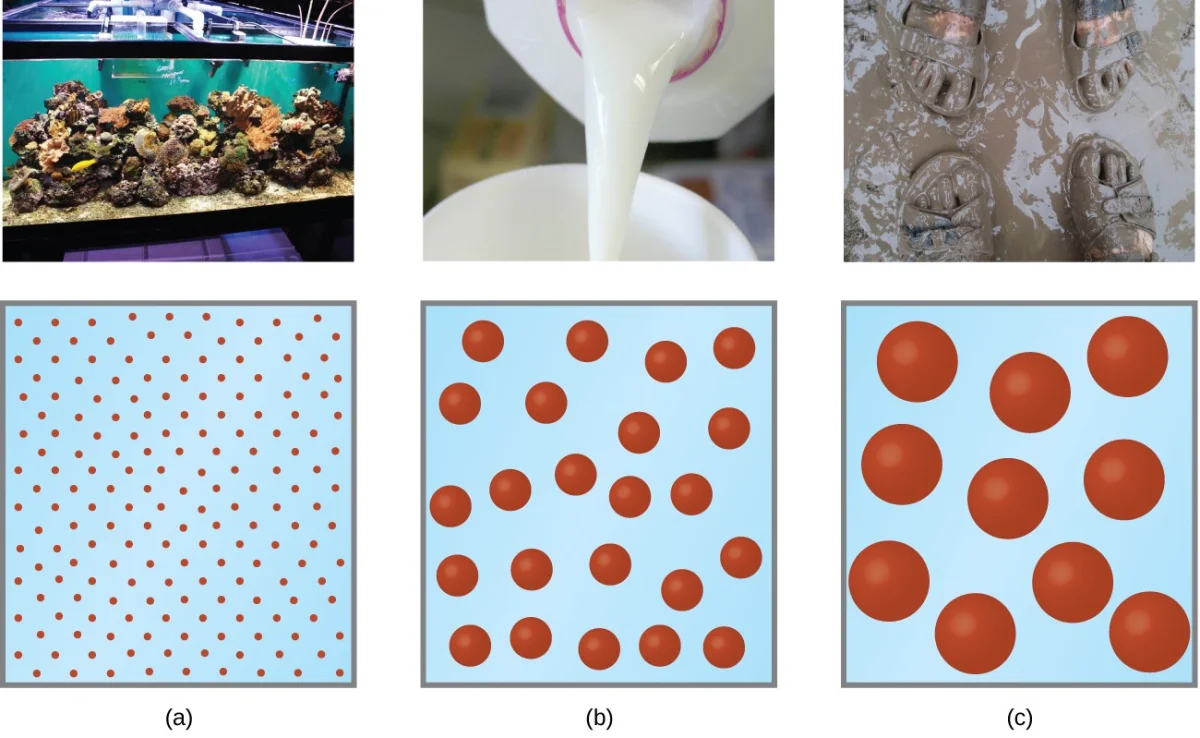
Property
True Solution
Colloid
Suspension
Particle size
< 1 nm
1 - 1,000 nm
> 1,000 nm
Settles on standing?
No
No (or very slowly)
Yes
Filterable?
No (passes through filter)
No (passes through filter)
Yes (caught by filter)
Tyndall effect?
No
Yes
Yes (but settles)
Appears
Transparent
Translucent/opaque
Opaque, cloudy
Example
Saltwater, sugar water
Milk, fog, blood
Muddy water, sand in water
Comparison of a true solution, colloid, and suspension. Particle size determines transparency, settling behavior, and whether light is scattered (Tyndall effect). Credit: OpenStax Chemistry 2e, CC BY 4.0
The Tyndall Effect
The Tyndall effect is the scattering of light by colloidal particles. Shine a flashlight through a true solution and the beam is invisible (particles too small to scatter light). Shine it through a colloid and the beam becomes visible as a glowing path through the mixture.
This is why:
Car headlights are visible in fog (fog is a colloid of water droplets in air)
A flashlight beam is visible in a dusty room (dust is a colloid of solid particles in air)
Saltwater appears clear (true solution, no scattering)
Milk appears white (colloid, scatters all wavelengths)
The Tyndall effect: light beams become visible when passing through a colloid because colloidal particles (1-1000 nm) are large enough to scatter light. True solutions do not show this effect. Credit: OpenStax Chemistry 2e, CC BY 4.0
Brownian Motion
Brownian motion is the random, zigzag movement of colloidal particles suspended in a fluid. It is caused by constant bombardment from surrounding solvent molecules. The particles are small enough to be jostled by individual molecular collisions but large enough to be observed under a microscope.
Brownian motion:
Is evidence for the kinetic molecular theory (molecules are in constant random motion)
Increases with temperature (faster-moving solvent molecules hit harder)
Types of Colloids
Colloids are classified by the phases of the dispersed substance and the medium:
Type
Dispersed Phase
Medium
Example
Sol
Solid
Liquid
Paint, blood
Gel
Liquid
Solid
Gelatin, jelly
Emulsion
Liquid
Liquid
Milk, mayonnaise
Foam
Gas
Liquid
Whipped cream, shaving cream
Aerosol (liquid)
Liquid
Gas
Fog, hairspray
Aerosol (solid)
Solid
Gas
Smoke, dust
Solid foam
Gas
Solid
Styrofoam, pumice
Solid sol
Solid
Solid
Colored glass, certain alloys
Emulsifying Agents
Oil and water form a suspension (they separate on standing). But add an emulsifier - a molecule with both hydrophilic and hydrophobic parts - and the oil is dispersed into tiny droplets that stay suspended as a colloid (an emulsion).
Examples of emulsifiers:
Soap and detergent - clean grease by emulsifying it in water
Bile salts - emulsify dietary fats in the small intestine so lipase can digest them
Lecithin (in egg yolk) - why mayonnaise stays mixed (oil emulsified in vinegar)
The emulsifier coats the oil droplets, with its polar head facing water and nonpolar tail embedded in the oil. This prevents the droplets from merging back together.
Coagulation and Flocculation
Colloidal particles often carry surface charges that create electrostatic repulsion, keeping them dispersed. Adding electrolytes (like salts) neutralizes these charges and causes the particles to clump together and settle out. This process is called coagulation or flocculation.
This is why:
Adding alum to murky water causes impurities to clump and settle (water treatment)
River water clears when it meets salty ocean water (salt neutralizes colloidal clay charges)
A student shines a laser pointer through three beakers: one with saltwater, one with milk, and one with muddy water. In which beaker(s) will the beam be visible?
Click to reveal answer
Milk and muddy water. Saltwater is a true solution (particles < 1 nm, no Tyndall effect - beam invisible). Milk is a colloid (fat droplets 100-500 nm, Tyndall effect - beam clearly visible). Muddy water is a suspension (particles > 1000 nm, scatters light but also blocks it). The Tyndall effect is the defining test for colloids: visible beam = colloid.
Bile salts are amphiphilic molecules that emulsify dietary fats. What type of colloid is formed, and why is this important for digestion?
Click to reveal answer
An emulsion (liquid-in-liquid colloid). Bile salts coat fat droplets with their nonpolar tails facing the fat and polar heads facing the aqueous intestinal fluid. This prevents the fat droplets from coalescing and increases the surface area available for pancreatic lipase to digest the fat. Without emulsification, large fat globules have too little surface area for efficient enzymatic digestion.