Gases are the simplest state of matter to model mathematically, and that simplicity is what makes this chapter so high-yield on the MCAT. Before diving into the gas laws, you need to understand the four defining characteristics that set gases apart from liquids and solids - and why those characteristics exist at the molecular level.
The Four Key Properties
1. Compressibility. Gases can be squeezed into a much smaller volume. A scuba tank holds the equivalent of thousands of liters of air compressed into a small metal cylinder. This works because gas molecules are far apart with mostly empty space between them. Push them closer together and the gas takes up less volume. Liquids and solids are nearly incompressible because their molecules are already touching.
2. Expansion to fill the container. Release perfume in one corner of a room and eventually you smell it everywhere. Gas molecules have no fixed volume or shape - they expand to uniformly fill whatever container they occupy. This happens because gas molecules are in constant random motion with enough kinetic energy to overcome any intermolecular attractions.
3. Low density. Gases are roughly 1,000 times less dense than liquids or solids of the same substance. Air at sea level has a density of about 1.2 g/L, while liquid water is 1,000 g/L. The vast empty space between gas molecules means very little mass per unit volume.
4. Diffusion and mixing. Gases mix completely and spontaneously with other gases. Open a container of ammonia and a container of hydrochloric acid at opposite ends of a bench, and a white cloud of ammonium chloride forms in the middle as the gases diffuse toward each other. There are no boundaries or layers - gases are perfectly miscible in all proportions.
Why These Properties Exist
All four properties trace back to one molecular-level fact: gas molecules are very far apart relative to their size. At standard conditions, the average distance between gas molecules is roughly 10 times the molecular diameter. This means the gas is about 99.9% empty space.
Because the molecules are so far apart, intermolecular forces (London dispersion, dipole-dipole, hydrogen bonding) are negligible. Each molecule moves independently, in a straight line, until it collides with another molecule or the container wall. This independence is what makes gas behavior so mathematically predictable.
Property
Solid
Liquid
Gas
Shape
Fixed
Takes container shape
Fills container
Volume
Fixed
Fixed
Fills container
Compressibility
Nearly zero
Very low
High
Density
High
High
Low (~10001 of liquid)
Molecular motion
Vibration only
Slide past neighbors
Free, random motion
Intermolecular forces
Strong
Moderate
Negligible
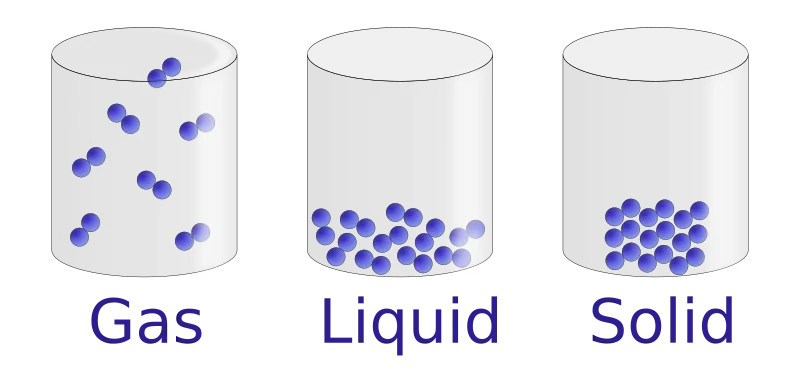
Particle arrangement in solids, liquids, and gases. In gases, molecules are widely separated with negligible intermolecular forces, explaining their compressibility, expansion to fill containers, and low density. Credit: Wikimedia Commons, CC BY-SA 3.0
Pressure - How Gases Push Back
Gas molecules constantly slam into the walls of their container. Each collision exerts a tiny force on the wall. Add up billions of collisions per second across every square centimeter of wall, and you get a measurable macroscopic pressure.
Unit conversions you must know:
Unit
Equivalence
1 atm
760 mmHg = 760 torr
1 atm
101,325 Pa = 101.325 kPa
1 bar
100,000 Pa (close to 1 atm)
Temperature and Kinetic Energy
Temperature is directly proportional to the average kinetic energy of gas molecules. Higher temperature means faster-moving molecules, which means harder and more frequent collisions with container walls, which means higher pressure (if volume is constant).
Critical rule: Gas law calculations ALWAYS require temperature in Kelvin. Celsius and Fahrenheit will give you wrong answers. Convert using:
K = C + 273 (or more precisely, + 273.15)
Zero Kelvin (absolute zero) is the temperature at which molecular motion theoretically stops. You cannot have a negative Kelvin temperature, which is why the Kelvin scale makes gas law math work.
Why can gases be compressed but liquids cannot?
Click to reveal answer
Because gas molecules are far apart with mostly empty space between them. Compression pushes molecules closer together into that empty space. In liquids, molecules are already essentially touching - there is no empty space to compress into. The intermolecular distance in gases is roughly 10x the molecular diameter, compared to essentially zero gap in liquids.
A student uses 25 C in the ideal gas law equation instead of converting to Kelvin. How will this affect the calculated number of moles?
Click to reveal answer
The answer will be dramatically wrong - about 12 times too large. Using T = 25 instead of T = 298 makes the denominator about 12 times too small, so n = PV/RT will be about 12 times too large. Gas law problems ALWAYS require Kelvin. This is one of the most common calculation errors on the MCAT.
Before you can compare gas behavior across different experiments, you need a common reference point. Standard Temperature and Pressure (STP) provides that baseline, and it comes with one of the most useful numbers in all of MCAT chemistry: the molar volume of an ideal gas.
The STP Definition
Condition
Value
Standard Temperature
0 C = 273.15 K
Standard Pressure
1 atm = 760 mmHg = 101.325 kPa
Molar Volume at STP
At STP, one mole of ANY ideal gas occupies exactly 22.4 liters. This is true regardless of the gas’s identity - one mole of helium, one mole of oxygen, and one mole of sulfur hexafluoride all occupy 22.4 L at STP.
This follows directly from the ideal gas law:
V = nRT/P = (1 mol)(0.0821 L·atm/mol·K)(273 K) / (1 atm) = 22.4 L
Why Molar Volume Is Identity-Independent
The molar volume being the same for all ideal gases is a direct consequence of Avogadro’s hypothesis: equal volumes of gases at the same temperature and pressure contain equal numbers of molecules. At STP, 22.4 L always contains 6.022×10²³ molecules, whether they are tiny helium atoms or large SF₆ molecules.
This seems counterintuitive - how can a mole of heavy gas take up the same space as a mole of light gas? The answer is that in the gas phase, molecules are so far apart that their actual size is negligible compared to the empty space between them. The volume of a gas is determined by how much space the molecules MOVE through, not how much space they physically occupy.
Using Molar Volume as a Shortcut
Example: How many liters does 0.5 mol of N2 occupy at STP?
0.5 mol x 22.4 L/mol = 11.2 L
Example: What is the mass of 44.8 L of CO2 at STP?
44.8 L / 22.4 L/mol = 2.0 mol CO2
2.0 mol x 44 g/mol = 88 g
Standard Conditions vs. Standard State
Do not confuse STP with “standard state” conditions used in thermodynamics:
STP (gas laws): 0 C (273 K), 1 atm
Standard state (thermodynamics): 25 C (298 K), 1 atm, 1 M concentrations
The MCAT can use either depending on the context. Gas law problems usually specify STP. Thermodynamics problems use standard state (25 C).
At STP, which occupies a larger volume: 1 mole of H2 or 1 mole of Xe?
Click to reveal answer
They occupy the same volume - 22.4 L each. At STP, one mole of any ideal gas occupies 22.4 L regardless of the gas's identity or molar mass. The actual size of individual molecules is negligible compared to the space between them. Xenon atoms are much larger than H2 molecules, but both gases are overwhelmingly empty space.
What is the density of N2 gas at STP? (Molar mass of N2 = 28 g/mol)
Click to reveal answer
1.25 g/L. At STP, 1 mol of N2 has a mass of 28 g and occupies 22.4 L. Density = mass/volume = 28 g / 22.4 L = 1.25 g/L. This shortcut (density = molar mass / 22.4) works for any ideal gas at STP.
Squeeze a balloon and it gets smaller. Let go and it springs back. You have been demonstrating Boyle’s law since childhood - you just did not know it had a name.
The Law
At constant temperature and constant amount of gas, pressure and volume are inversely proportional.
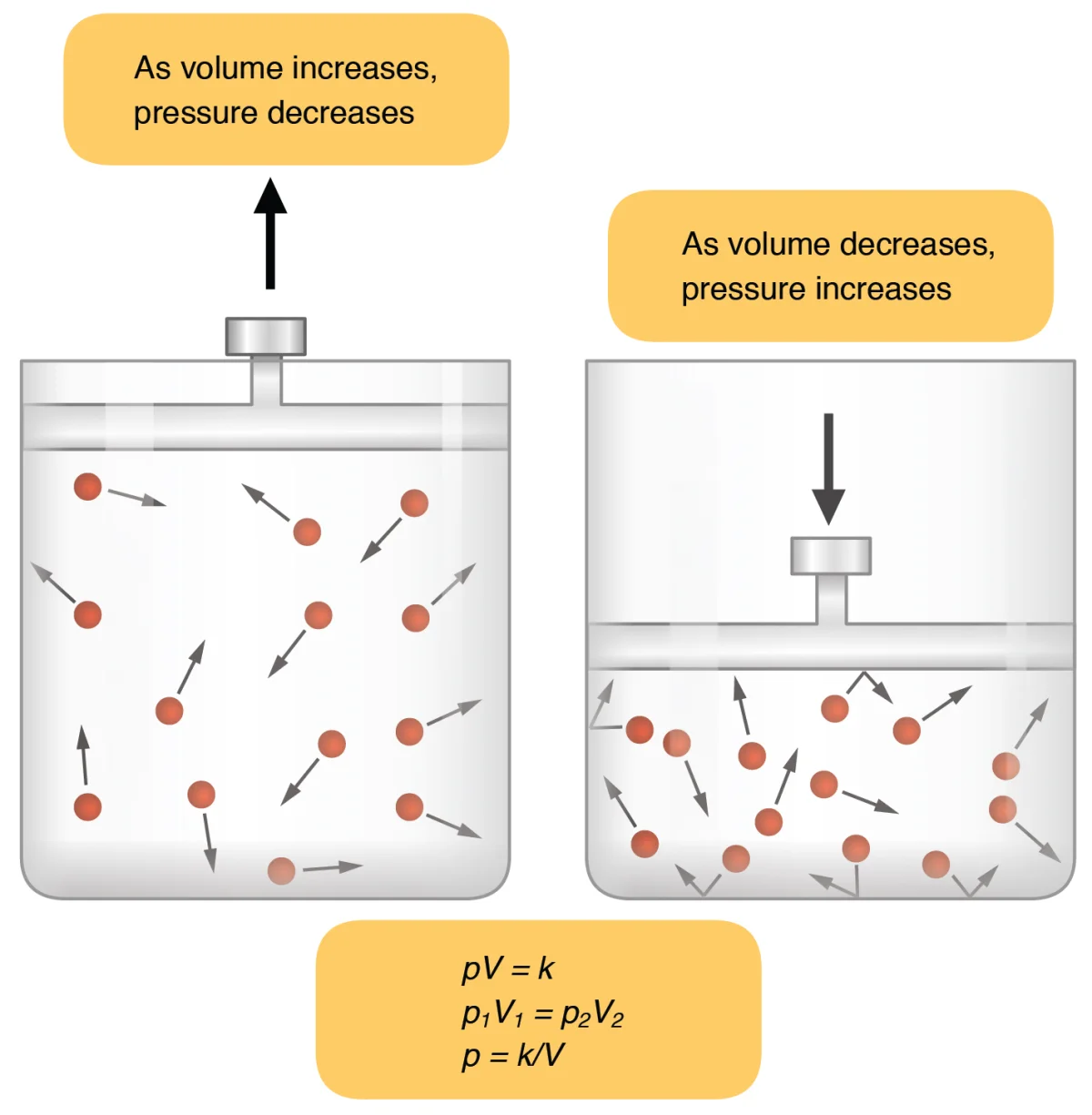
Boyle's law demonstrated with a piston: increasing volume decreases pressure (left), and decreasing volume increases pressure (right). The number of gas molecules stays the same. Credit: OpenStax Anatomy and Physiology, CC BY 3.0
The Graph
A plot of P vs. V at constant temperature produces a hyperbola - a smooth curve that approaches both axes but never touches them. Each curve is called an isotherm (constant temperature line). Higher temperatures produce isotherms that are farther from the origin.
A plot of P vs. 1/V produces a straight line through the origin with slope = nRT. This linear form is useful for confirming Boyle’s law behavior from experimental data.
Why It Works (Molecular Level)
When you compress a gas (decrease volume), the same number of molecules now occupy a smaller space. They hit the container walls more frequently because there is less distance to travel between collisions. More collisions per second per unit area = higher pressure.
Breathing Is Boyle’s Law
Every breath you take is a demonstration of Boyle’s law:
Inhalation: Your diaphragm contracts and moves downward, increasing the volume of your thoracic cavity. By Boyle’s law, the increased volume causes the pressure inside your lungs to drop below atmospheric pressure. Air rushes in from high pressure (outside) to low pressure (inside).
Exhalation: Your diaphragm relaxes and moves upward, decreasing thoracic volume. Pressure inside the lungs rises above atmospheric pressure, and air is pushed out.
Worked Example
A gas occupies 6.0 L at 2.0 atm. What volume will it occupy at 4.0 atm (constant temperature)?
P₁V₁ = P₂V₂
(2.0 atm)(6.0 L) = (4.0 atm)(V₂)
V₂ = 12.0 / 4.0 = 3.0 L
The pressure doubled, so the volume halved. This proportional reasoning is faster than the algebra and is how the MCAT expects you to think.
A sealed syringe contains 10 mL of gas at 1 atm. If the plunger is pushed in until the volume is 2 mL, what is the new pressure (assuming constant temperature)?
Click to reveal answer
5 atm. P₁V₁ = P₂V₂. (1 atm)(10 mL) = P₂(2 mL). P₂ = 210 = 5 atm. Volume decreased by a factor of 5, so pressure increased by a factor of 5. This is the inverse relationship of Boyle's law in action.
During inhalation, what happens to the volume and pressure inside the lungs, and which gas law explains this?
Click to reveal answer
Volume increases and pressure decreases - explained by Boyle's law. The diaphragm contracts and moves down, increasing thoracic volume. By Boyle's law (P ∝ 1/V at constant T), the increased volume causes intrapulmonary pressure to drop below atmospheric pressure. Air flows in from high pressure (outside) to low pressure (lungs).
Watch a hot air balloon on a cool morning. The pilot fires the burner, the air inside heats up, the balloon swells, and it lifts off the ground. Cool the air and the balloon sinks. This is Charles’s law - the direct relationship between gas volume and temperature.
A hot air balloon in flight. The pilot heats the air inside the envelope, causing it to expand (Charles's law). The expanded air is less dense than the cooler surrounding air, generating lift. Credit: Wikimedia Commons, CC BY-SA 4.0
The Law
At constant pressure and constant amount of gas, volume and temperature are directly proportional.
The Graph
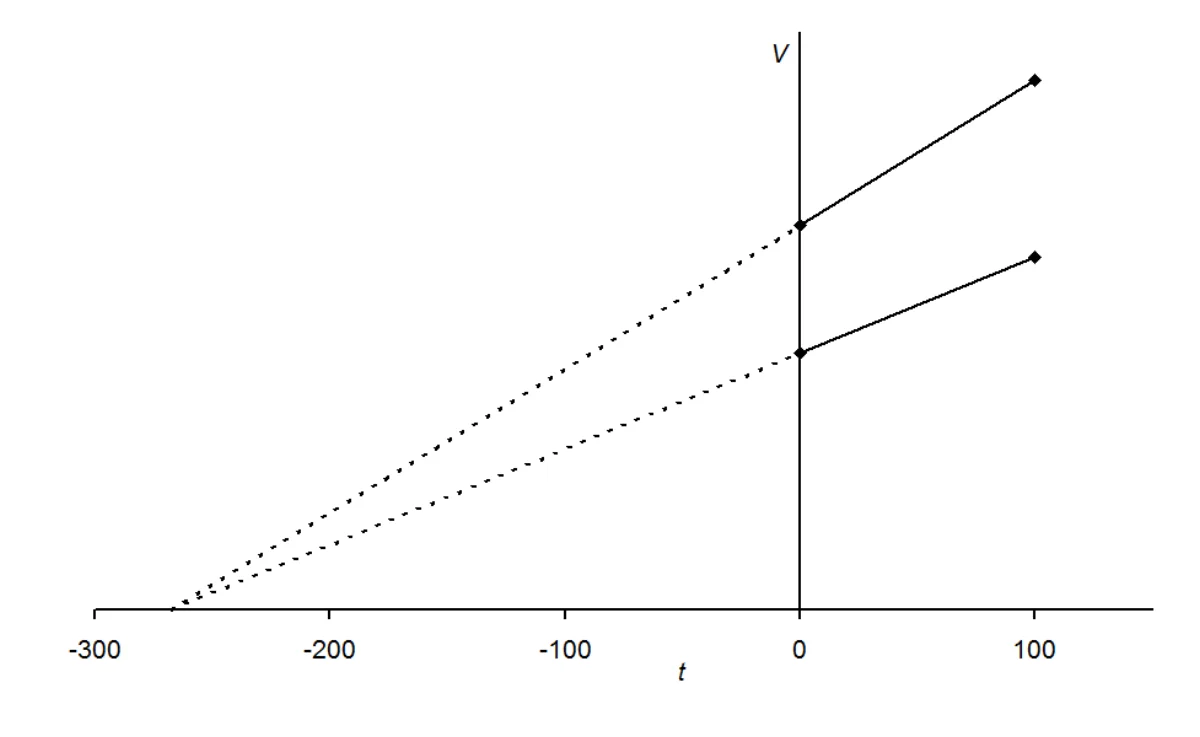
A plot of V vs. T (in Kelvin) produces a straight line that, when extrapolated, passes through the origin (0 K, 0 L). This is one of the key pieces of evidence for the existence of absolute zero - the temperature at which an ideal gas would theoretically have zero volume.
Volume vs. temperature graph for two gas samples. Both lines extrapolate to zero volume at -273 C (absolute zero). The dashed lines show extrapolation beyond the range where the gas would liquefy. Credit: Wikimedia Commons, CC BY-SA 3.0
A plot of V vs. T in Celsius also produces a straight line, but it crosses the x-axis at -273 C rather than at zero. This is why Kelvin is essential for gas law calculations - it is the only temperature scale where the proportionality V ∝ T holds true.
Why It Works (Molecular Level)
When you heat a gas at constant pressure, the molecules gain kinetic energy and move faster. They hit the container walls harder and more often. If the container can expand (constant pressure means the walls can move), the gas pushes outward until the increased molecular speed is balanced by the larger volume. The net result: the gas takes up more space at higher temperatures.
Absolute Zero and the Kelvin Scale
If you extrapolate the V vs. T line all the way down, it hits zero volume at -273.15 C. This is absolute zero (0 K) - the theoretical temperature at which gas molecules would have zero kinetic energy and occupy zero volume.
In reality, all gases liquefy before reaching absolute zero, so you never actually get zero volume. But the extrapolation demonstrates why the Kelvin scale exists and why gas law calculations require it.
Worked Example
A gas occupies 3.0 L at 300 K. What volume will it occupy at 600 K (constant pressure)?
V₁/T₁ = V₂/T₂
3.0 L / 300 K = V₂ / 600 K
V₂ = 3.0 x (300600) = 6.0 L
Temperature doubled, so volume doubled. Direct proportionality makes this straightforward.
A balloon has a volume of 2.0 L at 200 K. What is its volume at 400 K, assuming constant pressure?
Click to reveal answer
4.0 L. V₁/T₁ = V₂/T₂. Temperature doubled (200 K to 400 K), so volume doubles (2.0 L to 4.0 L). Charles's law is a direct proportion - V and T change by the same factor.
Why does Charles's law require temperature in Kelvin rather than Celsius?
Click to reveal answer
Because the proportionality V ∝ T only holds on the Kelvin scale. On the Celsius scale, the V vs. T line does not pass through the origin (it crosses at -273 C). Using Celsius would break the direct proportionality and give incorrect results. The Kelvin scale starts at absolute zero, making V/T = constant mathematically valid.
Ever seen the warning label on an aerosol can that says “do not expose to temperatures above 120 F”? That warning exists because of Gay-Lussac’s law. Heat a sealed, rigid container and the pressure inside rises. Heat it enough and the container explodes.
The Law
At constant volume and constant amount of gas, pressure and temperature are directly proportional.
The Graph
A plot of P vs. T (in Kelvin) produces a straight line through the origin, just like Charles’s law but with pressure on the y-axis instead of volume. The slope depends on the amount of gas and the volume of the container.
Why It Works (Molecular Level)
In a rigid container, the volume cannot change. When you increase the temperature, molecules gain kinetic energy - they move faster and collide with the walls more forcefully and more frequently. Since the walls cannot move outward to accommodate this increased molecular activity, the pressure increases.
The Combined Gas Law
Boyle’s, Charles’s, and Gay-Lussac’s laws are all special cases of the combined gas law:
If constant…
Cancels to…
Law
T
P₁V₁ = P₂V₂
Boyle’s
P
V₁/T₁ = V₂/T₂
Charles’s
V
P₁/T₁ = P₂/T₂
Gay-Lussac’s
Worked Example
A sealed steel tank contains gas at 300 K and 2.0 atm. The tank is heated to 600 K. What is the new pressure?
P₁/T₁ = P₂/T₂
2.0 atm / 300 K = P₂ / 600 K
P₂ = 2.0 x (300600) = 4.0 atm
Temperature doubled, so pressure doubled. The volume of the rigid tank stays the same throughout.
A rigid container of gas has a pressure of 3.0 atm at 400 K. If the temperature is decreased to 200 K, what is the new pressure?
Click to reveal answer
1.5 atm. P₁/T₁ = P₂/T₂. Temperature halved (400 K to 200 K), so pressure halves (3.0 to 1.5 atm). Gay-Lussac's law is a direct proportion between P and T at constant volume.
Which gas law would you use to solve this: a gas at 1.5 atm and 4.0 L at 300 K is changed to 2.0 atm at 400 K. Find the new volume.
Click to reveal answer
The combined gas law: P₁V₁/T₁ = P₂V₂/T₂. Since P, V, and T are all changing, you need the combined gas law. (1.5)(4.0)/300 = (2.0)(V₂)/400. V₂ = (1.5 x 4.0 x 400)/(300 x 2.0) = 4.0 L. None of the individual gas laws (Boyle's, Charles's, or Gay-Lussac's) work here because no variable is held constant.
Blow air into a balloon and it gets bigger. Every puff adds more gas molecules, and the balloon expands to accommodate them. Avogadro’s law quantifies this intuition: more molecules means more volume, in a direct one-to-one proportion.
The Law
At constant temperature and pressure, volume is directly proportional to the number of moles of gas.
Avogadro’s Hypothesis
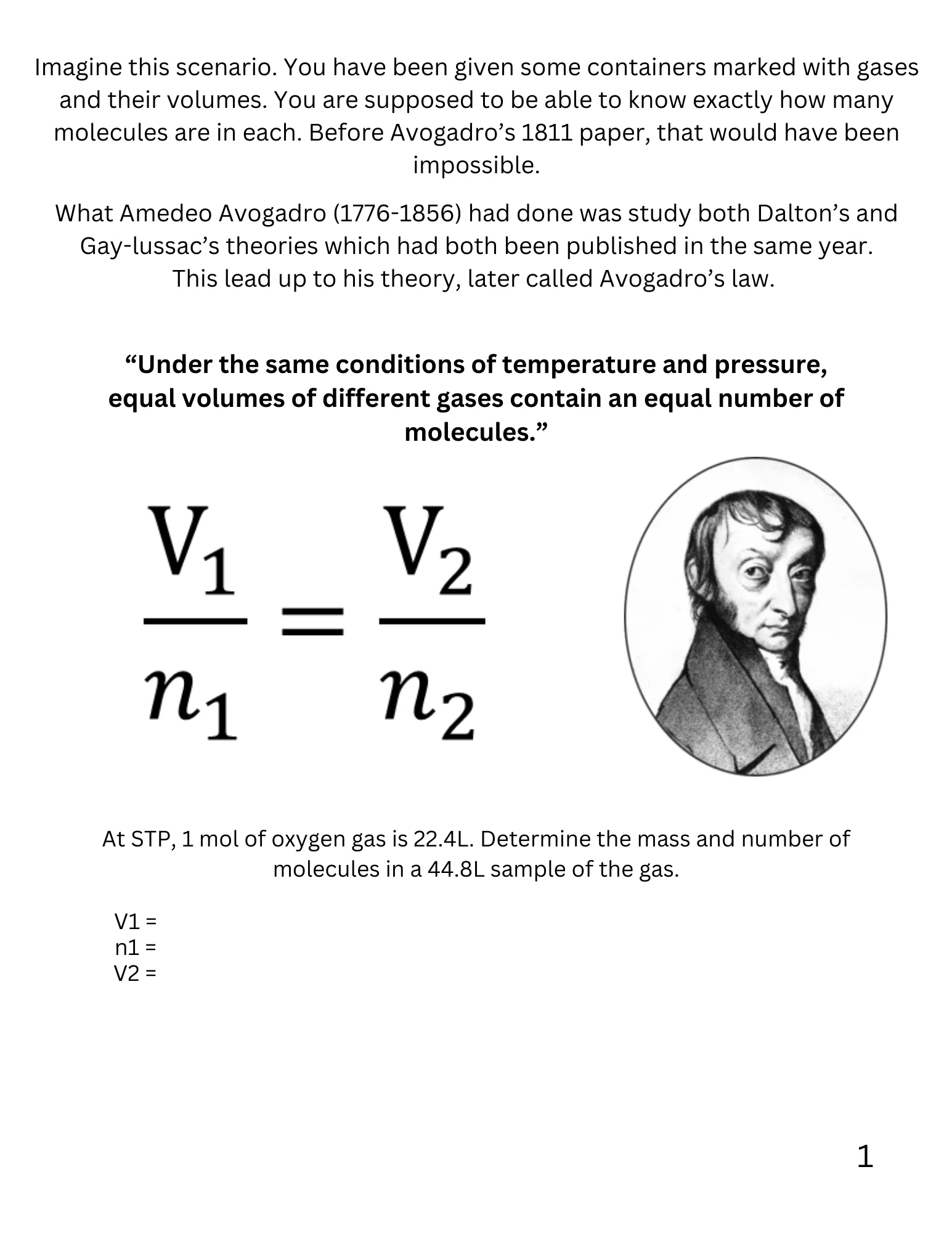
Avogadro proposed that equal volumes of gases at the same temperature and pressure contain equal numbers of molecules. This was revolutionary because it meant that gas volume is determined by particle count, not particle identity or size.
This hypothesis directly leads to the concept of molar volume: at STP, one mole of any ideal gas occupies 22.4 L, regardless of what gas it is.
Avogadro's law: at constant temperature and pressure, equal volumes of any gas contain the same number of molecules. Doubling the moles of gas doubles the volume, regardless of the gas's identity. Credit: Wikimedia Commons, CC0
Gas Stoichiometry Connection
Avogadro’s law is the bridge between gas law calculations and chemical stoichiometry. Because volume is proportional to moles (at constant T and P), you can use volume ratios directly as mole ratios in balanced equations.
Example: In the reaction N2 + 3H2 → 2NH3, if all gases are at the same temperature and pressure:
1 volume of N2 reacts with 3 volumes of H2 to produce 2 volumes of NH3
10 L of N2 requires 30 L of H2 and produces 20 L of NH3
This only works when all species are gases at the same conditions. If a reactant or product is a liquid or solid, you must use moles (not volumes).
The Four Gas Laws Summary
Law
Variables
Relationship
Constant
Equation
Boyle’s
P, V
Inverse
T, n
P₁V₁ = P₂V₂
Charles’s
V, T
Direct
P, n
V₁/T₁ = V₂/T₂
Gay-Lussac’s
P, T
Direct
V, n
P₁/T₁ = P₂/T₂
Avogadro’s
V, n
Direct
T, P
V₁/n₁ = V₂/n₂
At constant temperature and pressure, a container holds 2.0 mol of gas at 44.8 L. If 1.0 mol of gas is added, what is the new volume?
Click to reveal answer
67.2 L. V₁/n₁ = V₂/n₂. 44.8 L / 2.0 mol = V₂ / 3.0 mol. V₂ = 44.8 x (2.03.0) = 67.2 L. Adding 50% more moles increases the volume by 50%. Note that 44.8 L / 2 mol = 22.4 L/mol, confirming this is at STP.
In the reaction 2CO + O2 → 2CO2 at constant T and P, if 10 L of CO is used, what volume of O2 is needed and what volume of CO2 is produced?
Click to reveal answer
5 L of O2 needed; 10 L of CO2 produced. By Avogadro's law, volume ratios equal mole ratios at constant T and P. The balanced equation shows 2:1:2 for CO:O2:CO2. So 10 L CO requires 210 = 5 L O2, and produces 10 L CO2. This shortcut only works when all species are gases at the same conditions.
All four individual gas laws are just special cases of one master equation. The ideal gas law combines Boyle’s, Charles’s, Gay-Lussac’s, and Avogadro’s laws into a single relationship that describes how any ideal gas behaves under any conditions. This is the most important equation in the entire gas phase chapter.
The Equation
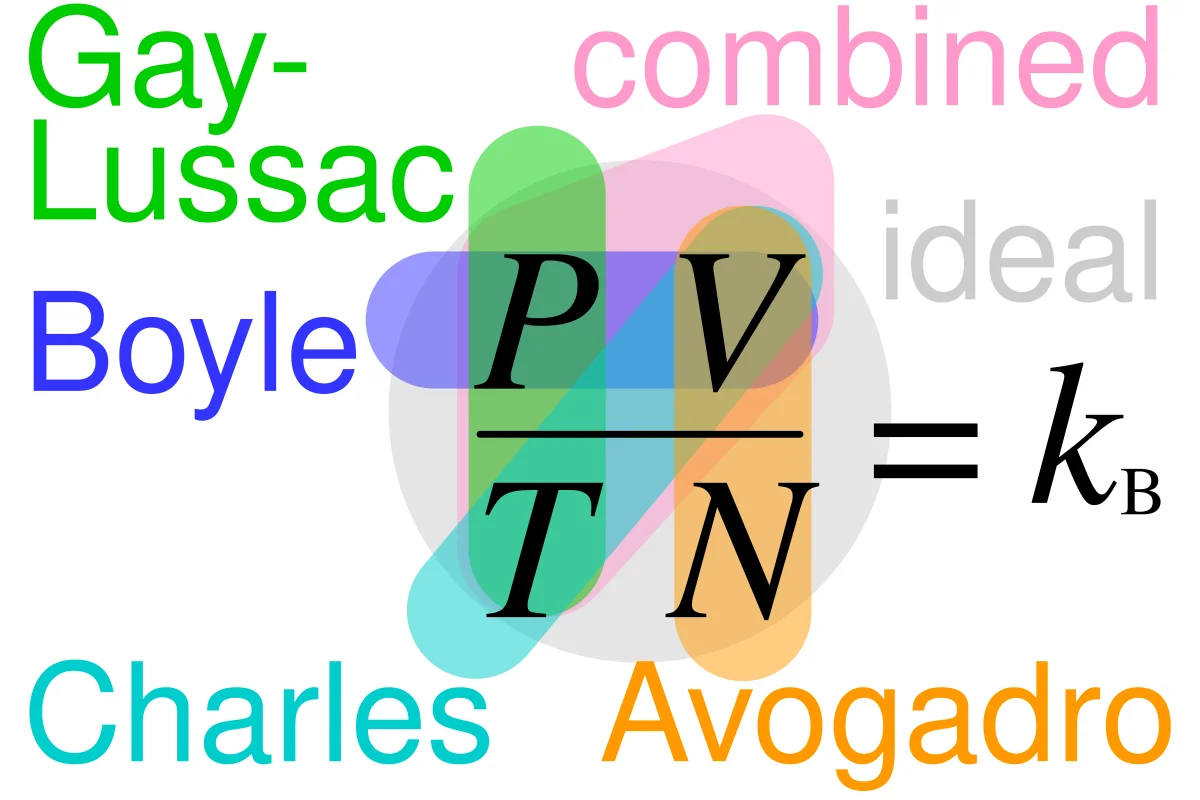
How the individual gas laws relate to the ideal gas law. Each named law holds certain variables constant while describing the relationship between the remaining variables. Credit: Wikimedia Commons, CC BY-SA 4.0
The Gas Constant R
The value of R depends on the units you are using:
R Value
Units
When to Use
0.0821
L·atm/(mol·K)
When P is in atm and V is in L (most common on MCAT)
8.314
J/(mol·K)
When working with energy (thermodynamics, kinetics)
62.36
L·torr/(mol·K)
When P is in torr (rarely needed)
For gas law problems, use R = 0.0821 almost every time. The value R = 8.314 J/(mol·K) shows up in thermodynamics equations like ΔG = ΔG° + RTlnQ and the Arrhenius equation.
Assumptions of the Ideal Gas Model
The ideal gas law works perfectly only for an “ideal” gas - a theoretical gas that:
Has no intermolecular forces. Molecules do not attract or repel each other.
Has no molecular volume. Molecules are treated as dimensionless points.
Undergoes perfectly elastic collisions. No kinetic energy is lost when molecules collide.
No real gas is truly ideal, but most gases behave nearly ideally at high temperatures and low pressures (when molecules are far apart and moving fast). We will revisit when this model breaks down in Section 8.12 on real gases.
Calculating Molar Mass from Gas Data
The ideal gas law lets you determine the molar mass of an unknown gas. Start with PV = nRT and substitute n = mass/molar mass:
PV = (m/M)RT
Rearranging:
M = mRT / (PV)
Or, since density d = m/V:
Gas Density
From d = PM/(RT), you can see that:
Heavier gases are denser (higher M = higher d). CO2 (M = 44) is denser than N2 (M = 28), which is why CO2 sinks and accumulates in low areas.
Higher pressure increases density (compressing gas into less space).
Higher temperature decreases density (molecules spread out). This is why hot air rises - it is less dense than the surrounding cooler air.
Worked Example
What volume does 2.0 mol of an ideal gas occupy at 546 K and 2.0 atm?
Estimate: 0.0821 x 546 is roughly 0.08 x 550 = 44. Then 2 x 44 / 2 = 44.8 L
Notice: 2 mol at STP would be 44.8 L. This gas is at double the temperature (546 vs. 273) and double the pressure (2 vs. 1) compared to STP. The temperature doubles the volume (Charles’s law), but the pressure halves it (Boyle’s law). The two effects cancel, giving the same 44.8 L. Proportional reasoning confirms the algebra.
A 4.4 g sample of gas occupies 2.24 L at STP. What is the molar mass and likely identity of the gas?
Click to reveal answer
M = 44 g/mol - the gas is CO2. At STP, 2.24 L = 0.1 mol (since 22.4 L = 1 mol). Molar mass = 4.4 g / 0.1 mol = 44 g/mol. Common gases with M = 44: CO2 (12 + 32 = 44), N2O (28 + 16 = 44), or C3H8 (propane, 36 + 8 = 44). In a general chemistry context, CO2 is the most likely answer.
Two gas containers at the same temperature and pressure contain the same number of moles. Container A holds H2 and Container B holds O2. Which has the greater density?
Click to reveal answer
Container B (O2). Since d = PM/(RT), and P, R, and T are the same for both, density depends only on molar mass. O2 (M = 32) has a molar mass 16 times greater than H2 (M = 2), so O2 is 16 times denser. Both containers have the same volume (Avogadro's law), but the O2 container has much more mass.
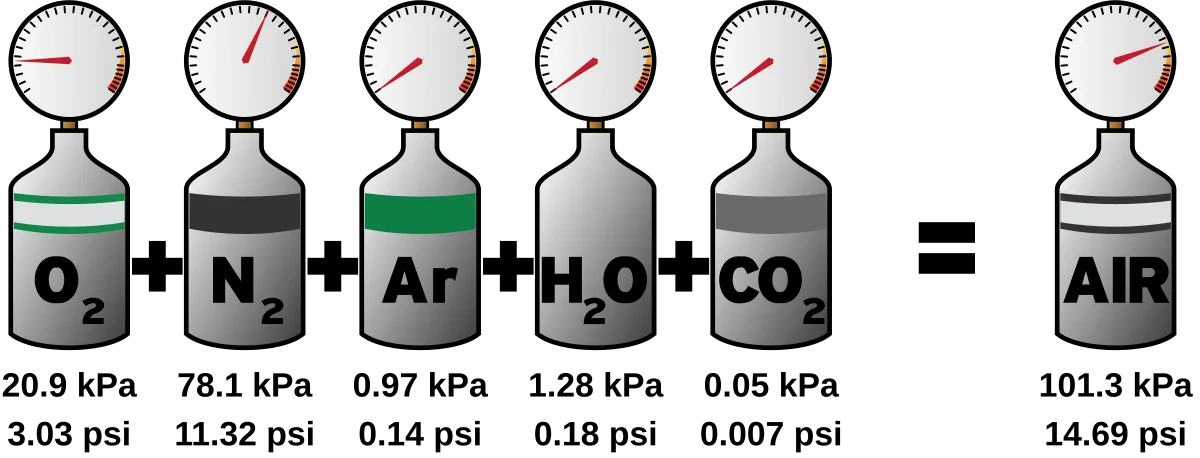
The air you breathe is not a single gas - it is a mixture of nitrogen (78%), oxygen (21%), argon (0.9%), carbon dioxide (0.04%), and trace amounts of other gases. Each gas contributes its own portion of the total atmospheric pressure, completely independent of the others. Dalton’s law tells you exactly how to calculate each gas’s contribution.
The Law
The total pressure of a gas mixture equals the sum of the partial pressures of each individual gas.
Partial Pressure and Mole Fraction
The partial pressure of a gas is the pressure it would exert if it occupied the entire container alone. It is calculated using the mole fraction:
Worked Example
A container holds 2.0 mol of N2 and 1.0 mol of O2 at a total pressure of 3.0 atm. What is the partial pressure of each gas?
Total moles: 2.0 + 1.0 = 3.0 mol
X(N2) = 3.02.0 = 0.667
X(O2) = 3.01.0 = 0.333
P(N2) = 0.667 x 3.0 atm = 2.0 atm
P(O2) = 0.333 x 3.0 atm = 1.0 atm
Check: 2.0 + 1.0 = 3.0 atm. The partial pressures sum to the total.
Collection of Gas Over Water
A classic MCAT application of Dalton’s law is correcting for water vapor when gas is collected by displacing water. When gas bubbles through water and is collected in an inverted container, the collected gas is actually a mixture of the desired gas plus water vapor.
The total pressure of the collected gas equals atmospheric pressure (since the water levels are equalized). But the total pressure includes water vapor:
P(gas) = P(total) - P(water vapor)
The vapor pressure of water at a given temperature is provided in the passage or in a data table. At 25 C, water’s vapor pressure is about 24 mmHg (or 0.031 atm).
Atmospheric Pressure and Partial Pressures
At sea level, P(total) = 1 atm = 760 mmHg. The partial pressures of atmospheric gases:
Gas
Mole Fraction
Partial Pressure (mmHg)
N2
0.78
593
O2
0.21
160
Ar
0.009
7
CO2
0.0004
0.3
Dalton's law illustrated with atmospheric gases. Each gas contributes its own partial pressure to the total atmospheric pressure of 101.3 kPa (1 atm). Credit: Wikimedia Commons, CC BY-SA 4.0
Oxygen gas is collected over water at 25 C and a total pressure of 760 mmHg. The vapor pressure of water at 25 C is 24 mmHg. What is the partial pressure of the dry O2?
Click to reveal answer
736 mmHg. P(O2) = P(total) - P(H2O) = 760 - 24 = 736 mmHg. The collected gas is a mixture of O2 and water vapor. To find the pressure due to O2 alone, subtract the vapor pressure of water from the total. Always subtract water vapor when gas is collected over water.
A gas mixture contains 3 mol He, 2 mol Ne, and 5 mol Ar at a total pressure of 10 atm. What is the partial pressure of Ne?
Click to reveal answer
2 atm. X(Ne) = 2/(3+2+5) = 102 = 0.20. P(Ne) = X(Ne) x P(total) = 0.20 x 10 atm = 2 atm. The mole fraction tells you what fraction of the total pressure is contributed by each gas.
The gas laws tell you WHAT gases do. Kinetic molecular theory tells you WHY. KMT is a model that explains macroscopic gas behavior (pressure, temperature, volume) in terms of the microscopic motion of individual molecules. Understand these five postulates and you can derive every gas law from first principles.
The Five Postulates of KMT
1. Gas molecules are in constant, random, straight-line motion. They travel in all directions with a range of speeds. Between collisions, their paths are straight lines.
2. The volume of individual gas molecules is negligible compared to the container volume. Gas is mostly empty space. The actual volume occupied by the molecules themselves is essentially zero relative to the container.
3. Gas molecules exert no attractive or repulsive forces on each other. They are completely independent - no intermolecular forces. This is why gases mix uniformly and why each gas in a mixture behaves independently (Dalton’s law).
4. Collisions between gas molecules and with container walls are perfectly elastic. No kinetic energy is lost during collisions. Energy can transfer between molecules, but the total kinetic energy of the system is conserved.
5. The average kinetic energy of gas molecules is directly proportional to the absolute temperature. This is the most important postulate for the MCAT. It links the macroscopic quantity (temperature) to microscopic behavior (molecular motion).
Temperature and Kinetic Energy
The fifth postulate gives us one of the most important relationships in gas phase chemistry:
Critical insight: Average kinetic energy depends ONLY on temperature. It does NOT depend on the identity, mass, or molar mass of the gas. At the same temperature, helium atoms and xenon atoms have the same average kinetic energy. This seems surprising, but it means that heavier molecules must move more slowly to have the same kinetic energy as lighter ones (since KE = 21 mv²).
Root Mean Square Speed
Since KE = 21 mv², and KE(avg) = 23 kT, we can solve for the speed of gas molecules:
From this equation:
Higher temperature = faster speed (v increases with T)
Lighter molecules = faster speed (v decreases with M)
Speed is proportional to √T and inversely proportional to √M
How KMT Explains the Gas Laws
Gas Law
KMT Explanation
Boyle’s (P ∝ 1/V)
Smaller volume = molecules hit walls more often = higher pressure
Charles’s (V ∝ T)
Higher T = faster molecules = they push walls outward = larger volume (at constant P)
Gay-Lussac’s (P ∝ T)
Higher T = faster molecules = harder, more frequent wall hits = higher pressure (at constant V)
Avogadro’s (V ∝ n)
More molecules = more collisions with walls = walls must expand to maintain constant P
Dalton’s (P = sum of partials)
Each gas acts independently (no IMFs) = each contributes its own collisions
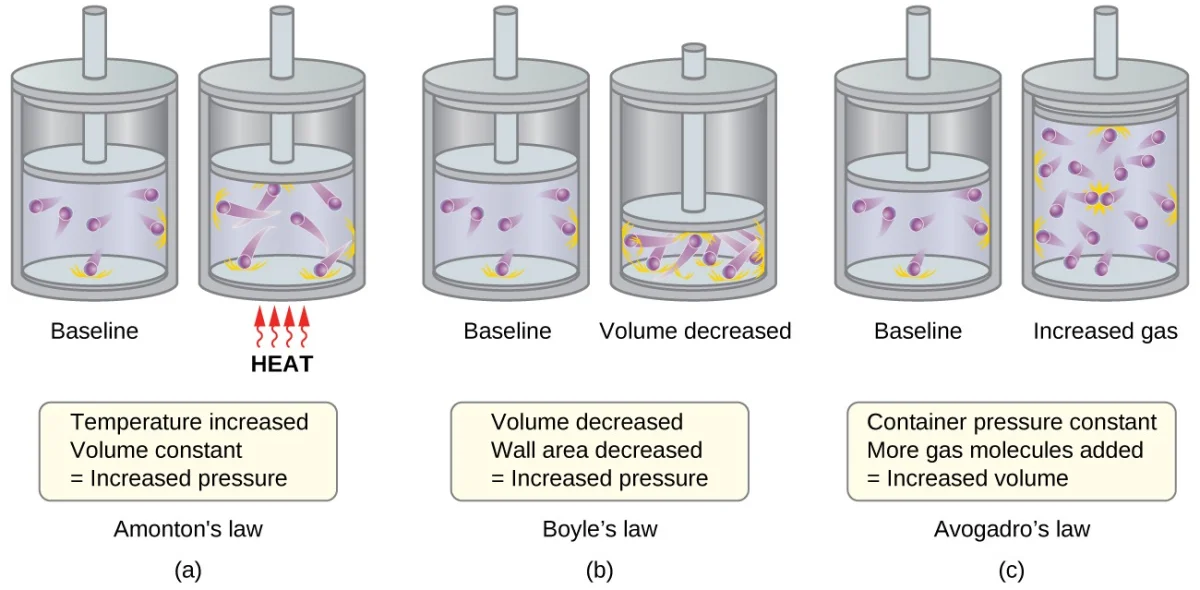
KMT explains the gas laws at the molecular level. (a) Heating increases collision force and frequency (Gay-Lussac's law). (b) Smaller volume means more frequent wall collisions (Boyle's law). (c) More molecules require more volume at constant pressure (Avogadro's law). Credit: OpenStax Chemistry 2e, CC BY 4.0
Heat Capacity of Gases: Cp vs. Cv
Kinetic molecular theory also explains why gases have two different heat capacities:
Cv (heat capacity at constant volume): All added heat goes into increasing molecular kinetic energy (translation, rotation, vibration). No work is done because the volume does not change.
Cp (heat capacity at constant pressure): Some added heat goes into kinetic energy, but some goes into doing expansion work (pushing the atmosphere back as the gas expands). Therefore, Cp > Cv for all gases.
Pressure at the Molecular Level
Pressure arises from the cumulative effect of molecular collisions with container walls. The pressure of a gas depends on:
Number of molecules (more molecules = more collisions)
Speed of molecules (faster = harder hits)
Mass of molecules (heavier = harder hits)
Frequency of collisions (depends on speed, number, and container size)
This is why P = nRT/V works: n counts molecules, T determines their speed, and 1/V determines how often they hit any given wall area.
At the same temperature, which has a greater average kinetic energy: a sample of He (M = 4) or a sample of Ar (M = 40)?
Click to reveal answer
They are equal. Average kinetic energy depends ONLY on temperature (KE = 23 kT). At the same temperature, all gas molecules have the same average KE regardless of their mass. However, He atoms move much faster than Ar atoms because they are lighter (v(rms) = sqrt(3RT/M)).
Which postulate of kinetic molecular theory is violated by real gases at high pressures?
Click to reveal answer
Postulate 2 (negligible molecular volume) and Postulate 3 (no intermolecular forces). At high pressures, molecules are crammed close together, so their actual volume becomes significant relative to the container volume. Additionally, when molecules are close together, intermolecular forces (especially London dispersion forces) become non-negligible. These two violations are corrected by the van der Waals equation.
Not all molecules in a gas sample move at the same speed. Some are barely crawling, some are zipping along at extreme velocities, and most are somewhere in between. The Maxwell-Boltzmann distribution describes exactly how molecular speeds are spread out in a gas sample, and it explains why raising the temperature makes reactions faster.
The Distribution Curve
The Maxwell-Boltzmann distribution is a plot of “number of molecules” (y-axis) vs. “molecular speed” (x-axis). The curve:
Starts at zero (no molecules have zero speed)
Rises to a peak at the most probable speed
Has a long tail extending to the right (a few molecules move very fast)
Is asymmetric - the tail always extends further to the right than the left
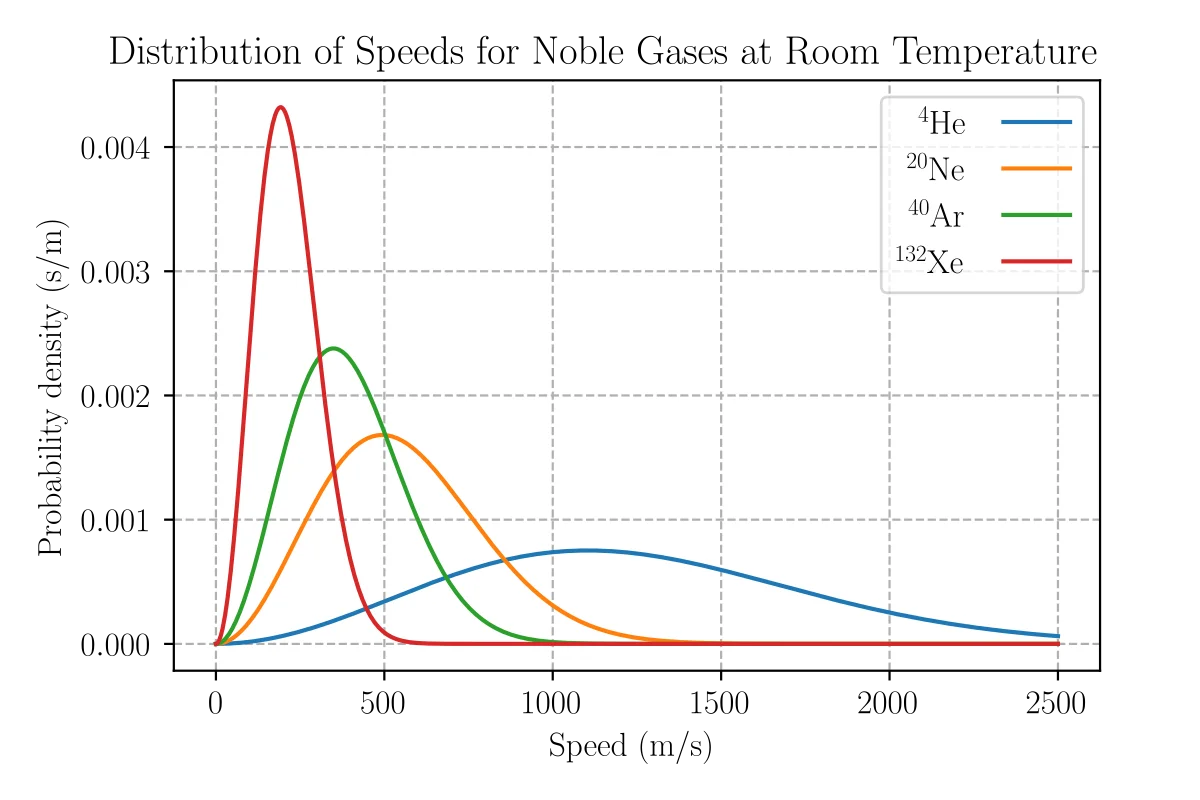
Maxwell-Boltzmann speed distributions for noble gases at room temperature. Lighter gases (He) have broader distributions shifted to higher speeds. Heavier gases (Xe) have narrower, taller peaks at lower speeds. All four gases have the same average kinetic energy at the same temperature. Credit: Wikimedia Commons, public domain
Three Measures of Speed
The distribution defines three characteristic speeds, all slightly different:
Speed
Definition
Relative Magnitude
Most probable (v(mp))
Speed at the peak of the curve
Smallest
Average (v(avg))
Arithmetic mean of all speeds
Middle
Root mean square (v(rms))
sqrt of the mean of v²
Largest
The order is always: v(mp) < v(avg) < v(rms). For MCAT purposes, you mainly need to know v(rms) = sqrt(3RT/M) and that these three speeds are close to each other.
Effect of Temperature
Increasing temperature changes the Maxwell-Boltzmann curve in three ways:
The peak shifts to the right (higher most probable speed)
The peak gets shorter (fewer molecules at the most probable speed)
The curve broadens (wider range of speeds)
The total area under the curve stays the same (same number of molecules), but the distribution flattens out and shifts toward higher speeds. This means that at higher temperatures, a larger fraction of molecules exceed any given speed threshold - including the activation energy threshold for a chemical reaction.
Effect of Molar Mass
At the same temperature, lighter gases have:
A peak shifted further to the right (higher speeds)
A broader, flatter distribution
Higher v(rms) values
Heavier gases have a narrower, taller curve centered at lower speeds. Both have the same average kinetic energy (same temperature), but the lighter gas converts that energy into more speed because KE = 21 mv².
Temperature vs. Molar Mass Effects - Summary
Change
Effect on Speed Distribution
Increase T (same gas)
Peak shifts right, curve broadens and flattens
Decrease T (same gas)
Peak shifts left, curve narrows and gets taller
Lighter gas (same T)
Peak shifts right, curve broadens and flattens
Heavier gas (same T)
Peak shifts left, curve narrows and gets taller
Notice that increasing temperature and decreasing molar mass have the same qualitative effect on the distribution. Both shift the curve to higher speeds.
A sample of N2 gas is heated from 300 K to 600 K. What happens to the Maxwell-Boltzmann distribution curve?
Click to reveal answer
The curve shifts to the right, becomes shorter, and broadens. The peak moves to a higher speed (molecules are faster on average). The peak height decreases and the curve spreads out over a wider range of speeds. The total area under the curve stays the same (same number of molecules). More molecules now exceed any given energy threshold, which is why higher temperature increases reaction rates.
At the same temperature, which gas has a higher average molecular speed: He (M = 4) or N2 (M = 28)?
Click to reveal answer
He. v(rms) = sqrt(3RT/M). Since He has a much smaller molar mass than N2, its molecules move much faster at the same temperature. Specifically, v(He)/v(N2) = sqrt(428) = sqrt(7) is roughly 2.6, so He molecules move about 2.6 times faster. Both gases have the same average kinetic energy (same T), but He converts that energy into more speed because its molecules are lighter.
Open a bottle of perfume across the room and you smell it within seconds. Release a bottle of heavy cologne next to it and the lighter perfume molecules reach your nose first. Lighter molecules travel faster, so they spread through a room and escape through tiny openings more quickly. Graham’s law quantifies exactly how much faster.
Effusion vs. Diffusion
These terms are often confused but describe different processes:
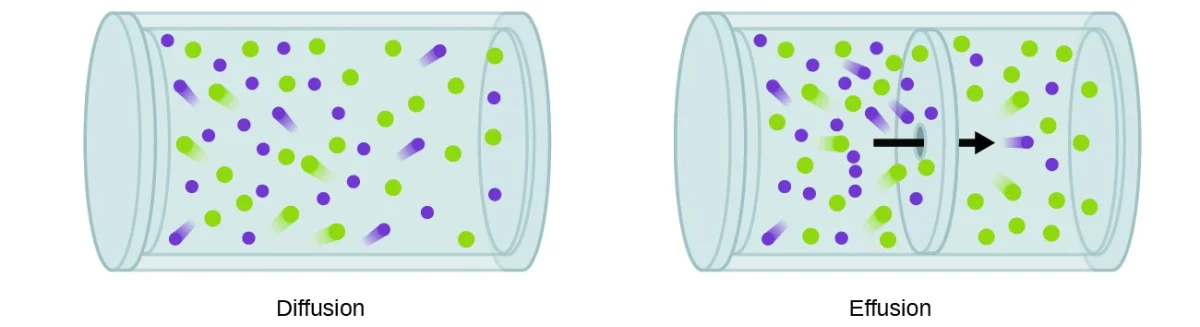
Effusion: Gas molecules escape through a tiny hole (smaller than the mean free path of the gas) into a vacuum. One molecule at a time squeezes through. Think of a pinhole leak in a tire - the air slowly effuses out.
Diffusion: Gas molecules spread through another gas (or into empty space) by random motion. This is what happens when you open a bottle of ammonia and smell it across the room. Diffusion is slower than effusion because molecules collide with other gas molecules along the way.
Graham’s law applies strictly to effusion, but the same mathematical relationship approximately describes relative diffusion rates as well.
Diffusion (left) vs. effusion (right). In diffusion, gas molecules spread through another gas by random motion. In effusion, molecules escape through a tiny hole into a vacuum. Lighter molecules effuse faster. Credit: OpenStax Chemistry 2e, CC BY 4.0
The Law
Why Graham’s Law Works
Graham’s law is a direct consequence of kinetic molecular theory. At the same temperature, all gas molecules have the same average kinetic energy:
KE = 21 mv² = 23 kT
Since KE is the same for both gases at the same temperature:
21 m₁v₁² = 21 m₂v₂²
Solving for the velocity ratio:
v₁/v₂ = sqrt(m₂/m₁) = sqrt(M₂/M₁)
Since the rate of effusion is proportional to molecular speed (faster molecules reach the hole more quickly), Graham’s law follows directly.
Worked Examples
Example 1: How much faster does H2 (M = 2) effuse compared to O2 (M = 32)?
rate(H2)/rate(O2) = sqrt(232) = sqrt(16) = 4
Hydrogen effuses 4 times faster than oxygen.
Example 2: Gas A effuses 3 times faster than Gas B (M = 36). What is the molar mass of Gas A?
rate(A)/rate(B) = sqrt(M(B)/M(A))
3 = sqrt(36/M(A))
9 = 36/M(A)
M(A) = 936 = 4 g/mol (This is helium.)
Applications
Uranium enrichment: The original method for enriching uranium for nuclear fuel used Graham’s law. Natural uranium is mostly U-238, with only 0.7% U-235 (the fissile isotope). UF6 gas containing U-235 effuses slightly faster than UF6 containing U-238. By passing UF6 through thousands of porous barriers, the lighter isotope is gradually concentrated. The separation factor per stage is tiny (sqrt(349352) = 1.004), requiring thousands of stages.
Gas X effuses at twice the rate of SO2 (M = 64). What is the molar mass of Gas X?
Click to reveal answer
16 g/mol. rate(X)/rate(SO2) = sqrt(M(SO2)/M(X)). 2 = sqrt(64/M(X)). Square both sides: 4 = 64/M(X). M(X) = 464 = 16 g/mol. This is consistent with CH4 (methane, M = 16) or O atoms (but O does not exist as a stable monatomic gas). The answer is most likely CH4.
What is the difference between effusion and diffusion?
Click to reveal answer
Effusion is escape through a tiny hole into a vacuum; diffusion is spreading through another gas. Effusion involves molecules passing one at a time through a hole smaller than the mean free path. Diffusion involves molecules spreading out by random motion while colliding with other gas molecules. Effusion is faster because there are no other molecules in the way. Graham's law applies precisely to effusion but approximately to diffusion.
Everything in this chapter so far has assumed ideal gas behavior - no intermolecular forces, no molecular volume, perfectly elastic collisions. But real molecules DO attract each other, and they DO take up space. Under everyday conditions these effects are small enough to ignore, but under extreme conditions - high pressure and low temperature - the ideal gas law breaks down. Understanding when and why is one of the most commonly tested gas phase concepts on the MCAT.
When Do Gases Deviate from Ideal Behavior?
Gases behave LEAST ideally when molecules are close together (so IMFs and volume matter) and moving slowly (so IMFs have time to affect their paths):
Condition
Deviation
Why
High pressure
Large
Molecules are packed close - volume and IMFs become significant
Low temperature
Large
Molecules move slowly - IMFs have greater relative effect
Low pressure
Small
Molecules are far apart - IMFs and volume negligible
High temperature
Small
Molecules move fast - IMFs cannot significantly deflect them
The Two Corrections
The ideal gas law fails for two reasons, each requiring a separate correction:
1. Intermolecular attractions (the “a” correction). Real molecules attract each other (primarily through London dispersion forces). As a molecule approaches a wall to create a collision, other molecules behind it pull it back slightly. This reduces the impact force and lowers the measured pressure below the ideal prediction.
Effect: P(real) < P(ideal) at moderate pressures
Larger molecules and more polarizable molecules have stronger attractions (larger “a” values)
2. Molecular volume (the “b” correction). Real molecules take up physical space. The volume available for molecular motion is less than the total container volume because some space is occupied by the molecules themselves.
Effect: V(available) < V(container)
Larger molecules exclude more volume (larger “b” values)
The Van der Waals Equation
The Compressibility Factor (Z)
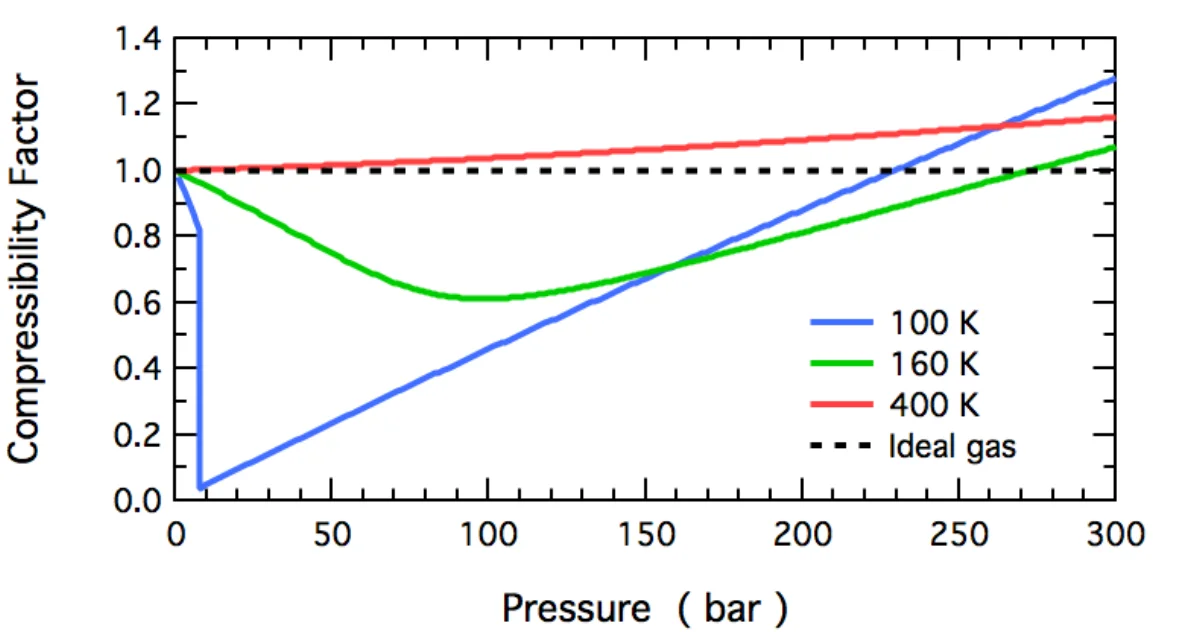
The compressibility factor Z = PV/(nRT) measures how much a real gas deviates from ideal behavior:
Z Value
Meaning
Dominant Effect
Z = 1
Ideal behavior
Neither correction matters
Z < 1
P(real) < P(ideal)
Intermolecular ATTRACTIONS dominate
Z > 1
P(real) > P(ideal)
Molecular VOLUME dominates
The PV/nRT vs. P Graph
This graph is one of the most commonly tested visuals in gas phase chemistry:
At low pressure: Z is close to 1 (near-ideal behavior)
At moderate pressure: Z dips below 1 for most gases (attractions pull molecules together, reducing pressure)
At very high pressure: Z rises above 1 (molecular volume becomes significant - the molecules are crammed so tightly that their physical size matters more than their attractions)
Compressibility factor (Z = PV/nRT) vs. pressure for N₂ at three temperatures. The dashed line at Z = 1 represents ideal gas behavior. At low temperatures, Z dips below 1 (intermolecular attractions dominate) before rising above 1 (molecular volume dominates). At high temperatures, deviations are smaller. Credit: Wikimedia Commons, CC BY-SA 4.0
The dip below 1 is more pronounced for gases with strong intermolecular forces (like water vapor, ammonia, or HCl). Small, nonpolar gases with weak IMFs (like H2 and He) show little to no dip and go above Z = 1 quickly.
Which Gases Deviate Most?
Gases with large, polar molecules deviate most from ideal behavior because they have both strong intermolecular forces (large a) and significant molecular volume (large b). Gases that are close to their condensation point (liquefaction temperature) are also highly non-ideal.
Gas
a (L²·atm/mol²)
b (L/mol)
Deviation Level
He
0.034
0.024
Very small (nearly ideal)
H2
0.244
0.027
Small
N2
1.39
0.039
Moderate
CO2
3.59
0.043
Moderate-large
H2O
5.46
0.031
Large
NH3
4.17
0.037
Large
Noble gases and H2 are the most ideal because they are small and have very weak intermolecular forces.
Conditions for Gas Liquefaction
Real gas behavior is closely connected to liquefaction (condensation). A gas can only be liquefied below its critical temperature - the temperature above which no amount of pressure can force the gas into a liquid phase. Above the critical temperature, the substance is a supercritical fluid that has properties of both liquid and gas.
Under what conditions do gases behave most ideally?
Click to reveal answer
High temperature and low pressure. At high T, molecules move fast and intermolecular forces have minimal effect on their trajectories. At low P, molecules are far apart, so both intermolecular forces and molecular volume are negligible relative to the empty space between molecules. "Hot and spacious = ideal."
In the van der Waals equation, what do the "a" and "b" constants correct for, and what happens to the equation when both are zero?
Click to reveal answer
"a" corrects for intermolecular attractions; "b" corrects for molecular volume. The "a" term (an²/V²) is added to the measured pressure because attractions reduce the measured pressure below the ideal value. The "b" term (nb) is subtracted from the total volume because molecular volume reduces the available free space. When a = 0 and b = 0, the equation simplifies to PV = nRT - the ideal gas law.