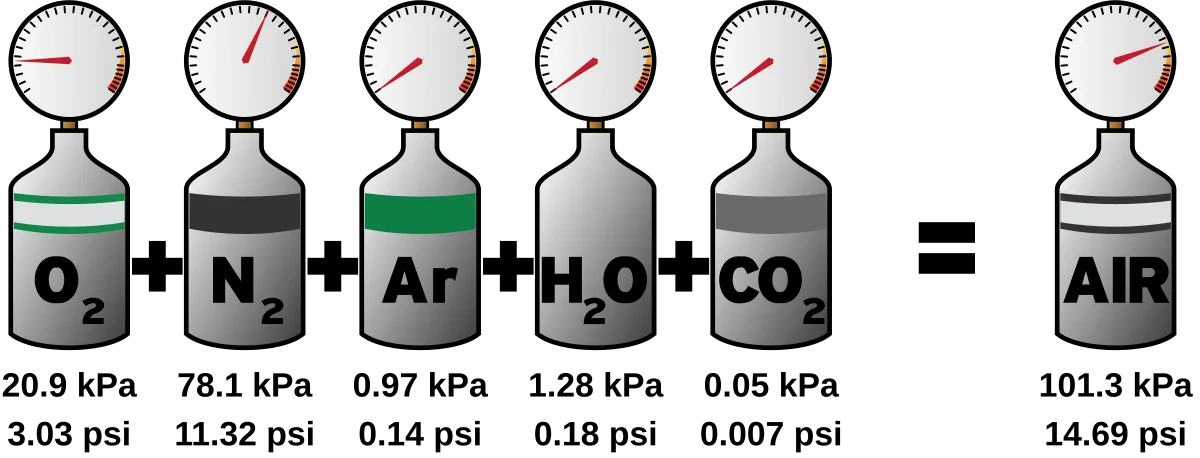
The air you breathe is not a single gas - it is a mixture of nitrogen (78%), oxygen (21%), argon (0.9%), carbon dioxide (0.04%), and trace amounts of other gases. Each gas contributes its own portion of the total atmospheric pressure, completely independent of the others. Dalton’s law tells you exactly how to calculate each gas’s contribution.
The Law
The total pressure of a gas mixture equals the sum of the partial pressures of each individual gas.
Partial Pressure and Mole Fraction
The partial pressure of a gas is the pressure it would exert if it occupied the entire container alone. It is calculated using the mole fraction:
Worked Example
A container holds 2.0 mol of N2 and 1.0 mol of O2 at a total pressure of 3.0 atm. What is the partial pressure of each gas?
Total moles: 2.0 + 1.0 = 3.0 mol
X(N2) = 3.02.0 = 0.667
X(O2) = 3.01.0 = 0.333
P(N2) = 0.667 x 3.0 atm = 2.0 atm
P(O2) = 0.333 x 3.0 atm = 1.0 atm
Check: 2.0 + 1.0 = 3.0 atm. The partial pressures sum to the total.
Collection of Gas Over Water
A classic MCAT application of Dalton’s law is correcting for water vapor when gas is collected by displacing water. When gas bubbles through water and is collected in an inverted container, the collected gas is actually a mixture of the desired gas plus water vapor.
The total pressure of the collected gas equals atmospheric pressure (since the water levels are equalized). But the total pressure includes water vapor:
P(gas) = P(total) - P(water vapor)
The vapor pressure of water at a given temperature is provided in the passage or in a data table. At 25 C, water’s vapor pressure is about 24 mmHg (or 0.031 atm).
Atmospheric Pressure and Partial Pressures
At sea level, P(total) = 1 atm = 760 mmHg. The partial pressures of atmospheric gases:
Gas
Mole Fraction
Partial Pressure (mmHg)
N2
0.78
593
O2
0.21
160
Ar
0.009
7
CO2
0.0004
0.3
Dalton's law illustrated with atmospheric gases. Each gas contributes its own partial pressure to the total atmospheric pressure of 101.3 kPa (1 atm). Credit: Wikimedia Commons, CC BY-SA 4.0
Oxygen gas is collected over water at 25 C and a total pressure of 760 mmHg. The vapor pressure of water at 25 C is 24 mmHg. What is the partial pressure of the dry O2?
Click to reveal answer
736 mmHg. P(O2) = P(total) - P(H2O) = 760 - 24 = 736 mmHg. The collected gas is a mixture of O2 and water vapor. To find the pressure due to O2 alone, subtract the vapor pressure of water from the total. Always subtract water vapor when gas is collected over water.
A gas mixture contains 3 mol He, 2 mol Ne, and 5 mol Ar at a total pressure of 10 atm. What is the partial pressure of Ne?
Click to reveal answer
2 atm. X(Ne) = 2/(3+2+5) = 102 = 0.20. P(Ne) = X(Ne) x P(total) = 0.20 x 10 atm = 2 atm. The mole fraction tells you what fraction of the total pressure is contributed by each gas.