
Real Gases
Everything in this chapter so far has assumed ideal gas behavior - no intermolecular forces, no molecular volume, perfectly elastic collisions. But real molecules DO attract each other, and they DO take up space. Under everyday conditions these effects are small enough to ignore, but under extreme conditions - high pressure and low temperature - the ideal gas law breaks down. Understanding when and why is one of the most commonly tested gas phase concepts on the MCAT.
When Do Gases Deviate from Ideal Behavior?
Gases behave LEAST ideally when molecules are close together (so IMFs and volume matter) and moving slowly (so IMFs have time to affect their paths):
| Condition | Deviation | Why |
|---|---|---|
| High pressure | Large | Molecules are packed close - volume and IMFs become significant |
| Low temperature | Large | Molecules move slowly - IMFs have greater relative effect |
| Low pressure | Small | Molecules are far apart - IMFs and volume negligible |
| High temperature | Small | Molecules move fast - IMFs cannot significantly deflect them |
The Two Corrections
The ideal gas law fails for two reasons, each requiring a separate correction:
1. Intermolecular attractions (the “a” correction). Real molecules attract each other (primarily through London dispersion forces). As a molecule approaches a wall to create a collision, other molecules behind it pull it back slightly. This reduces the impact force and lowers the measured pressure below the ideal prediction.
- Effect: P(real) < P(ideal) at moderate pressures
- Larger molecules and more polarizable molecules have stronger attractions (larger “a” values)
2. Molecular volume (the “b” correction). Real molecules take up physical space. The volume available for molecular motion is less than the total container volume because some space is occupied by the molecules themselves.
- Effect: V(available) < V(container)
- Larger molecules exclude more volume (larger “b” values)
The Van der Waals Equation
The Compressibility Factor (Z)
The compressibility factor Z = PV/(nRT) measures how much a real gas deviates from ideal behavior:
| Z Value | Meaning | Dominant Effect |
|---|---|---|
| Z = 1 | Ideal behavior | Neither correction matters |
| Z < 1 | P(real) < P(ideal) | Intermolecular ATTRACTIONS dominate |
| Z > 1 | P(real) > P(ideal) | Molecular VOLUME dominates |
The PV/nRT vs. P Graph
This graph is one of the most commonly tested visuals in gas phase chemistry:
- At low pressure: Z is close to 1 (near-ideal behavior)
- At moderate pressure: Z dips below 1 for most gases (attractions pull molecules together, reducing pressure)
- At very high pressure: Z rises above 1 (molecular volume becomes significant - the molecules are crammed so tightly that their physical size matters more than their attractions)
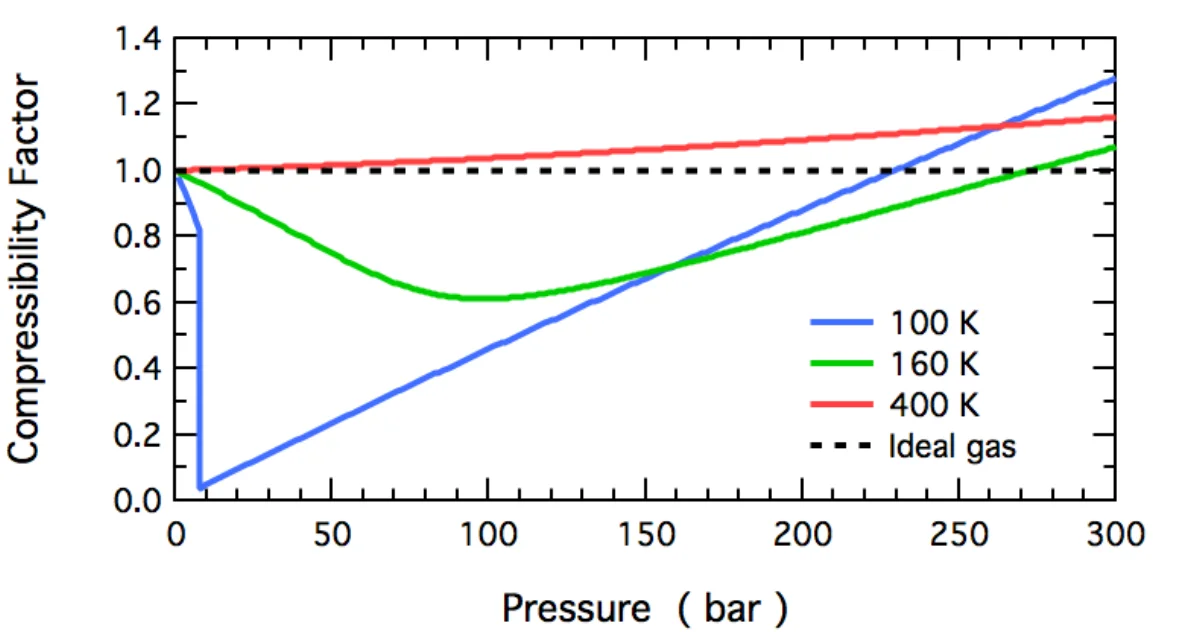
The dip below 1 is more pronounced for gases with strong intermolecular forces (like water vapor, ammonia, or HCl). Small, nonpolar gases with weak IMFs (like H2 and He) show little to no dip and go above Z = 1 quickly.
Which Gases Deviate Most?
Gases with large, polar molecules deviate most from ideal behavior because they have both strong intermolecular forces (large a) and significant molecular volume (large b). Gases that are close to their condensation point (liquefaction temperature) are also highly non-ideal.
| Gas | a (L²·atm/mol²) | b (L/mol) | Deviation Level |
|---|---|---|---|
| He | 0.034 | 0.024 | Very small (nearly ideal) |
| H2 | 0.244 | 0.027 | Small |
| N2 | 1.39 | 0.039 | Moderate |
| CO2 | 3.59 | 0.043 | Moderate-large |
| H2O | 5.46 | 0.031 | Large |
| NH3 | 4.17 | 0.037 | Large |
Noble gases and H2 are the most ideal because they are small and have very weak intermolecular forces.
Conditions for Gas Liquefaction
Real gas behavior is closely connected to liquefaction (condensation). A gas can only be liquefied below its critical temperature - the temperature above which no amount of pressure can force the gas into a liquid phase. Above the critical temperature, the substance is a supercritical fluid that has properties of both liquid and gas.