Blow air into a balloon and it gets bigger. Every puff adds more gas molecules, and the balloon expands to accommodate them. Avogadro’s law quantifies this intuition: more molecules means more volume, in a direct one-to-one proportion.
The Law
At constant temperature and pressure, volume is directly proportional to the number of moles of gas.
Avogadro’s Hypothesis
Avogadro proposed that equal volumes of gases at the same temperature and pressure contain equal numbers of molecules. This was revolutionary because it meant that gas volume is determined by particle count, not particle identity or size.
This hypothesis directly leads to the concept of molar volume: at STP, one mole of any ideal gas occupies 22.4 L, regardless of what gas it is.
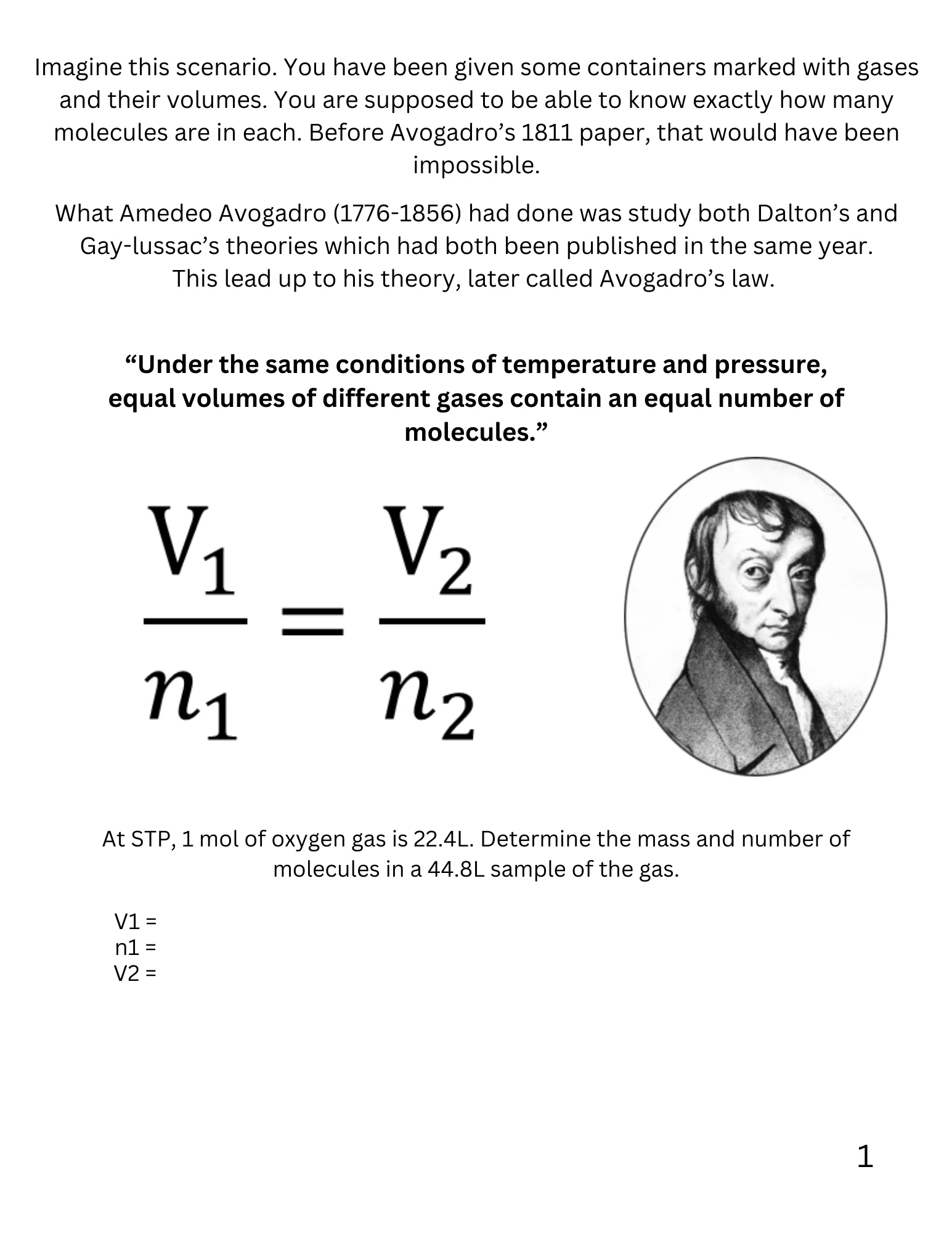
Avogadro's law: at constant temperature and pressure, equal volumes of any gas contain the same number of molecules. Doubling the moles of gas doubles the volume, regardless of the gas's identity. Credit: Wikimedia Commons, CC0
Gas Stoichiometry Connection
Avogadro’s law is the bridge between gas law calculations and chemical stoichiometry. Because volume is proportional to moles (at constant T and P), you can use volume ratios directly as mole ratios in balanced equations.
Example: In the reaction N2 + 3H2 → 2NH3, if all gases are at the same temperature and pressure:
1 volume of N2 reacts with 3 volumes of H2 to produce 2 volumes of NH3
10 L of N2 requires 30 L of H2 and produces 20 L of NH3
This only works when all species are gases at the same conditions. If a reactant or product is a liquid or solid, you must use moles (not volumes).
The Four Gas Laws Summary
Law
Variables
Relationship
Constant
Equation
Boyle’s
P, V
Inverse
T, n
P₁V₁ = P₂V₂
Charles’s
V, T
Direct
P, n
V₁/T₁ = V₂/T₂
Gay-Lussac’s
P, T
Direct
V, n
P₁/T₁ = P₂/T₂
Avogadro’s
V, n
Direct
T, P
V₁/n₁ = V₂/n₂
At constant temperature and pressure, a container holds 2.0 mol of gas at 44.8 L. If 1.0 mol of gas is added, what is the new volume?
Click to reveal answer
67.2 L. V₁/n₁ = V₂/n₂. 44.8 L / 2.0 mol = V₂ / 3.0 mol. V₂ = 44.8 x (2.03.0) = 67.2 L. Adding 50% more moles increases the volume by 50%. Note that 44.8 L / 2 mol = 22.4 L/mol, confirming this is at STP.
In the reaction 2CO + O2 → 2CO2 at constant T and P, if 10 L of CO is used, what volume of O2 is needed and what volume of CO2 is produced?
Click to reveal answer
5 L of O2 needed; 10 L of CO2 produced. By Avogadro's law, volume ratios equal mole ratios at constant T and P. The balanced equation shows 2:1:2 for CO:O2:CO2. So 10 L CO requires 210 = 5 L O2, and produces 10 L CO2. This shortcut only works when all species are gases at the same conditions.