Open a bottle of perfume across the room and you smell it within seconds. Release a bottle of heavy cologne next to it and the lighter perfume molecules reach your nose first. Lighter molecules travel faster, so they spread through a room and escape through tiny openings more quickly. Graham’s law quantifies exactly how much faster.
Effusion vs. Diffusion
These terms are often confused but describe different processes:
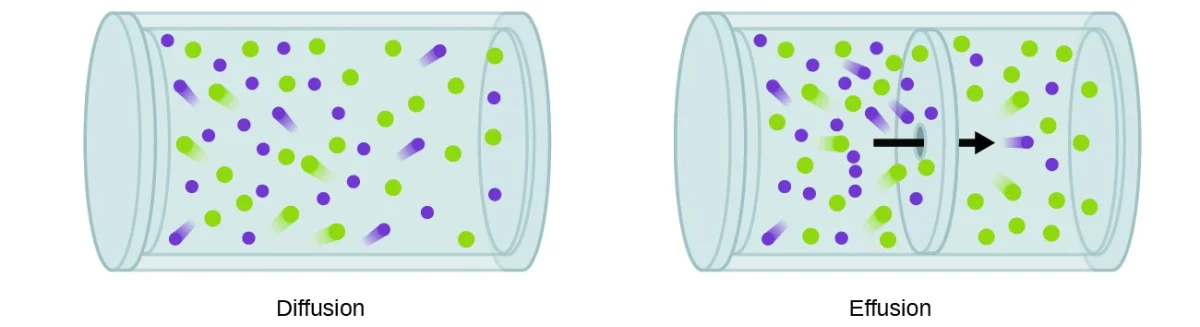
Effusion: Gas molecules escape through a tiny hole (smaller than the mean free path of the gas) into a vacuum. One molecule at a time squeezes through. Think of a pinhole leak in a tire - the air slowly effuses out.
Diffusion: Gas molecules spread through another gas (or into empty space) by random motion. This is what happens when you open a bottle of ammonia and smell it across the room. Diffusion is slower than effusion because molecules collide with other gas molecules along the way.
Graham’s law applies strictly to effusion, but the same mathematical relationship approximately describes relative diffusion rates as well.
Diffusion (left) vs. effusion (right). In diffusion, gas molecules spread through another gas by random motion. In effusion, molecules escape through a tiny hole into a vacuum. Lighter molecules effuse faster. Credit: OpenStax Chemistry 2e, CC BY 4.0
The Law
Why Graham’s Law Works
Graham’s law is a direct consequence of kinetic molecular theory. At the same temperature, all gas molecules have the same average kinetic energy:
KE = 21 mv² = 23 kT
Since KE is the same for both gases at the same temperature:
21 m₁v₁² = 21 m₂v₂²
Solving for the velocity ratio:
v₁/v₂ = sqrt(m₂/m₁) = sqrt(M₂/M₁)
Since the rate of effusion is proportional to molecular speed (faster molecules reach the hole more quickly), Graham’s law follows directly.
Worked Examples
Example 1: How much faster does H2 (M = 2) effuse compared to O2 (M = 32)?
rate(H2)/rate(O2) = sqrt(232) = sqrt(16) = 4
Hydrogen effuses 4 times faster than oxygen.
Example 2: Gas A effuses 3 times faster than Gas B (M = 36). What is the molar mass of Gas A?
rate(A)/rate(B) = sqrt(M(B)/M(A))
3 = sqrt(36/M(A))
9 = 36/M(A)
M(A) = 936 = 4 g/mol (This is helium.)
Applications
Uranium enrichment: The original method for enriching uranium for nuclear fuel used Graham’s law. Natural uranium is mostly U-238, with only 0.7% U-235 (the fissile isotope). UF6 gas containing U-235 effuses slightly faster than UF6 containing U-238. By passing UF6 through thousands of porous barriers, the lighter isotope is gradually concentrated. The separation factor per stage is tiny (sqrt(349352) = 1.004), requiring thousands of stages.
Gas X effuses at twice the rate of SO2 (M = 64). What is the molar mass of Gas X?
Click to reveal answer
16 g/mol. rate(X)/rate(SO2) = sqrt(M(SO2)/M(X)). 2 = sqrt(64/M(X)). Square both sides: 4 = 64/M(X). M(X) = 464 = 16 g/mol. This is consistent with CH4 (methane, M = 16) or O atoms (but O does not exist as a stable monatomic gas). The answer is most likely CH4.
What is the difference between effusion and diffusion?
Click to reveal answer
Effusion is escape through a tiny hole into a vacuum; diffusion is spreading through another gas. Effusion involves molecules passing one at a time through a hole smaller than the mean free path. Diffusion involves molecules spreading out by random motion while colliding with other gas molecules. Effusion is faster because there are no other molecules in the way. Graham's law applies precisely to effusion but approximately to diffusion.