
The Ideal Gas Law
All four individual gas laws are just special cases of one master equation. The ideal gas law combines Boyle’s, Charles’s, Gay-Lussac’s, and Avogadro’s laws into a single relationship that describes how any ideal gas behaves under any conditions. This is the most important equation in the entire gas phase chapter.
The Equation
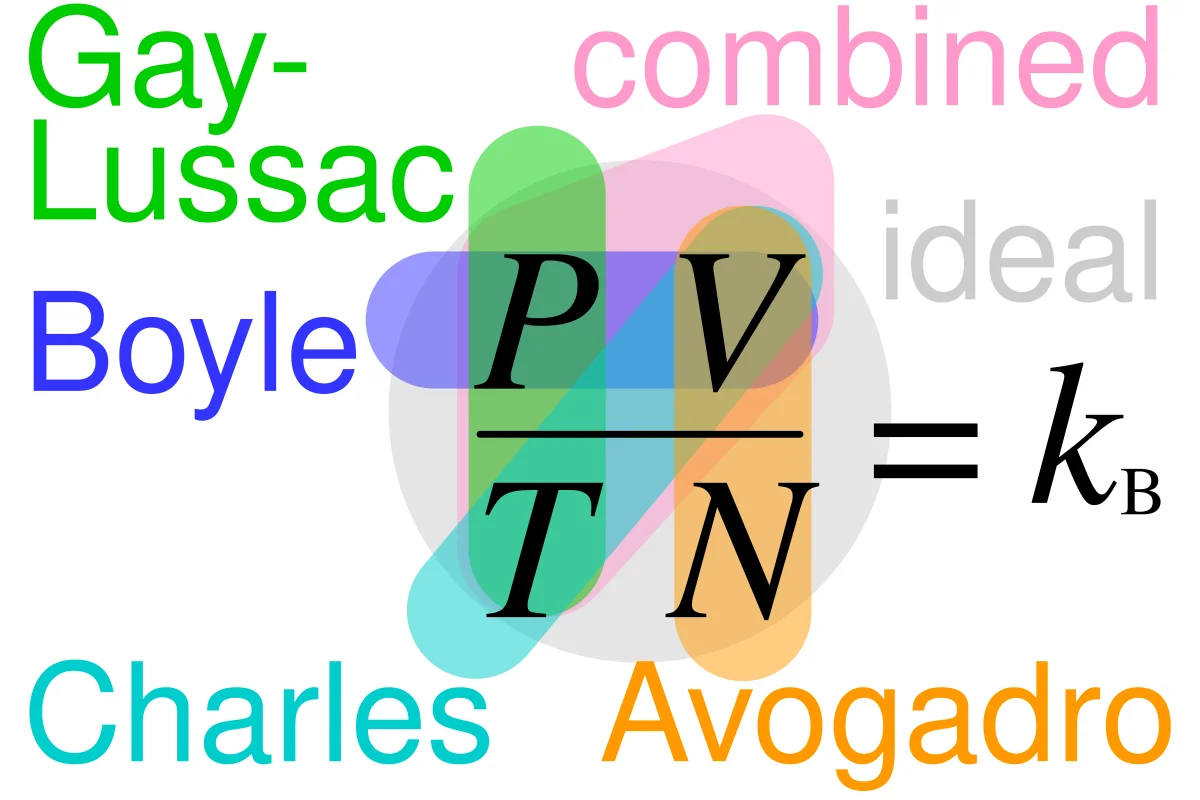
The Gas Constant R
The value of R depends on the units you are using:
| R Value | Units | When to Use |
|---|---|---|
| 0.0821 | L·atm/(mol·K) | When P is in atm and V is in L (most common on MCAT) |
| 8.314 | J/(mol·K) | When working with energy (thermodynamics, kinetics) |
| 62.36 | L·torr/(mol·K) | When P is in torr (rarely needed) |
For gas law problems, use R = 0.0821 almost every time. The value R = 8.314 J/(mol·K) shows up in thermodynamics equations like ΔG = ΔG° + RTlnQ and the Arrhenius equation.
Assumptions of the Ideal Gas Model
The ideal gas law works perfectly only for an “ideal” gas - a theoretical gas that:
- Has no intermolecular forces. Molecules do not attract or repel each other.
- Has no molecular volume. Molecules are treated as dimensionless points.
- Undergoes perfectly elastic collisions. No kinetic energy is lost when molecules collide.
No real gas is truly ideal, but most gases behave nearly ideally at high temperatures and low pressures (when molecules are far apart and moving fast). We will revisit when this model breaks down in Section 8.12 on real gases.
Calculating Molar Mass from Gas Data
The ideal gas law lets you determine the molar mass of an unknown gas. Start with PV = nRT and substitute n = mass/molar mass:
PV = (m/M)RT
Rearranging:
M = mRT / (PV)
Or, since density d = m/V:
Gas Density
From d = PM/(RT), you can see that:
- Heavier gases are denser (higher M = higher d). CO2 (M = 44) is denser than N2 (M = 28), which is why CO2 sinks and accumulates in low areas.
- Higher pressure increases density (compressing gas into less space).
- Higher temperature decreases density (molecules spread out). This is why hot air rises - it is less dense than the surrounding cooler air.
Worked Example
What volume does 2.0 mol of an ideal gas occupy at 546 K and 2.0 atm?
PV = nRT
V = nRT/P = (2.0 mol)(0.0821 L·atm/mol·K)(546 K) / (2.0 atm)
V = (2.0)(0.0821)(546) / 2.0
Estimate: 0.0821 x 546 is roughly 0.08 x 550 = 44. Then 2 x 44 / 2 = 44.8 L
Notice: 2 mol at STP would be 44.8 L. This gas is at double the temperature (546 vs. 273) and double the pressure (2 vs. 1) compared to STP. The temperature doubles the volume (Charles’s law), but the pressure halves it (Boyle’s law). The two effects cancel, giving the same 44.8 L. Proportional reasoning confirms the algebra.