Squeeze a balloon and it gets smaller. Let go and it springs back. You have been demonstrating Boyle’s law since childhood - you just did not know it had a name.
The Law
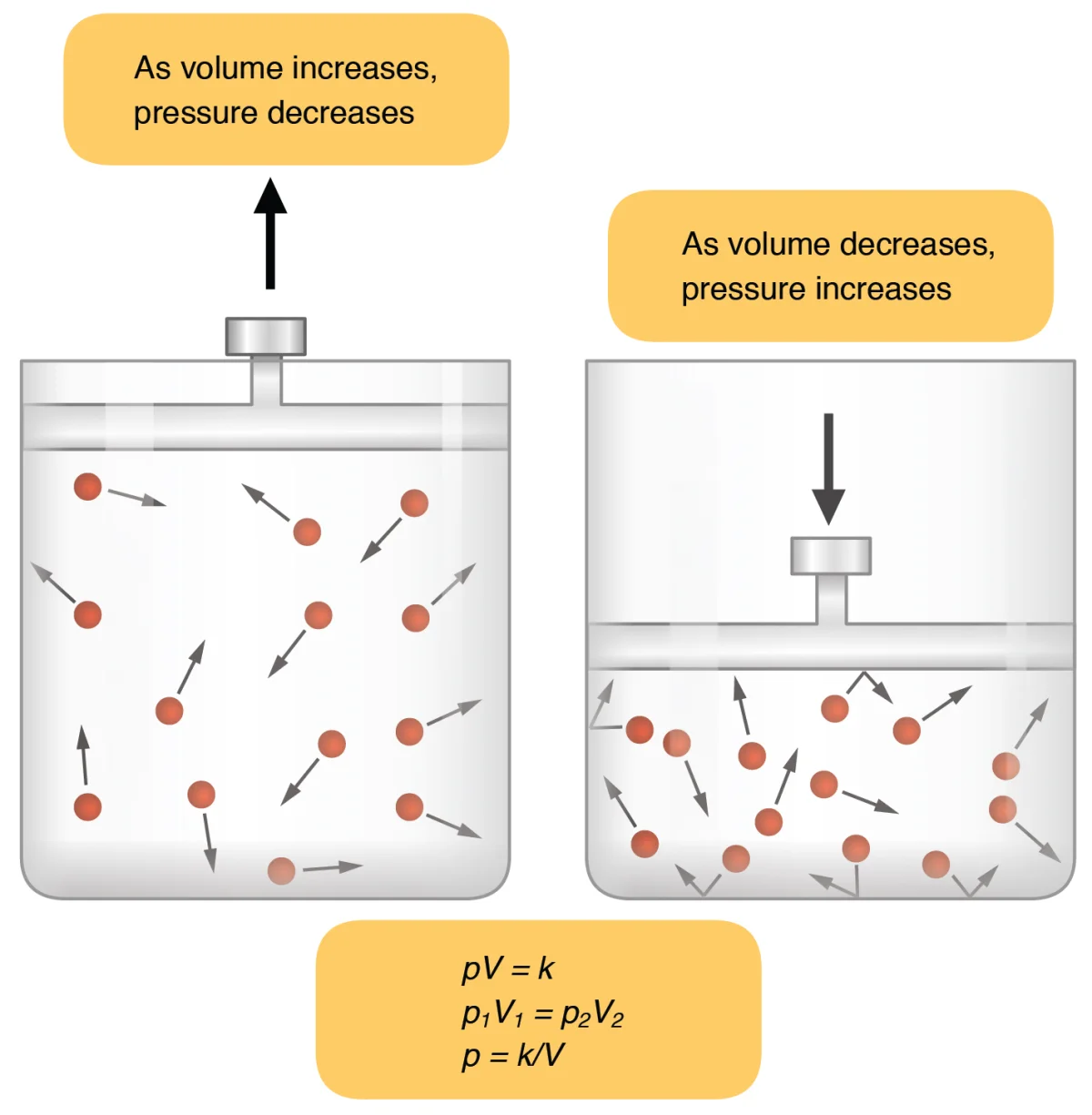
At constant temperature and constant amount of gas, pressure and volume are inversely proportional.
Boyle's law demonstrated with a piston: increasing volume decreases pressure (left), and decreasing volume increases pressure (right). The number of gas molecules stays the same. Credit: OpenStax Anatomy and Physiology, CC BY 3.0
The Graph
A plot of P vs. V at constant temperature produces a hyperbola - a smooth curve that approaches both axes but never touches them. Each curve is called an isotherm (constant temperature line). Higher temperatures produce isotherms that are farther from the origin.
A plot of P vs. 1/V produces a straight line through the origin with slope = nRT. This linear form is useful for confirming Boyle’s law behavior from experimental data.
Why It Works (Molecular Level)
When you compress a gas (decrease volume), the same number of molecules now occupy a smaller space. They hit the container walls more frequently because there is less distance to travel between collisions. More collisions per second per unit area = higher pressure.
Breathing Is Boyle’s Law
Every breath you take is a demonstration of Boyle’s law:
Inhalation: Your diaphragm contracts and moves downward, increasing the volume of your thoracic cavity. By Boyle’s law, the increased volume causes the pressure inside your lungs to drop below atmospheric pressure. Air rushes in from high pressure (outside) to low pressure (inside).
Exhalation: Your diaphragm relaxes and moves upward, decreasing thoracic volume. Pressure inside the lungs rises above atmospheric pressure, and air is pushed out.
Worked Example
A gas occupies 6.0 L at 2.0 atm. What volume will it occupy at 4.0 atm (constant temperature)?
P₁V₁ = P₂V₂
(2.0 atm)(6.0 L) = (4.0 atm)(V₂)
V₂ = 12.0 / 4.0 = 3.0 L
The pressure doubled, so the volume halved. This proportional reasoning is faster than the algebra and is how the MCAT expects you to think.
A sealed syringe contains 10 mL of gas at 1 atm. If the plunger is pushed in until the volume is 2 mL, what is the new pressure (assuming constant temperature)?
Click to reveal answer
5 atm. P₁V₁ = P₂V₂. (1 atm)(10 mL) = P₂(2 mL). P₂ = 210 = 5 atm. Volume decreased by a factor of 5, so pressure increased by a factor of 5. This is the inverse relationship of Boyle's law in action.
During inhalation, what happens to the volume and pressure inside the lungs, and which gas law explains this?
Click to reveal answer
Volume increases and pressure decreases - explained by Boyle's law. The diaphragm contracts and moves down, increasing thoracic volume. By Boyle's law (P ∝ 1/V at constant T), the increased volume causes intrapulmonary pressure to drop below atmospheric pressure. Air flows in from high pressure (outside) to low pressure (lungs).