Watch a hot air balloon on a cool morning. The pilot fires the burner, the air inside heats up, the balloon swells, and it lifts off the ground. Cool the air and the balloon sinks. This is Charles’s law - the direct relationship between gas volume and temperature.
A hot air balloon in flight. The pilot heats the air inside the envelope, causing it to expand (Charles's law). The expanded air is less dense than the cooler surrounding air, generating lift. Credit: Wikimedia Commons, CC BY-SA 4.0
The Law
At constant pressure and constant amount of gas, volume and temperature are directly proportional.
The Graph
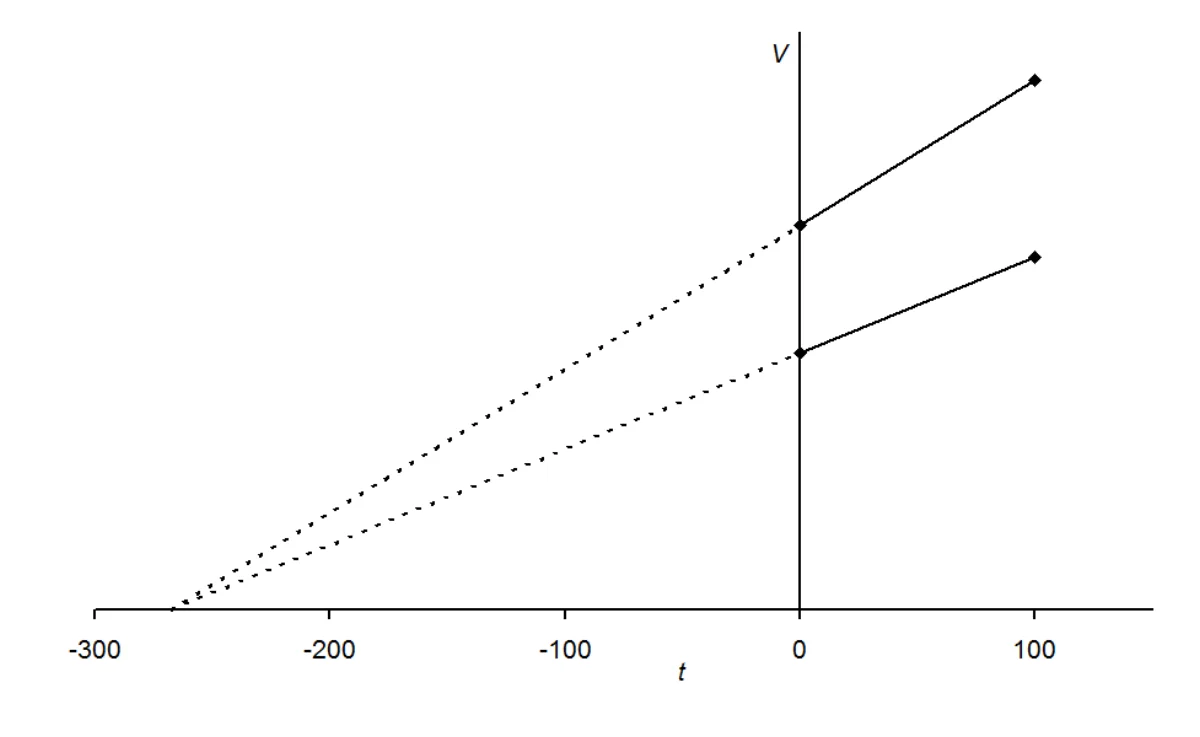
A plot of V vs. T (in Kelvin) produces a straight line that, when extrapolated, passes through the origin (0 K, 0 L). This is one of the key pieces of evidence for the existence of absolute zero - the temperature at which an ideal gas would theoretically have zero volume.
Volume vs. temperature graph for two gas samples. Both lines extrapolate to zero volume at -273 C (absolute zero). The dashed lines show extrapolation beyond the range where the gas would liquefy. Credit: Wikimedia Commons, CC BY-SA 3.0
A plot of V vs. T in Celsius also produces a straight line, but it crosses the x-axis at -273 C rather than at zero. This is why Kelvin is essential for gas law calculations - it is the only temperature scale where the proportionality V ∝ T holds true.
Why It Works (Molecular Level)
When you heat a gas at constant pressure, the molecules gain kinetic energy and move faster. They hit the container walls harder and more often. If the container can expand (constant pressure means the walls can move), the gas pushes outward until the increased molecular speed is balanced by the larger volume. The net result: the gas takes up more space at higher temperatures.
Absolute Zero and the Kelvin Scale
If you extrapolate the V vs. T line all the way down, it hits zero volume at -273.15 C. This is absolute zero (0 K) - the theoretical temperature at which gas molecules would have zero kinetic energy and occupy zero volume.
In reality, all gases liquefy before reaching absolute zero, so you never actually get zero volume. But the extrapolation demonstrates why the Kelvin scale exists and why gas law calculations require it.
Worked Example
A gas occupies 3.0 L at 300 K. What volume will it occupy at 600 K (constant pressure)?
V₁/T₁ = V₂/T₂
3.0 L / 300 K = V₂ / 600 K
V₂ = 3.0 x (300600) = 6.0 L
Temperature doubled, so volume doubled. Direct proportionality makes this straightforward.
A balloon has a volume of 2.0 L at 200 K. What is its volume at 400 K, assuming constant pressure?
Click to reveal answer
4.0 L. V₁/T₁ = V₂/T₂. Temperature doubled (200 K to 400 K), so volume doubles (2.0 L to 4.0 L). Charles's law is a direct proportion - V and T change by the same factor.
Why does Charles's law require temperature in Kelvin rather than Celsius?
Click to reveal answer
Because the proportionality V ∝ T only holds on the Kelvin scale. On the Celsius scale, the V vs. T line does not pass through the origin (it crosses at -273 C). Using Celsius would break the direct proportionality and give incorrect results. The Kelvin scale starts at absolute zero, making V/T = constant mathematically valid.