
Characteristics of Gases
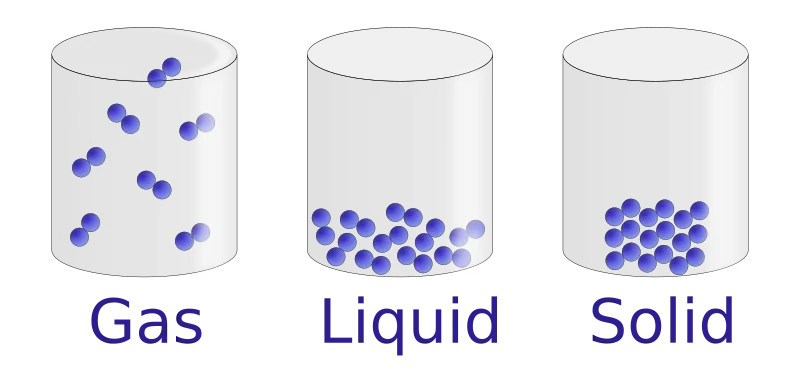
Gases are the simplest state of matter to model mathematically, and that simplicity is what makes this chapter so high-yield on the MCAT. Before diving into the gas laws, you need to understand the four defining characteristics that set gases apart from liquids and solids - and why those characteristics exist at the molecular level.
The Four Key Properties
1. Compressibility. Gases can be squeezed into a much smaller volume. A scuba tank holds the equivalent of thousands of liters of air compressed into a small metal cylinder. This works because gas molecules are far apart with mostly empty space between them. Push them closer together and the gas takes up less volume. Liquids and solids are nearly incompressible because their molecules are already touching.
2. Expansion to fill the container. Release perfume in one corner of a room and eventually you smell it everywhere. Gas molecules have no fixed volume or shape - they expand to uniformly fill whatever container they occupy. This happens because gas molecules are in constant random motion with enough kinetic energy to overcome any intermolecular attractions.
3. Low density. Gases are roughly 1,000 times less dense than liquids or solids of the same substance. Air at sea level has a density of about 1.2 g/L, while liquid water is 1,000 g/L. The vast empty space between gas molecules means very little mass per unit volume.
4. Diffusion and mixing. Gases mix completely and spontaneously with other gases. Open a container of ammonia and a container of hydrochloric acid at opposite ends of a bench, and a white cloud of ammonium chloride forms in the middle as the gases diffuse toward each other. There are no boundaries or layers - gases are perfectly miscible in all proportions.
Why These Properties Exist
All four properties trace back to one molecular-level fact: gas molecules are very far apart relative to their size. At standard conditions, the average distance between gas molecules is roughly 10 times the molecular diameter. This means the gas is about 99.9% empty space.
Because the molecules are so far apart, intermolecular forces (London dispersion, dipole-dipole, hydrogen bonding) are negligible. Each molecule moves independently, in a straight line, until it collides with another molecule or the container wall. This independence is what makes gas behavior so mathematically predictable.
| Property | Solid | Liquid | Gas |
|---|---|---|---|
| Shape | Fixed | Takes container shape | Fills container |
| Volume | Fixed | Fixed | Fills container |
| Compressibility | Nearly zero | Very low | High |
| Density | High | High | Low (~ of liquid) |
| Molecular motion | Vibration only | Slide past neighbors | Free, random motion |
| Intermolecular forces | Strong | Moderate | Negligible |
Pressure - How Gases Push Back
Gas molecules constantly slam into the walls of their container. Each collision exerts a tiny force on the wall. Add up billions of collisions per second across every square centimeter of wall, and you get a measurable macroscopic pressure.
Unit conversions you must know:
| Unit | Equivalence |
|---|---|
| 1 atm | 760 mmHg = 760 torr |
| 1 atm | 101,325 Pa = 101.325 kPa |
| 1 bar | 100,000 Pa (close to 1 atm) |
Temperature and Kinetic Energy
Temperature is directly proportional to the average kinetic energy of gas molecules. Higher temperature means faster-moving molecules, which means harder and more frequent collisions with container walls, which means higher pressure (if volume is constant).
Critical rule: Gas law calculations ALWAYS require temperature in Kelvin. Celsius and Fahrenheit will give you wrong answers. Convert using:
K = C + 273 (or more precisely, + 273.15)
Zero Kelvin (absolute zero) is the temperature at which molecular motion theoretically stops. You cannot have a negative Kelvin temperature, which is why the Kelvin scale makes gas law math work.