Before you can understand how atoms bond, you need to understand where electrons live. Electrons do not orbit the nucleus like planets around the sun. They exist in regions of probability called orbitals - three-dimensional shapes that tell you where an electron is most likely to be found. The shape of an orbital determines how it can overlap with orbitals on neighboring atoms, and that overlap is what creates chemical bonds.
Think of an orbital as a room in a house. The shape of the room determines what furniture you can fit inside and how you can connect it to the room next door. A round room connects differently than a long, narrow room. In the same way, a spherical s orbital overlaps with its neighbors differently than a dumbbell-shaped p orbital. Understanding these shapes is the first step to understanding organic bonding.
s Orbitals
s orbitals are spherical. The electron density is distributed equally in all directions around the nucleus. Every energy level (n = 1, 2, 3, …) has exactly one s orbital.
The key properties of s orbitals for organic chemistry:
Shape: Sphere centered on the nucleus
Number per shell: 1
Maximum electrons: 2 (one spin-up, one spin-down)
Directional preference: None - s orbitals have no preferred direction, which means they can overlap with a neighboring orbital along any axis
As the principal quantum number n increases, s orbitals get larger. A 2s orbital is bigger than a 1s orbital, and a 3s orbital is bigger still. Larger orbitals mean the electron is, on average, farther from the nucleus.
Higher-energy s orbitals also develop radial nodes - spherical shells within the orbital where the probability of finding the electron drops to exactly zero. The 1s has zero radial nodes, the 2s has one, and the 3s has two. The general formula is: radial nodes = n - l - 1.
p Orbitals
p orbitals are dumbbell-shaped, with two lobes on opposite sides of the nucleus separated by a nodal plane. Each p orbital has one angular node - a flat plane passing through the nucleus where the electron will never be found.
Starting at n = 2, every energy level has three p orbitals oriented along the three spatial axes: px, py, and pz. These three orbitals are identical in shape and energy but point in different directions.
The directional nature of p orbitals is crucial for organic chemistry. When a p orbital on one atom lines up with a p orbital on a neighboring atom, the side-by-side overlap creates a pi bond. When a p orbital points directly at a neighbor, the head-on overlap creates a sigma bond. The orientation matters.
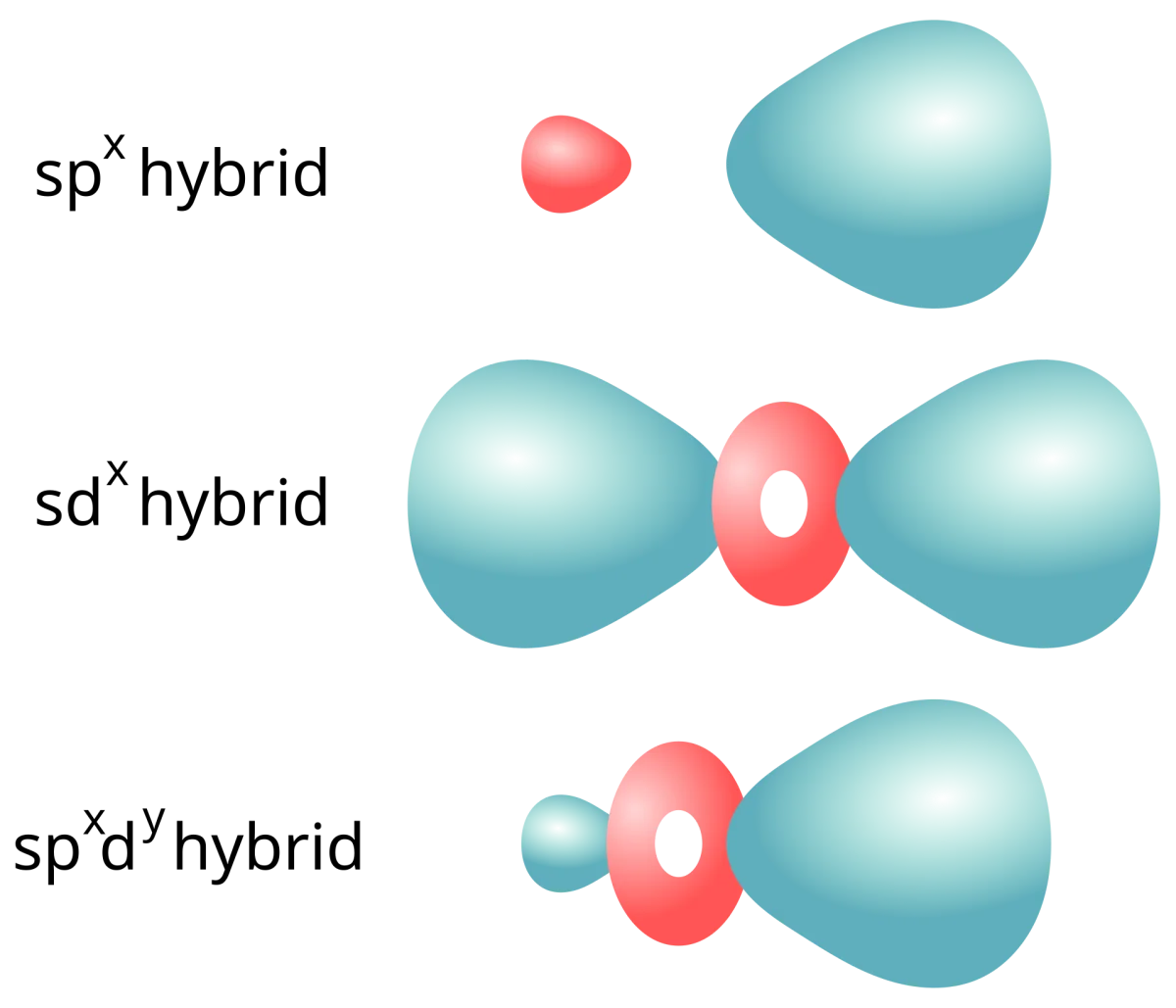
In organic molecules, the s and p atomic orbitals rarely stay "pure" — they mix to form hybrid orbitals. The sp³, sp², and sp hybrids shown here are built directly from the spherical s orbital and the dumbbell-shaped p orbitals, and they are what carbon actually uses to bond. d orbitals matter for transition metals and hypervalent atoms but rarely appear in second-row organic chemistry. Credit: Wikimedia Commons, CC BY-SA
d Orbitals
d orbitals have more complex cloverleaf shapes, with four lobes in most cases. They first appear at n = 3, and there are five d orbitals per shell, holding up to 10 electrons.
For organic chemistry on the MCAT, d orbitals matter in two contexts:
Expanded octets: Elements in the third row and below (like sulfur and phosphorus) have accessible d orbitals, which allows them to form more than four bonds. This is why sulfur in SF6 has six bonds - it uses d orbitals.
Molecular orbital theory: When you construct MO diagrams, d orbitals can participate in bonding for heavier atoms.
You do not need to draw d orbital shapes on the MCAT. What matters is knowing they exist, they start at n = 3, there are five of them, and they enable expanded octets for third-row elements.
f Orbitals
f orbitals are the most complex, with seven per shell starting at n = 4. They hold up to 14 electrons and are relevant to the lanthanides and actinides. The MCAT does not test f orbital shapes. Know they exist and move on.
Nodes - Where Electrons Cannot Be
A node is a region where the probability of finding an electron is exactly zero. There are two types:
Radial (spherical) nodes: Spherical shells within the orbital where electron density drops to zero. A 2s orbital has one radial node - imagine a hollow sphere inside the larger sphere of electron density.
Angular (planar) nodes: Flat planes or conical surfaces through the nucleus. A p orbital has one angular node (the plane between its two lobes). d orbitals have two angular nodes.
The formulas you need:
Formula
Value
Total nodes
n - 1
Angular nodes
l
Radial nodes
n - l - 1
For a 3p orbital: total nodes = 3 - 1 = 2, angular nodes = 1, radial nodes = 2 - 1 = 1.
Why Orbital Shapes Matter in Organic Chemistry
In general chemistry, you learned orbital shapes to understand electron configurations. In organic chemistry, orbital shapes matter for a different reason: they determine how bonds form.
s + s overlap creates sigma bonds in H2.
s + p overlap creates sigma bonds in molecules like HF.
p + p head-on overlap creates sigma bonds between carbon atoms.
p + p side-by-side overlap creates pi bonds in double and triple bonds.
Hybrid orbitals (sp3, sp2, sp) are mixtures of s and p orbitals with shapes designed for specific molecular geometries.
Every bond you will encounter in organic chemistry traces back to the overlap of atomic or hybrid orbitals. The rest of this chapter builds on this foundation.
Orbital Shape Summary
Orbital
l
Shape
Number per shell
Max electrons
First appears
s
0
Sphere
1
2
n = 1
p
1
Dumbbell
3
6
n = 2
d
2
Cloverleaf
5
10
n = 3
f
3
Complex
7
14
n = 4
A carbon atom forms a double bond with another carbon. What types of orbitals overlap to form the pi bond in this double bond?
Click to reveal answer
Two unhybridized p orbitals overlap side-by-side. In a C=C double bond, each carbon is sp2 hybridized. The three sp2 hybrids form sigma bonds. The one remaining unhybridized p orbital on each carbon is perpendicular to the plane of the sp2 hybrids. These two p orbitals overlap laterally (side-by-side) to form the pi bond.
How many total nodes, angular nodes, and radial nodes does a 4p orbital have?
Click to reveal answer
Total nodes = 3, angular nodes = 1, radial nodes = 2. Total = n - 1 = 4 - 1 = 3. Angular = l = 1 (for p orbitals). Radial = n - l - 1 = 4 - 1 - 1 = 2.
In the last section, you learned about atomic orbitals - the rooms where electrons live in isolated atoms. But organic chemistry is not about isolated atoms. It is about atoms bonded together. What happens to those atomic orbitals when two atoms approach each other and their electron clouds start to overlap?
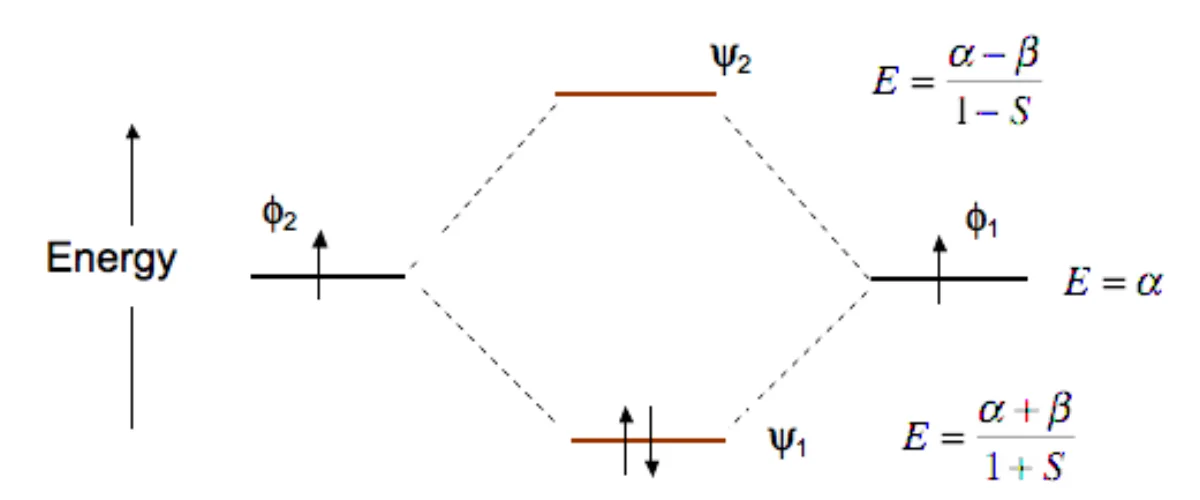
Molecular orbital (MO) theory gives the answer. When two atomic orbitals combine, they do not simply coexist. They merge into new orbitals that belong to the entire molecule. And here is the critical part: two atomic orbitals always produce exactly two molecular orbitals - one that is lower in energy than either original (the bonding orbital) and one that is higher in energy (the antibonding orbital).
MO diagram for H₂: two 1s atomic orbitals combine into a lower-energy bonding σ orbital (in-phase) and a higher-energy antibonding σ* orbital (out-of-phase). The two electrons fill the bonding MO, giving a stable single bond. Credit: Wikimedia Commons, CC BY-SA
Bonding Orbitals
When two atomic orbitals overlap in phase (same sign of the wave function), they undergo constructive interference. Electron density builds up in the region between the two nuclei, pulling them together. The result is a bonding molecular orbital - it is lower in energy than either atomic orbital alone, and electrons in it stabilize the bond.
A bonding orbital concentrates electron density between the nuclei. This shared electron density is what holds the two atoms together. More electron density between nuclei means a stronger bond.
Antibonding Orbitals
When two atomic orbitals overlap out of phase (opposite signs), they undergo destructive interference. Electron density is pushed away from the region between the nuclei, creating a node right in the middle. The result is an antibonding molecular orbital - it is higher in energy than either atomic orbital, and electrons in it destabilize the bond.
Antibonding orbitals are labeled with an asterisk: sigma-star (sigma*) or pi-star (pi*). If an antibonding orbital is occupied, its electrons actively work against the bond.
MO Diagrams for Diatomic Molecules
An MO diagram shows the energy levels of atomic orbitals on the sides and molecular orbitals in the middle. Electrons fill molecular orbitals from lowest to highest energy, just like atomic orbitals follow the Aufbau principle.
For simple diatomics like H2:
Each hydrogen contributes one 1s atomic orbital (two total)
Two atomic orbitals combine to form two molecular orbitals: one sigma bonding (lower energy) and one sigma* antibonding (higher energy)
The two electrons (one from each H) fill the bonding orbital
Result: bond order = 1, stable molecule
For He2 (hypothetical):
Each helium contributes one 1s orbital (two total)
Same two molecular orbitals form: sigma and sigma*
Four electrons total: two fill the bonding, two fill the antibonding
Bonding and antibonding cancel - bond order = 0, molecule does not exist
Bond Order
Bond order tells you how many net bonds hold two atoms together. It is calculated from the MO diagram:
Examples:
Molecule
Bonding e-
Antibonding e-
Bond Order
Stable?
H2
2
0
1
Yes
He2
2
2
0
No
N2
8
2
3
Yes (triple bond)
O2
8
4
2
Yes (double bond)
Ne2
8
8
0
No
MO Diagrams for Second-Row Diatomics
For molecules involving second-row elements (Li through Ne), the MO diagram gets more complex because both s and p atomic orbitals participate.
When two 2p orbitals overlap head-on, they form sigma(2p) bonding and sigma*(2p) antibonding MOs. When two 2p orbitals overlap side-by-side, they form pi(2p) bonding and pi*(2p) antibonding MOs.
The key complication is s-p mixing. For elements Li through N, the sigma(2p) and sigma(2s) orbitals interact, pushing sigma(2p) above pi(2p) in energy. For O and F, s-p mixing is weaker, so sigma(2p) drops below pi(2p).
The practical consequence: the filling order for B2, C2, and N2 differs from O2 and F2. You do not need to memorize every MO diagram, but you should understand the concept and be able to determine bond order and magnetic properties.
HOMO and LUMO
Two molecular orbitals are especially important for understanding reactivity:
HOMO (Highest Occupied Molecular Orbital): The highest-energy MO that contains electrons. This is where the molecule donates electrons from - it acts as the nucleophile’s “active orbital.”
LUMO (Lowest Unoccupied Molecular Orbital): The lowest-energy empty MO. This is where the molecule accepts electrons - it acts as the electrophile’s “active orbital.”
Chemical reactions in organic chemistry are fundamentally about electrons flowing from one molecule’s HOMO into another molecule’s LUMO. The better the energy match and orbital overlap between HOMO and LUMO, the faster the reaction proceeds.
Paramagnetism from MO Theory
One of the greatest successes of MO theory is explaining the magnetic properties of O2. Lewis structures predict that O2 should be diamagnetic (all electrons paired), but experiments show it is paramagnetic (attracted to a magnet).
The MO diagram for O2 resolves this. After filling all bonding and antibonding orbitals, two electrons end up in the two degenerate (equal energy) pi*(2p) orbitals. By Hund’s rule, they fill one per orbital with parallel spins. These two unpaired electrons make O2 paramagnetic.
MO Theory vs. Lewis Structures vs. Valence Bond Theory
The MCAT expects you to understand three bonding models and when each one is most useful:
Model
What it shows
Best for
Lewis structures
Electron pairs, formal charges, octets
Quick bonding overview, predicting shape
Valence bond theory
Orbital overlap, hybridization
Explaining geometry and sigma/pi bonds
MO theory
Bonding/antibonding, bond order, magnetism
Bond strength, paramagnetism, delocalization
Lewis structures are the fastest. Valence bond theory (hybridization) explains geometry. MO theory is the most complete but takes the most work. Use each model when it best answers the question.
Calculate the bond order of O2 using MO theory. O2 has 8 bonding electrons and 4 antibonding electrons.
Click to reveal answer
Bond order = (8 - 4) / 2 = 2. O2 has a double bond. This matches the Lewis structure (O=O). However, MO theory also reveals that O2 has two unpaired electrons in its pi* orbitals, making it paramagnetic - something Lewis structures cannot predict.
Why does He2 not exist as a stable molecule?
Click to reveal answer
Bond order = 0. He2 would have 4 electrons: 2 in the bonding sigma orbital and 2 in the antibonding sigma* orbital. Bond order = (2 - 2) / 2 = 0. The antibonding electrons completely cancel the stabilization from the bonding electrons, so no net bond forms.
Carbon has a problem. Its ground-state electron configuration is 1s2 2s2 2p2, which gives it two unpaired electrons in two p orbitals. If carbon only used those unhybridized orbitals, it could only form two bonds - but we know carbon almost always forms four bonds. Something has to change.
The solution is hybridization. The s and p orbitals on carbon mix together to create a new set of equivalent hybrid orbitals, each with the same shape and energy. These hybrids point in specific directions, giving carbon its characteristic geometries: tetrahedral, trigonal planar, or linear.
Toggle sp³ / sp² / sp below to see the hybrid lobes rearrange and the unhybridized p orbitals appear. Bond-angle arcs snap to 109.5°, 120°, and 180° so you can correlate hybridization with geometry directly.
Hybridisation: sp³, sp², and sp
Orbitals
Orbital lobe, one phaseOpposite phaseMixed into the hybridsLeft out: unhybridised p
Count the electron groups, then read everything else off. The number of hybrid orbitals equals the number of atomic orbitals that went into the mix, and that equals the number of electron groups around the atom. So counting groups gives you hybridisation, geometry and bond angle in one step. Every p orbital left out of the mix stays perpendicular to the hybrids, and those leftovers are what pi bonds are built from: one for a double bond, two for a triple.
sp3 Hybridization
When one s orbital mixes with three p orbitals, the result is four sp3 hybrid orbitals. These four orbitals are identical in shape and energy, and they point toward the corners of a tetrahedron with 109.5-degree bond angles.
Every sp3 carbon has four regions of electron density (four sigma bonds, or some combination of bonds and lone pairs). No unhybridized p orbitals remain - all p orbitals participated in the mixing.
Common sp3 atoms in organic chemistry:
Carbon in methane (CH4), ethane (C2H6), and any saturated carbon
Nitrogen with three bonds and one lone pair (e.g., amines like NH3)
Oxygen with two bonds and two lone pairs (e.g., water, alcohols)
sp2 Hybridization
When one s orbital mixes with two p orbitals, the result is three sp2 hybrid orbitals plus one unhybridized p orbital. The three sp2 hybrids lie in a plane at 120-degree angles (trigonal planar). The leftover p orbital sticks straight up and down, perpendicular to that plane.
That unhybridized p orbital is not just sitting there doing nothing. It is available for side-by-side overlap with a p orbital on a neighboring atom to form a pi bond. This is why sp2 carbons always participate in double bonds.
Common sp2 atoms:
Carbon in alkenes (C=C), carbonyls (C=O), and aromatic rings
The carbon in a carboxylic acid’s C=O
Nitrogen in imines (C=N)
sp Hybridization
When one s orbital mixes with one p orbital, the result is two sp hybrid orbitals plus two unhybridized p orbitals. The two sp hybrids point in opposite directions at 180 degrees (linear). The two leftover p orbitals are perpendicular to each other and to the sp hybrids.
Those two unhybridized p orbitals can form two pi bonds - one in each perpendicular plane. This is why sp carbons participate in triple bonds (one sigma + two pi) or two cumulated double bonds (allenes).
Common sp atoms:
Carbon in alkynes (C is identical to C)
Carbon in nitriles (C is identical to N)
Carbon in CO2 (O=C=O)
How to Assign Hybridization - The Quick Method
Here is the fastest way to determine any atom’s hybridization in an organic molecule:
Count the number of sigma bonds + lone pairs on the atom. That total equals the number of hybrid orbitals, which tells you the hybridization.
Important: count sigma bonds, not total bonds. A double bond counts as one sigma bond (plus one pi bond). A triple bond counts as one sigma bond (plus two pi bonds).
Worked Examples
Methane (CH4): Carbon has four single bonds to hydrogen. Four sigma bonds + zero lone pairs = 4 regions. Hybridization = sp3. Geometry = tetrahedral. Bond angle = 109.5 degrees.
Ethene (H2C=CH2): Each carbon has two C-H sigma bonds + one C=C bond (which is one sigma + one pi). Three sigma bonds + zero lone pairs = 3 regions. Hybridization = sp2. Geometry = trigonal planar. Bond angle = 120 degrees.
Ethyne (HC is identical to CH): Each carbon has one C-H sigma bond + one C triple bond (which is one sigma + two pi). Two sigma bonds + zero lone pairs = 2 regions. Hybridization = sp. Geometry = linear. Bond angle = 180 degrees.
Ammonia (NH3): Nitrogen has three N-H sigma bonds + one lone pair. Three sigma bonds + one lone pair = 4 regions. Hybridization = sp3. Note: the electron geometry is tetrahedral, but the molecular geometry (shape you would see) is trigonal pyramidal because one “arm” of the tetrahedron is an invisible lone pair.
Water (H2O): Oxygen has two O-H sigma bonds + two lone pairs. Two sigma bonds + two lone pairs = 4 regions. Hybridization = sp3. Electron geometry = tetrahedral. Molecular geometry = bent.
The Connection Between Hybridization and Bonding
Hybridization determines three things simultaneously:
Geometry - The arrangement of atoms around the central atom
Bond angles - How far apart the bonded atoms are
Number of pi bonds - How many unhybridized p orbitals remain for pi bonding
This third point is the most important for organic chemistry. Every unhybridized p orbital is available to form a pi bond. If you know the hybridization, you know how many pi bonds that atom can form:
sp3: zero unhybridized p orbitals, zero pi bonds
sp2: one unhybridized p orbital, one pi bond maximum
sp: two unhybridized p orbitals, two pi bonds maximum
Hybridization and Electronegativity
As s character increases, electrons are held closer to the nucleus. An sp orbital has 50% s character. An sp2 orbital has 33% s character. An sp3 orbital has 25% s character.
This means sp-hybridized atoms are effectively more electronegative than sp3-hybridized atoms of the same element. The practical consequence: sp carbons hold onto electrons more tightly than sp3 carbons.
This explains why terminal alkynes (RC is identical to CH) are weakly acidic (pKa around 25), while alkanes (RCH3) are essentially nonacidic (pKa around 50). The sp carbon in the alkyne stabilizes the resulting carbanion much better because it holds the negative charge closer to the nucleus.
What is the hybridization of each carbon in CH3-CH=CH2? How many total sigma and pi bonds does the molecule have?
Click to reveal answer
Carbon 1 (CH3): sp3. Carbon 2 (CH=): sp2. Carbon 3 (=CH2): sp2. Carbon 1 has four sigma bonds (3 C-H + 1 C-C). Carbons 2 and 3 each have three sigma bonds. The molecule has 8 sigma bonds total (3 C-H on C1 + 1 C-C + 1 C-H on C2 + 1 C=C sigma + 2 C-H on C3) and 1 pi bond (in the C=C double bond).
Why is a terminal alkyne C-H (pKa ~25) more acidic than an alkane C-H (pKa ~50)?
Click to reveal answer
The sp-hybridized carbon has 50% s character vs. 25% for sp3. Greater s character means the orbital holding the electrons is closer to the nucleus, stabilizing the negative charge on the conjugate base. The sp carbanion from a terminal alkyne is much more stable than the sp3 carbanion from an alkane.
Every bond between two atoms in organic chemistry starts with a sigma bond. It is the foundation - the first handshake between two atoms. Double bonds have one sigma and one pi. Triple bonds have one sigma and two pi. But no matter how many bonds connect two atoms, the sigma bond is always there, always first, always strongest.
How Sigma Bonds Form
A sigma bond forms when two orbitals overlap head-on - directly along the internuclear axis (the imaginary line connecting the two nuclei). The electron density in a sigma bond is concentrated in a cylindrical region between and around this axis.
Several types of orbital overlap can create a sigma bond:
s-s overlap: Two s orbitals overlap. Example: H-H bond in H2.
s-sp3 overlap: An s orbital overlaps with an sp3 hybrid. Example: C-H bonds in methane.
sp3-sp3 overlap: Two sp3 hybrids overlap head-on. Example: C-C bond in ethane.
sp2-sp2 overlap: Two sp2 hybrids overlap head-on. Example: the sigma bond in ethene’s C=C.
sp-sp overlap: Two sp hybrids overlap head-on. Example: the sigma bond in ethyne’s C triple bond.
sp2-sp3 overlap: An sp2 hybrid overlaps with an sp3 hybrid. Example: the C-C bond where an alkene carbon meets a saturated carbon.
In every case, the key feature is the same: the orbitals point directly at each other along the bond axis.
Sigma (σ) bond formation through head-on orbital overlap. Two orbitals point directly at each other and share electron density along the internuclear axis. This geometry allows free rotation around the bond. Credit: Wikimedia Commons, CC BY-SA
Properties of Sigma Bonds
Sigma bonds have several characteristics that distinguish them from pi bonds:
1. They are strong. Head-on overlap is the most effective type of orbital overlap because it maximizes the shared electron density between the nuclei. A C-C sigma bond has a bond dissociation energy of approximately 347 kJ/mol.
2. They have cylindrical symmetry. If you could slice through a sigma bond perpendicular to the bond axis, the cross-section would be circular. Electron density is evenly distributed around the axis.
3. They allow free rotation. This is the most important property for organic chemistry. Because the electron density wraps symmetrically around the bond axis, the two atoms can rotate relative to each other without breaking the bond. Spinning one atom around the bond axis does not disrupt the overlap.
Free Rotation and Conformational Isomers
Free rotation around sigma bonds is what gives rise to conformational isomers (conformers). Ethane, for example, can rotate around its C-C sigma bond to adopt an infinite number of conformations, from perfectly staggered (lowest energy) to perfectly eclipsed (highest energy).
This rotation costs very little energy - at room temperature, molecules rotate rapidly around their sigma bonds, constantly interconverting between conformations. The energy barrier for rotation in ethane is only about 12 kJ/mol, easily overcome by thermal energy.
When Sigma Bond Rotation Is Restricted
Although sigma bonds generally allow free rotation, there are situations where rotation is effectively restricted:
Bulky substituents: Very large groups on adjacent carbons create steric strain that makes certain rotational conformations unfavorable. The molecule spends most of its time in conformations that minimize steric clashes.
Ring structures: Sigma bonds within rings cannot rotate freely because doing so would require breaking the ring. Cyclohexane’s ring bonds are sigma bonds, but their rotation is locked into chair, boat, and twist-boat conformations.
Amide bonds: The C-N bond in amides has partial double-bond character due to resonance, restricting rotation. This is critical for protein structure - the peptide bond is planar because of this restricted rotation.
Counting Sigma Bonds in a Molecule
Every single bond in a molecule is a sigma bond. Every double bond contains one sigma bond (plus one pi). Every triple bond contains one sigma bond (plus two pi). This gives you a simple counting method:
Practice counting: Acetic acid (CH3COOH)
3 C-H bonds = 3 sigma bonds
1 C-C bond = 1 sigma bond
1 C=O bond = 1 sigma + 1 pi
1 C-O bond = 1 sigma bond
1 O-H bond = 1 sigma bond
Total: 7 sigma bonds, 1 pi bond
Sigma Bond Strength and s Character
The strength of a sigma bond depends partly on the hybridization of the orbitals forming it. Orbitals with more s character overlap more effectively because s orbitals are closer to the nucleus and more tightly held.
Bond type
Orbital overlap
Approximate strength
C(sp)-C(sp)
sp-sp
Strongest sigma
C(sp2)-C(sp2)
sp2-sp2
Medium
C(sp3)-C(sp3)
sp3-sp3
Weakest C-C sigma
The trend makes sense: sp orbitals have 50% s character, so their head-on overlap is more concentrated and effective than sp3 orbitals with only 25% s character. This is why the C-C sigma bond in ethyne is shorter and stronger than the C-C sigma bond in ethane.
How many sigma bonds and pi bonds are in the molecule HCN (hydrogen cyanide)?
Click to reveal answer
2 sigma bonds and 2 pi bonds. The H-C bond is one sigma bond. The C triple bond to N is one sigma plus two pi bonds. Total: 2 sigma, 2 pi. The carbon is sp hybridized (2 regions of electron density), and the nitrogen is sp hybridized as well.
Why can molecules rotate freely around C-C single bonds but not around C=C double bonds?
Click to reveal answer
Sigma bonds have cylindrical symmetry; pi bonds do not. Rotating around a sigma bond does not disrupt the head-on overlap because electron density is symmetric around the bond axis. Rotating around a double bond would break the side-by-side overlap of the pi bond, which costs about 264 kJ/mol of energy. At room temperature, this barrier is too high to overcome, so rotation is restricted.
You have already seen that sigma bonds form through head-on overlap - like a handshake. Pi bonds form differently. Two p orbitals on adjacent atoms align parallel to each other and overlap side-by-side, above and below the bond axis. The electron density does not sit between the nuclei like in a sigma bond. Instead, it forms two lobes - one above the plane and one below.
How Pi Bonds Form
A pi bond requires two unhybridized p orbitals on adjacent atoms that are parallel to each other. These p orbitals overlap laterally - their lobes are side by side, not pointing at each other.
The electron density in a pi bond sits in two regions: one above and one below the plane defined by the sigma bond framework. There is a nodal plane right along the bond axis where the pi electron density is exactly zero. This is fundamentally different from a sigma bond, where the highest electron density is right along the axis.
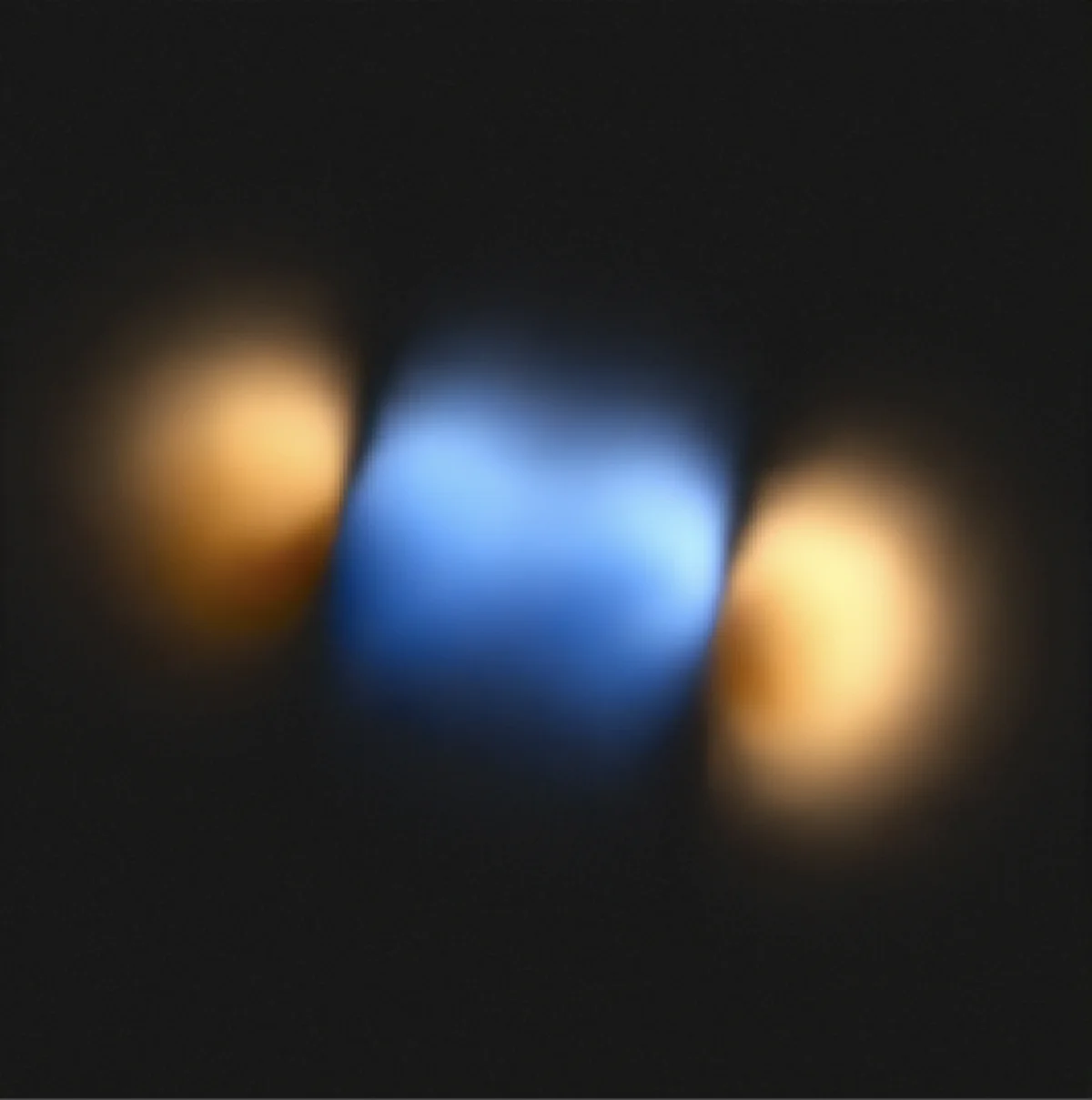
A sigma bond, shown here, forms from head-on overlap with maximum electron density along the internuclear axis. A pi bond differs fundamentally: it forms from the side-by-side overlap of parallel unhybridized p orbitals, with electron density above and below the sigma framework and a nodal plane along the bond axis itself. Credit: Wikimedia Commons, CC BY-SA
Pi Bonds in Double and Triple Bonds
Pi bonds never exist alone. They are always layered on top of a sigma bond. This is because sigma bonds form first (they are lower energy and more stable), and pi bonds add on:
Single bond (e.g., C-C): 1 sigma, 0 pi
Double bond (e.g., C=C): 1 sigma + 1 pi
Triple bond (e.g., C triple bond C): 1 sigma + 2 pi
In a double bond, the sigma bond forms from head-on overlap of hybrid orbitals (sp2-sp2 for a C=C bond). The pi bond forms from side-by-side overlap of the unhybridized p orbitals that remain after hybridization.
In a triple bond, the sigma bond forms from sp-sp overlap. The two pi bonds form from the two remaining unhybridized p orbitals on each carbon, oriented perpendicular to each other. One pi bond is in the horizontal plane, the other in the vertical plane.
Properties of Pi Bonds
1. They are weaker than sigma bonds. Side-by-side overlap is less effective than head-on overlap because the orbitals do not point directly at each other. The pi bond in ethene has a bond energy of about 264 kJ/mol, compared to about 347 kJ/mol for a typical C-C sigma bond.
However, the total bond energy of a double bond (one sigma + one pi) is greater than a single bond (one sigma only). The C=C double bond has a total dissociation energy of about 614 kJ/mol.
2. They restrict rotation. This is the most important consequence of pi bonds in organic chemistry. To rotate around a double bond, you would have to break the pi bond by twisting the p orbitals out of alignment. That costs about 264 kJ/mol - far too much energy at room temperature.
This restricted rotation is why cis/trans (E/Z) isomerism exists around double bonds. The two sides of a double bond are locked in place. Groups on the same side (cis/Z) cannot flip to the other side (trans/E) without breaking the pi bond.
3. They have a nodal plane. The sigma bond framework defines a plane, and the pi electron density sits above and below this plane. There is zero electron density right at the plane. This matters because electrophiles attack the pi electron cloud from above or below, not from the side.
Recognizing Pi Bonds in Structures
Any time you see a double bond line (=) or triple bond line, pi bonds are present. But pi bonds also appear in less obvious places:
Aromatic rings: Benzene has three pi bonds (though they are delocalized)
Carbonyl groups (C=O): One sigma + one pi between carbon and oxygen
Carboxylate ions (COO-): Pi electrons delocalized over both C-O bonds
Amide bonds: Partial pi bond character in the C-N bond due to resonance
Pi Bonds and Planarity
Atoms connected by a pi bond and all atoms directly attached to them must lie in the same plane. This is because the p orbitals forming the pi bond must be parallel, and parallel p orbitals require a planar arrangement.
For ethene (H2C=CH2), all six atoms (two carbons and four hydrogens) are coplanar. The molecule is flat.
For molecules with extended pi systems (conjugation), the planar requirement extends across the entire conjugated region. This planarity has major consequences for molecular shape, especially in aromatic compounds and in biological molecules like the peptide bond.
Counting Pi Bonds - Quick Practice
Molecule
Structure
Pi bonds
Ethane
CH3-CH3
0
Ethene
CH2=CH2
1
Ethyne
CH is triple bond CH
2
Benzene
C6H6 (ring with alternating double bonds)
3
Acetone
CH3-CO-CH3
1 (in C=O)
Carbon dioxide
O=C=O
2
Acetic acid
CH3-COOH
1 (in C=O)
Why does cis/trans isomerism exist around C=C double bonds but not around C-C single bonds?
Click to reveal answer
Pi bonds restrict rotation. The C=C double bond has a pi bond formed by side-by-side p orbital overlap. Rotating one carbon would break this overlap, costing about 264 kJ/mol of energy. This barrier locks substituents on a given side. Single bonds have only a sigma bond with cylindrical symmetry, so rotation is free and no "sides" are defined.
Where is the electron density of a pi bond located relative to the sigma bond framework?
Click to reveal answer
Above and below the plane of the sigma bonds. The pi bond's electron density forms two lobes - one above and one below the molecular plane. There is a nodal plane right along the sigma bond axis where pi electron density is zero. This exposed electron density is why pi bonds are the primary targets for electrophilic attack.
If you tie two friends together with one rope, they can stand fairly far apart and the connection is easy to cut. Tie them with two ropes, and they are pulled closer together, harder to separate. Tie them with three ropes, and they are practically glued to each other - very close, very hard to break free.
That is the relationship between bond order, bond length, and bond strength in a single image. More bonds between two atoms means a shorter distance between them and more energy required to break them apart. This three-way relationship is one of the most predictable trends in organic chemistry, and the MCAT tests it regularly.
Bond Order
Bond order is the number of chemical bonds between two atoms. For simple covalent bonds:
Single bond: Bond order = 1
Double bond: Bond order = 2
Triple bond: Bond order = 3
For molecules described by resonance, bond order can be a non-integer. In the carbonate ion (CO3 2-), each C-O bond has a bond order of 34 (four bonds distributed over three positions). In benzene, each C-C bond has a bond order of 1.5 (three double bonds shared over six positions).
From MO theory, bond order = (bonding electrons - antibonding electrons) / 2. This formula handles diatomic molecules and gives the same results as simple bond counting for organic molecules.
Bond Length
Bond length is the equilibrium distance between two bonded nuclei. It depends on three main factors:
1. Bond order. Higher bond order means shorter bond length. More bonds pull the nuclei closer together.
Bond
Bond order
Bond length (pm)
C-C
1
154
C=C
2
134
C triple bond C
3
120
2. Atomic size. Bonds involving larger atoms are longer. A C-I bond (214 pm) is much longer than a C-F bond (135 pm) because iodine is much larger than fluorine.
3. Hybridization. Orbitals with more s character are held closer to the nucleus, creating shorter bonds. An sp-sp sigma bond is shorter than an sp3-sp3 sigma bond.
Bond type
Hybridization
Approximate length
C(sp3)-C(sp3)
sp3-sp3
154 pm
C(sp2)-C(sp2)
sp2-sp2
147 pm (sigma only)
C(sp)-C(sp)
sp-sp
137 pm (sigma only)
Bond Strength (Bond Dissociation Energy)
Bond dissociation energy (BDE) is the energy required to homolytically break one mole of bonds in the gas phase. Higher BDE means a stronger, harder-to-break bond.
Bond
Bond order
BDE (kJ/mol)
C-C
1
347
C=C
2
614
C triple bond C
3
839
C-H
1
413
C-O
1
358
C=O
2
745
C-N
1
305
Notice that a C=C double bond (614 kJ/mol) is not exactly twice the energy of a C-C single bond (347 kJ/mol). The sigma component contributes about 347 kJ/mol, and the pi component contributes about 267 kJ/mol. The pi bond is weaker because side-by-side overlap is less effective than head-on overlap.
The Bond Order Trend Summary
Property
Single bond
Double bond
Triple bond
Bond order
1
2
3
Bond length
Longest
Medium
Shortest
Bond energy
Weakest
Medium
Strongest
Sigma bonds
1
1
1
Pi bonds
0
1
2
Rotation
Free
Restricted
Restricted
Resonance and Bond Order
When a molecule has resonance structures, the actual bond order is the average across all contributors. This affects both length and strength.
Benzene has alternating single and double bonds in any single resonance structure, but the true bond order of each C-C bond is 1.5. Accordingly, benzene’s C-C bond length (140 pm) falls between a single bond (154 pm) and a double bond (134 pm), and its bond energy is between the two as well.
Carboxylate ion (RCOO-): Two equivalent resonance structures share a double bond between two C-O positions. Each C-O bond has a bond order of 1.5, and both bonds are the same length - longer than a typical C=O but shorter than a C-O single bond.
Comparing Bonds Between Different Atoms
The trends above apply cleanly when comparing bonds between the same two elements (e.g., C-C vs. C=C). When comparing bonds between different elements, atomic size also matters:
C-F (135 pm) is shorter than C-Cl (177 pm) because fluorine is smaller
C=O (123 pm) is shorter than C=C (134 pm) because oxygen is smaller and more electronegative, pulling the bond tighter
C-H (109 pm) is shorter than C-C (154 pm) because hydrogen is very small
When the MCAT asks you to rank bond lengths, first check bond order (higher order = shorter), then check atomic size (smaller atoms = shorter bonds).
Rank the following in order of increasing bond length: C-C, C=C, C triple bond C.
Click to reveal answer
C triple bond C (120 pm) < C=C (134 pm) < C-C (154 pm). Higher bond order means shorter bond length. The triple bond pulls the carbons closest together, and the single bond allows them the most distance. Remember: "Shorter, Stronger, More" - as bond order increases, length decreases.
The C-C bond length in benzene is 140 pm. Why is this neither 154 pm (single bond) nor 134 pm (double bond)?
Click to reveal answer
Resonance gives each C-C bond in benzene a bond order of 1.5. Benzene has two equivalent resonance structures with alternating single and double bonds. The real molecule is the average: every C-C bond is identical with bond order 1.5. The length (140 pm) falls between a pure single bond (154 pm) and a pure double bond (134 pm).
Line up a row of dominoes and flick the first one. The entire row falls in sequence because each domino transfers energy to the next. Now remove one domino from the middle. The chain stops dead at the gap - the remaining dominoes stand untouched.
Conjugation works exactly the same way. When p orbitals on adjacent atoms are aligned parallel to each other, pi electrons can delocalize across the entire system. Every atom in the chain participates, and the result is a molecule that is more stable, absorbs light at longer wavelengths, and behaves differently in reactions. But insert one sp3 carbon (an atom with no p orbital to contribute), and the chain breaks. The conjugation stops.
What Makes a System Conjugated?
A conjugated system is one where p orbitals on three or more adjacent atoms are aligned parallel, allowing continuous overlap. The simplest example is 1,3-butadiene: CH2=CH-CH=CH2.
In 1,3-butadiene, all four carbons are sp2 hybridized. Each has one unhybridized p orbital perpendicular to the molecular plane. These four p orbitals overlap continuously across the molecule, creating a single extended pi system.
The key requirement for conjugation is alternating single and double bonds (or a pattern that puts a p orbital on every adjacent atom). The “single” bonds between double bonds in a conjugated system are not ordinary single bonds - they have partial double-bond character because of the pi electron delocalization.
Benzene is the limiting case of conjugation. Six parallel p orbitals combine into six delocalized π molecular orbitals spanning the entire ring. The same principle that makes 1,3-butadiene's four p orbitals overlap continuously — and gives its central C-C bond partial double-bond character — becomes full cyclic delocalization in benzene. Credit: Wikimedia Commons, CC BY-SA
Conjugated vs. Isolated vs. Cumulated Double Bonds
Not all systems with multiple double bonds are conjugated. There are three arrangements:
Conjugated (1,3-diene): Double bonds separated by exactly one single bond. Example: CH2=CH-CH=CH2 (1,3-butadiene). The p orbitals overlap continuously. This is the most stable arrangement.
Isolated (1,4-diene): Double bonds separated by two or more single bonds. Example: CH2=CH-CH2-CH=CH2 (1,4-pentadiene). The sp3 carbon in the middle breaks conjugation. Each double bond behaves independently.
Cumulated (allene): Double bonds on the same carbon with no intervening single bond. Example: CH2=C=CH2 (allene). The central carbon is sp hybridized, and the two pi bonds are perpendicular to each other. This is the least stable arrangement.
Type
Pattern
Example
Stability
Conjugated
C=C-C=C
1,3-butadiene
Most stable
Isolated
C=C-CH2-C=C
1,4-pentadiene
Middle
Cumulated
C=C=C
Allene
Least stable
Why Conjugation Stabilizes Molecules
Conjugation stabilizes molecules for the same reason that spreading weight across a bridge’s supports is better than putting it all on one: delocalization distributes electron density across more atoms, reducing electron-electron repulsion and lowering the overall energy.
You can measure this stabilization experimentally. The heat of hydrogenation of 1,3-butadiene is 16 kJ/mol less than what you would predict by doubling the value for an isolated double bond. That 16 kJ/mol difference is the resonance energy (or delocalization energy) - free stability that the molecule gains just from being conjugated.
How to Identify Conjugation in Complex Molecules
Follow these steps to find conjugated systems in any organic molecule:
Identify all double bonds, lone pairs on p orbitals, and empty p orbitals.
Check if they are on adjacent atoms. If a double bond is next to another double bond (separated by one single bond), they are conjugated.
Check for lone pairs or empty p orbitals. A lone pair on an atom adjacent to a double bond can participate in conjugation if the atom has a p orbital (e.g., the nitrogen lone pair in aniline is conjugated with the aromatic ring).
Look for sp3 carbons that break the chain. Any sp3 atom interrupts conjugation.
Common conjugated systems in organic chemistry:
1,3-dienes (butadiene, isoprene)
Alpha, beta-unsaturated carbonyls (C=C-C=O)
Aromatic rings (benzene and its derivatives)
Enolate ions (C=C-O-)
Amides (N-C=O, where the nitrogen lone pair is conjugated)
Conjugation and UV-Vis Absorption
One practical consequence of conjugation is that it lowers the energy gap between the HOMO and LUMO. When this gap decreases, the molecule absorbs longer-wavelength (lower-energy) light.
Short conjugated systems absorb in the UV range (invisible to our eyes). As conjugation extends, the absorption shifts toward visible wavelengths. This is why many colored compounds - beta-carotene (orange), lycopene (red), chlorophyll (green) - have extensive conjugated systems.
Conjugation and Reactivity
Conjugated systems react differently than isolated double bonds. In 1,3-butadiene, electrophilic addition can produce both 1,2-addition and 1,4-addition products because the intermediate allylic carbocation is stabilized by conjugation.
At low temperatures, the 1,2-product (kinetic product) forms faster. At high temperatures, the 1,4-product (thermodynamic product) predominates because it produces the more substituted, more stable alkene. This kinetic vs. thermodynamic control is a major MCAT topic covered in later chapters.
Is the system in CH2=CH-CH2-CH=CH2 conjugated? Why or why not?
Click to reveal answer
No, it is not conjugated. This is 1,4-pentadiene. The central carbon (CH2) is sp3 - it has no unhybridized p orbital. This breaks the continuous p orbital chain required for conjugation. The two double bonds are isolated from each other and behave independently.
Why is aniline (C6H5-NH2) a much weaker base than cyclohexylamine (C6H11-NH2)?
Click to reveal answer
Aniline's nitrogen lone pair is conjugated with the aromatic ring. In aniline, nitrogen is sp2, and its lone pair occupies a p orbital that overlaps with the ring's pi system. The lone pair is delocalized into the ring, making it less available for protonation. In cyclohexylamine, nitrogen is sp3, the lone pair is in an sp3 orbital with no conjugation, so it is fully available to accept a proton.
A mule is not a horse that sometimes pretends to be a donkey. A mule is its own animal - a hybrid that has features of both parents, all the time. It does not flip between being a horse on Mondays and a donkey on Tuesdays. It is always a mule.
Resonance works exactly the same way. When a molecule can be drawn as two or more valid Lewis structures that differ only in where the electrons are (not where the atoms are), the real molecule is a blend of all those structures - a resonance hybrid. It is not flipping between structures. It is all of them at once, all the time.
The Rules for Drawing Resonance Structures
When you draw resonance structures, you must follow strict rules. Breaking any of these rules means you have drawn something that is not a resonance structure - it is a different molecule entirely.
Rule 1: Only electrons move. Atoms stay put.
This is the most important rule. Curved arrows in resonance show electron movement only. If you move an atom, you have drawn a structural isomer, not a resonance contributor.
Rule 2: The total number of electrons does not change.
Every resonance structure has the same total number of valence electrons. You are not adding or removing electrons - just rearranging them.
Rule 3: The connectivity of atoms does not change.
The same atoms are bonded to the same atoms in every resonance structure. Only the locations of double bonds, lone pairs, and formal charges shift.
Rule 4: All structures must be valid Lewis structures.
Each resonance contributor must obey the rules of Lewis structures. Do not exceed the octet for second-row elements (C, N, O, F). Third-row elements (S, P) can exceed the octet because they have d orbitals.
How to Draw Resonance Structures
Use curved arrows to show electron movement. There are three common patterns:
Pattern 1: Pi bond to adjacent atom.
Move a pi bond to the next position, shifting the double bond along the chain. Common in conjugated systems.
Pattern 2: Lone pair to pi bond.
A lone pair on an atom adjacent to a double bond moves into a pi bond with the next atom. The original double bond breaks and becomes a lone pair on the far atom. Common with atoms bearing lone pairs next to pi systems (nitrogen in amides, oxygen in carboxylates).
Pattern 3: Pi bond to adjacent atom with charge.
A pi bond adjacent to a positive charge can move to create a new pi bond at the positive center, shifting the charge to the other end. Common in allylic and benzylic carbocations.
The Resonance Hybrid
The resonance hybrid is the true structure of the molecule - a weighted average of all resonance contributors. In the hybrid:
Bonds that are single in some structures and double in others have an intermediate bond order
Charges that appear in some structures but not others are partially present, spread over multiple atoms
Bond lengths reflect the averaged bond order
For the carboxylate ion (RCOO-), two resonance structures each show a double bond to one oxygen and a single bond to the other. The hybrid has two identical C-O bonds, each with bond order 1.5, and the negative charge is equally distributed over both oxygen atoms.
Benzene's two Kekulé resonance structures (left) combine into the delocalized hybrid (right). The double-headed arrow between contributors means "resonance," not "equilibrium." The same idea applies to the carboxylate ion: its two resonance structures give every C-O bond equal bond order 1.5, with negative charge split equally between the two oxygens. Credit: Wikimedia Commons, CC BY-SA
Evaluating Resonance Contributors - Which One Matters More?
Not all resonance structures contribute equally to the hybrid. The most stable contributors have the greatest weight. Use these criteria to rank them:
1. More complete octets = better. Structures where every atom (especially carbon, nitrogen, oxygen) has a full octet are more important contributors than structures with incomplete octets.
2. Fewer formal charges = better. A structure with no formal charges is a better contributor than one with separated charges (e.g., one atom positive and another negative).
3. Negative charges on electronegative atoms = better. If a structure must have a negative formal charge, place it on the most electronegative atom (oxygen better than nitrogen, nitrogen better than carbon).
4. Positive charges on electropositive atoms = better. If a structure must have a positive formal charge, place it on the least electronegative atom.
5. Equivalent structures contribute equally. If two structures are mirror images of each other (like benzene’s two Kekule structures), they contribute equally to the hybrid.
Common Resonance Situations in Organic Chemistry
Carboxylic acids and carboxylates: The C=O and C-O bonds can exchange through resonance. In the carboxylate anion, this creates two equivalent structures and equal charge distribution.
Amides: The nitrogen lone pair can delocalize into the carbonyl, giving the C-N bond partial double-bond character. This is why peptide bonds are planar and rigid.
Enolates: Deprotonation alpha to a carbonyl creates a system where negative charge is shared between carbon and oxygen.
Aromatic rings: Benzene has two equivalent Kekule structures. Substituted aromatics can have additional resonance structures involving substituents that donate or withdraw electrons.
Allylic systems: Carbocations, carbanions, or radicals adjacent to a double bond are stabilized by resonance with the pi system.
Resonance vs. Equilibrium
The double-headed arrow between resonance structures (a double-headed arrow with two heads) is NOT the same as the equilibrium arrow (two opposing single-headed arrows). Equilibrium implies two distinct species interconverting over time. Resonance structures are not distinct species - they are partial descriptions of a single, unchanging molecule.
Feature
Resonance
Equilibrium
Arrow symbol
Double-headed single arrow
Two opposing arrows
Number of species
One (the hybrid)
Two or more
Interconversion
None - the hybrid is constant
Species convert back and forth
Atoms move?
No - only electrons shift
Yes - atoms may rearrange
Resonance Stabilization Energy
The energy difference between a molecule’s actual energy (the resonance hybrid) and the energy predicted for a single, non-delocalized structure is the resonance stabilization energy. The greater the resonance stabilization, the more stable the molecule.
Benzene’s resonance stabilization energy is approximately 150 kJ/mol - a massive amount that explains why benzene undergoes substitution reactions (preserving the ring) rather than addition reactions (destroying the ring).
Two resonance structures of an enolate place the negative charge on carbon vs. oxygen. Which is the major contributor and why?
Click to reveal answer
The structure with the negative charge on oxygen is the major contributor. Oxygen is more electronegative than carbon, so it stabilizes a negative charge better. The structure placing the charge on the more electronegative atom is lower in energy and contributes more to the hybrid. However, the carbon still bears partial negative charge in the hybrid, which is why enolates react at carbon.
A student draws a "resonance structure" of butane by moving a hydrogen atom from one carbon to another. Is this valid resonance? Why or why not?
Click to reveal answer
No, this is not resonance. Resonance structures differ only in the placement of electrons, not atoms. Moving a hydrogen atom changes the connectivity of the molecule, creating a structural isomer (not a resonance contributor). The cardinal rule: arrows move electrons, not atoms. If atoms move, it is not resonance.
Imagine a group of people standing in a line, each holding hands with the person next to them. Now rearrange them into a circle, everyone holding hands all the way around. The circle is inherently more stable - if one person stumbles, the ring supports them. No one person bears all the strain. That is aromaticity. When pi electrons are delocalized in a continuous loop around a ring, the result is extraordinary stability.
Benzene was the molecule that forced chemists to rethink everything they knew about bonding. It has three double bonds, which should make it highly reactive - but it stubbornly resists the addition reactions that other alkenes undergo. Instead of adding bromine across its double bonds (like cyclohexene does), benzene prefers substitution reactions that preserve its ring. Something about benzene makes it abnormally stable. That something is aromaticity.
The Four Criteria for Aromaticity
A molecule is aromatic if and only if it meets ALL four of these criteria:
Cyclic - The conjugated system forms a complete, unbroken ring
Planar - All atoms in the ring lie in the same plane, so p orbitals can align
Fully conjugated - Every atom in the ring contributes a p orbital to the pi system (no sp3 atoms in the ring)
4n + 2 pi electrons - The number of pi electrons in the ring follows Huckel’s rule
If a molecule meets the first three criteria but has 4n pi electrons instead of 4n + 2, it is antiaromatic - actually destabilized.
If a molecule fails any of the first three criteria (not cyclic, not planar, or not fully conjugated), it is non-aromatic - neither stabilized nor destabilized.
Huckel’s Rule: 4n + 2
Huckel’s rule is the mathematical test for aromaticity. Count the pi electrons in the cyclic conjugated system. If the count equals 4n + 2 (where n is a non-negative integer), the molecule is aromatic.
n
4n + 2 (aromatic)
4n (antiaromatic)
0
2
0
1
6
4
2
10
8
3
14
12
Benzene - The Classic Aromatic
Benzene (C6H6) has six pi electrons in a six-membered ring. Every carbon is sp2, contributing one p orbital. The ring is planar. The system is fully conjugated. 6 = 4(1) + 2. All four criteria are met. Benzene is aromatic.
Benzene's resonance: the two Kekulé structures (alternating double bonds) contribute equally to a delocalized hybrid in which all six C-C bonds are equivalent (bond order 1.5). The circle-in-hexagon notation represents this fully delocalized pi system. Credit: Wikimedia Commons, CC BY-SA
The consequences of benzene’s aromaticity:
Bond lengths are equal. All six C-C bonds are 140 pm (between single at 154 pm and double at 134 pm). Bond order is 1.5 for each.
Resonance energy is enormous. Benzene is approximately 150 kJ/mol more stable than a hypothetical “cyclohexatriene” with localized double bonds.
Substitution over addition. Benzene undergoes electrophilic aromatic substitution (preserving the aromatic ring) rather than addition (which would destroy it).
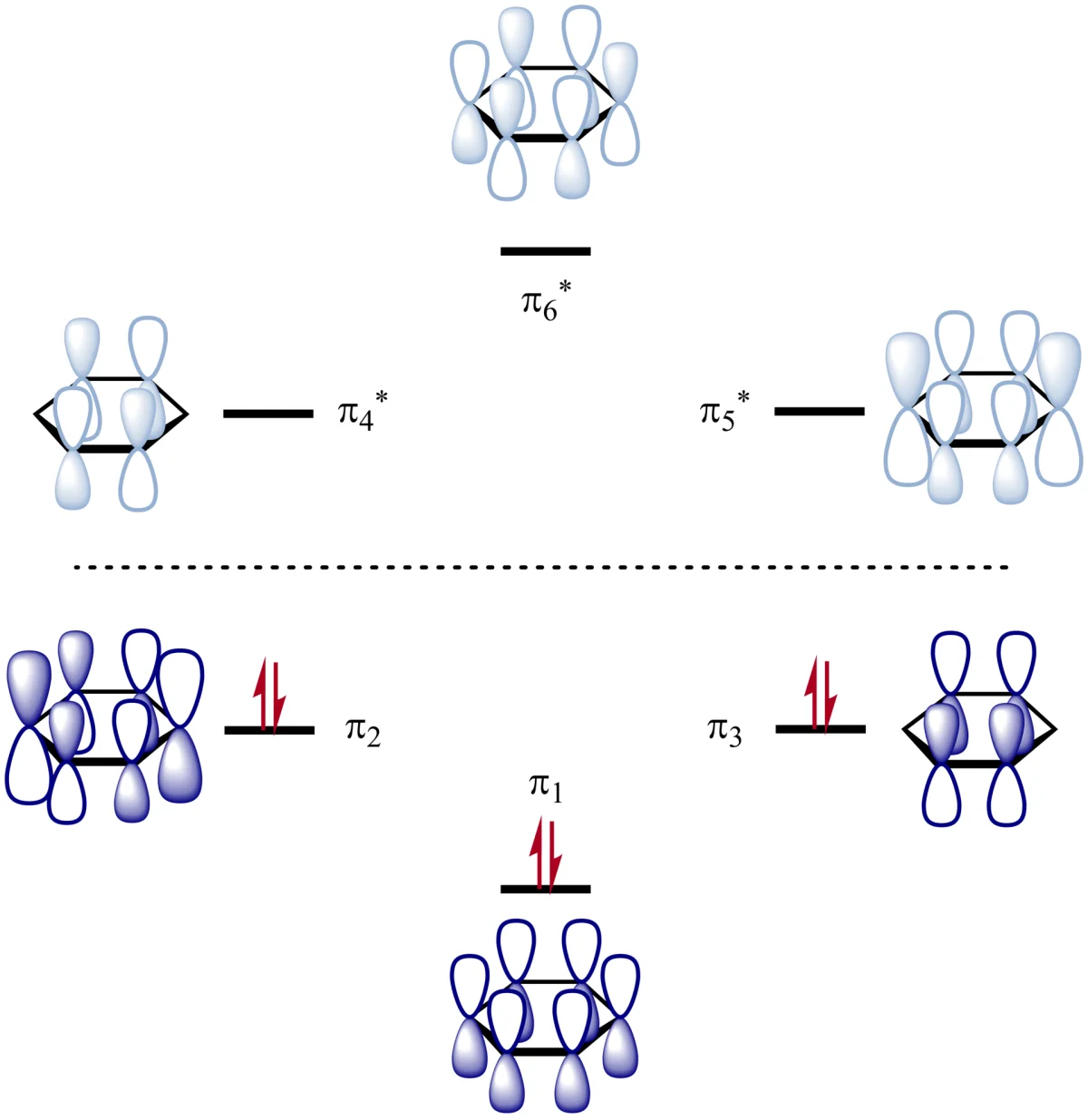
Hybridization underpins aromaticity. Benzene's carbons are all sp², giving the flat ring geometry and leaving one p orbital per carbon to contribute to the 6-π-electron cyclic system. Cyclobutadiene is sp² too but has only 4 π electrons (antiaromatic). Cyclohexane is sp³, has no continuous p-orbital framework, and is therefore non-aromatic — neither stabilized nor destabilized by delocalization. Credit: Wikimedia Commons, CC BY-SABenzene pi MO diagram: the six p orbitals combine into 6 molecular orbitals. The three lowest-energy bonding MOs are filled with the 6 pi electrons; three antibonding MOs remain empty. The wide bonding-antibonding gap is a quantitative signature of aromaticity. Credit: Wikimedia Commons, CC BY-SA
Other Aromatic Molecules
Aromaticity is not limited to benzene. Any molecule meeting the four criteria qualifies:
Cyclopentadienyl anion (C5H5-): Five carbons in a ring, each sp2. Four carbons contribute one pi electron each from the double bonds. The fifth carbon (which was sp3) becomes sp2 when deprotonated, and its lone pair goes into a p orbital. Total: 4 + 2 = 6 pi electrons. Aromatic.
Cycloheptatrienyl cation (tropylium, C7H7+): Seven carbons in a ring, each sp2. Three double bonds contribute 6 pi electrons. The carbocation has an empty p orbital but does not add electrons. Total: 6 pi electrons. Aromatic.
Pyridine: Six-membered ring with one nitrogen. The nitrogen contributes one pi electron from the double bond (its lone pair is in an sp2 orbital in the plane, NOT part of the pi system). Total: 6 pi electrons. Aromatic.
Pyrrole: Five-membered ring with one nitrogen. The nitrogen’s lone pair IS part of the pi system (it is in a p orbital perpendicular to the ring). Total: 4 (from two double bonds) + 2 (from nitrogen’s lone pair) = 6 pi electrons. Aromatic.
Antiaromaticity - Worse Than Nothing
A molecule that is cyclic, planar, fully conjugated, and has 4n pi electrons is antiaromatic. Antiaromaticity is not just the absence of stability - it is active destabilization. An antiaromatic molecule is LESS stable than a comparable non-aromatic (non-conjugated) molecule.
Cyclobutadiene is the textbook example. It has 4 pi electrons (4n where n = 1), is cyclic, planar, and fully conjugated. It is so unstable that it can only be observed at temperatures below 35 K (-238 degrees C). At room temperature, it immediately dimerizes to escape its antiaromatic fate.
Aromatic vs. Antiaromatic vs. Non-aromatic Summary
Category
Cyclic?
Planar?
Conjugated?
Pi electrons
Stability
Aromatic
Yes
Yes
Yes
4n + 2
Extra stable
Antiaromatic
Yes
Yes
Yes
4n
Extra unstable
Non-aromatic
No, or not planar, or not conjugated
-
-
Any
Normal
Heterocyclic Aromatics
Many biologically important molecules are heterocyclic aromatics - aromatic rings containing atoms other than carbon (usually nitrogen, oxygen, or sulfur). These show up constantly on the MCAT because they form the structural basis of DNA bases, amino acids (histidine, tryptophan), and many drug molecules.
Molecule
Ring size
Heteroatom
Pi electrons
Lone pair in ring?
Pyridine
6
N
6
No (in sp2 orbital)
Pyrrole
5
N
6
Yes (in p orbital)
Furan
5
O
6
Yes (one lone pair in p orbital)
Thiophene
5
S
6
Yes (one lone pair in p orbital)
Imidazole
5
2 N
6
One N yes, one N no
Cyclooctatetraene (C8H8) has 8 pi electrons and is cyclic and fully conjugated, but it is not antiaromatic. Why?
Click to reveal answer
Cyclooctatetraene is not planar. It adopts a tub-shaped (non-planar) conformation, which breaks the continuous p orbital overlap. Without planarity, it fails the criteria for antiaromaticity and is classified as non-aromatic instead. The molecule deliberately avoids planarity to escape the destabilization of antiaromaticity (4n = 8 electrons).
Is the cyclopentadienyl anion (C5H5-) aromatic? Count the pi electrons and check all criteria.
Click to reveal answer
Yes, it is aromatic. It is cyclic, planar, and every carbon is sp2 (fully conjugated). Two double bonds contribute 4 pi electrons, and the carbanion carbon contributes its lone pair (2 electrons) from a p orbital. Total = 6 pi electrons = 4(1) + 2. All four criteria are met. This explains why cyclopentadiene (pKa ~15) is an unusually strong carbon acid - deprotonation creates an aromatic, highly stabilized anion.
You learned VSEPR (Valence Shell Electron Pair Repulsion) in general chemistry as a way to predict molecular shapes. In organic chemistry, the same theory applies, but the context is different. Instead of predicting the shape of an entire small molecule like water or ammonia, you are now predicting the geometry around every single atom in a large organic structure. And the geometry around each atom determines the overall three-dimensional shape of the molecule.
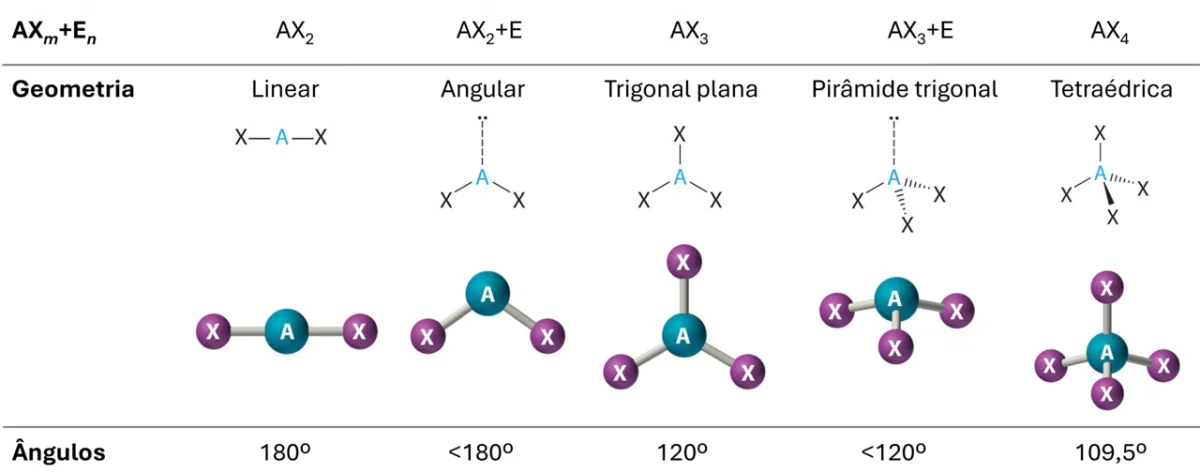
The core idea of VSEPR is simple: electron groups repel each other and arrange themselves as far apart as possible. That is it. Everything else follows from this one principle.
Common molecular geometries from VSEPR theory: linear (2 groups, 180°), trigonal planar (3, 120°), tetrahedral (4, 109.5°), trigonal pyramidal (3 bonds + 1 lone pair), and bent (2 bonds + 1-2 lone pairs). Credit: Wikimedia Commons, CC BY-SA
Electron Geometry vs. Molecular Geometry
This distinction trips up many students, so let us be very clear:
Electron geometry counts ALL regions of electron density (bonds AND lone pairs) and describes how they arrange around the central atom.
Molecular geometry describes only where the ATOMS are. Lone pairs are invisible in molecular geometry, but they still push the bonded atoms around.
The electron geometry tells you the hybridization. The molecular geometry tells you the actual shape someone would see.
The Four Geometries You Need for Organic Chemistry
Almost every atom in organic chemistry has one of these four geometries:
1. Tetrahedral (sp3) - 4 electron groups
Bond angle: 109.5 degrees
Example: carbon in methane, carbon in any alkane
All single bonds, maximum separation in 3D
The carbon is at the center of a tetrahedron with bonds pointing to the four corners
2. Trigonal planar (sp2) - 3 electron groups
Bond angle: 120 degrees
Example: carbon in ethene (C=C), carbonyl carbon (C=O)
Three groups in a flat triangle, with any remaining p orbital perpendicular to the plane
Found wherever there is a double bond
3. Linear (sp) - 2 electron groups
Bond angle: 180 degrees
Example: carbon in CO2, carbon in alkynes
Two groups pointing in exactly opposite directions
4. Bent - 2 bonded atoms + lone pairs
A special case of tetrahedral or trigonal planar electron geometry
Molecular geometry appears bent because lone pairs push the bonded atoms closer together
Example: water (tetrahedral electron geometry, bent molecular geometry with bond angle ~104.5 degrees)
Impact of Lone Pairs on Bond Angles
Lone pairs occupy more space than bonding pairs because they are attracted to only one nucleus (not two). They squeeze bonded atoms closer together, reducing bond angles below the ideal values.
Molecule
Electron groups
Lone pairs
Electron geometry
Molecular geometry
Bond angle
CH4
4
0
Tetrahedral
Tetrahedral
109.5 degrees
NH3
4
1
Tetrahedral
Trigonal pyramidal
~107 degrees
H2O
4
2
Tetrahedral
Bent
~104.5 degrees
BF3
3
0
Trigonal planar
Trigonal planar
120 degrees
Notice the pattern: more lone pairs means more compression of bond angles. Each lone pair squeezes the bonded atoms closer by about 2-2.5 degrees.
Applying VSEPR to Organic Molecules
In organic chemistry, you rarely need to analyze an entire molecule’s shape at once. Instead, you analyze the geometry around each individual atom. Here is a systematic approach:
Step 1: Pick an atom.
Step 2: Count the number of sigma bonds + lone pairs on that atom. (Double and triple bonds count as one region of electron density for VSEPR purposes.)
Step 3: Match to the geometry:
4 regions = tetrahedral electron geometry
3 regions = trigonal planar electron geometry
2 regions = linear electron geometry
Step 4: Remove lone pairs to get the molecular geometry around that atom.
Carbon 2 (the carboxyl carbon): 3 sigma bonds (1 C-C + 1 C=O + 1 C-O), 0 lone pairs. (The C=O double bond counts as one region.) Trigonal planar, 120 degrees.
Oxygen (C=O): 1 sigma bond to C + 0 pi bonds counted as electron regions + 2 lone pairs = 3 regions. But wait - actually the double bond means oxygen has 2 sigma bonds… Let us count carefully. This oxygen is double-bonded to carbon. For VSEPR: the C=O counts as 1 region on the oxygen side (1 bond to carbon) + 2 lone pairs = 3 regions. Trigonal planar electron geometry, but molecular geometry is bent (one bond, two lone pairs visible… actually one bond makes it just a terminal atom). Since this oxygen only bonds to one atom, we do not typically describe its geometry - it is just part of carbon’s geometry.
Molecular geometry is not just an academic exercise - it directly affects reactivity:
Tetrahedral carbons (sp3) have bond angles of 109.5 degrees. Nucleophilic substitution reactions (SN2) require the nucleophile to approach from the back side, 180 degrees from the leaving group.
Trigonal planar carbons (sp2) in carbonyls are accessible from both faces. Nucleophilic addition to aldehydes and ketones proceeds because the flat sp2 carbon is exposed.
Ring strain occurs when bond angles are forced away from the ideal. Cyclopropane has 60-degree angles (vs. 109.5 ideal for sp3), creating enormous angle strain that makes the C-C bonds unusually weak and reactive.
What is the molecular geometry around the nitrogen in trimethylamine, (CH3)3N?
Click to reveal answer
Trigonal pyramidal. Nitrogen has three sigma bonds to carbon and one lone pair. Four electron groups give tetrahedral electron geometry (sp3). Removing the lone pair from the visible shape gives trigonal pyramidal molecular geometry with bond angles slightly less than 109.5 degrees (approximately 107 degrees).
The bond angles in cyclopropane are 60 degrees instead of the ideal 109.5 degrees. What is the consequence?
Click to reveal answer
Severe angle strain makes cyclopropane highly reactive. The sp3 carbons want bond angles of 109.5 degrees, but the three-membered ring forces them to 60 degrees. This ~49-degree compression creates enormous ring strain, weakening the C-C bonds and making cyclopropane much more reactive than unstrained alkanes. This is why cyclopropane undergoes ring-opening reactions readily.
Two kids sit on a seesaw. If they weigh the same, the seesaw balances perfectly - the “center of weight” is right in the middle. If one kid is heavier, the seesaw tilts toward them - the center of weight shifts in their direction. Chemical bonds work the same way. When two atoms share electrons equally, the bond is nonpolar. When one atom pulls electrons more strongly (higher electronegativity), the shared electrons shift toward it, creating a polar bond.
But here is the twist: a molecule can have polar bonds and still be nonpolar overall. Just as four equally heavy kids sitting at equal distances around a round table create no net tilt in any direction, bond dipoles can cancel out when the geometry is symmetric. Polarity depends on both bond polarity AND molecular geometry.
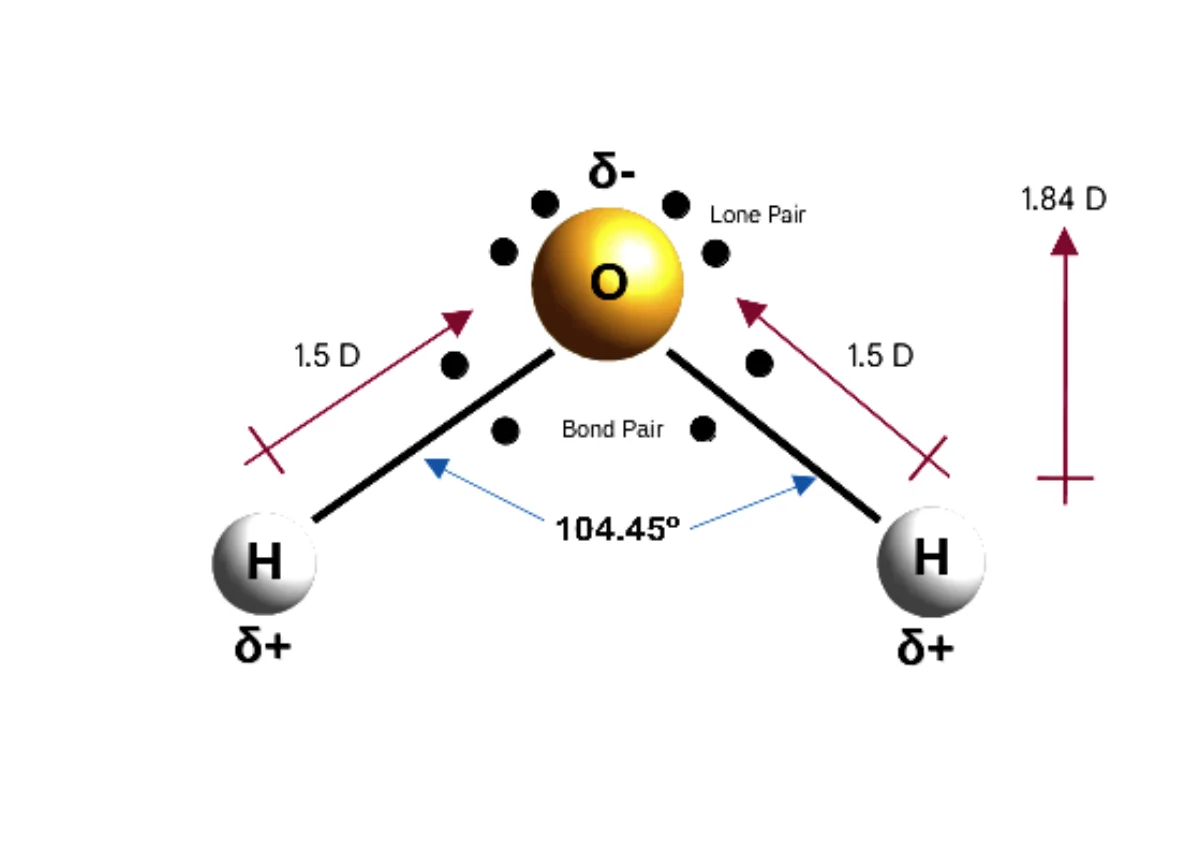
Water's dipole: the bent geometry means the two O-H bond dipoles do not cancel. The partial negative on oxygen (δ-) and partial positive on hydrogens (δ+) combine into a large net molecular dipole moment (1.85 D). This is why water is the quintessential polar solvent. Credit: Wikimedia Commons, CC BY-SA
Bond Polarity
A bond is polar when the two atoms have different electronegativities. The more electronegative atom pulls electron density toward itself, creating a partial negative charge (delta minus) on its end and a partial positive charge (delta plus) on the other end.
The greater the electronegativity difference, the more polar the bond:
Bond
Electronegativity difference
Polarity
C-H
0.4
Very slightly polar (often treated as nonpolar)
C-N
0.5
Slightly polar
C-O
1.0
Moderately polar
C-F
1.5
Highly polar
O-H
1.4
Highly polar
N-H
0.9
Moderately polar
For the MCAT, you do not need to memorize exact electronegativity values. Know the trend: F > O > N > C approximately equals S > H. This order lets you predict which end of any bond is delta-negative.
Bond Dipole vs. Molecular Dipole
A bond dipole is the polarity of a single bond. A molecular dipole is the vector sum of all bond dipoles in the molecule. To determine if a molecule is polar, you must add up all bond dipole vectors and see if they cancel.
This is where geometry becomes critical:
Symmetric molecules have zero net dipole even if they have polar bonds:
CO2 (O=C=O): Two C=O bond dipoles point in exactly opposite directions. They cancel perfectly. Net dipole = 0. Nonpolar.
CCl4: Four C-Cl bond dipoles point toward the corners of a tetrahedron. They cancel perfectly by symmetry. Net dipole = 0. Nonpolar.
BF3: Three B-F dipoles in a trigonal planar arrangement cancel. Net dipole = 0.
Asymmetric molecules have a net dipole:
Water (H2O): Two O-H dipoles point away from oxygen at about 104.5 degrees. They do NOT cancel (the angle is not 180 degrees). Net dipole points from H toward O. Polar.
CHCl3 (chloroform): Three C-Cl dipoles and one C-H dipole. The three Cl dipoles do not cancel with the single H dipole. Net dipole exists. Polar.
CH2Cl2 (dichloromethane): Two C-Cl dipoles and two C-H dipoles. They do not cancel. Polar.
Molecular geometry decides whether bond dipoles cancel. In a linear arrangement like CO₂, two equal and opposite C=O dipoles point 180° apart and cancel (nonpolar). In a bent arrangement like water, the two O-H dipoles point ~104.5° apart and add to a sizeable net dipole (polar). The geometry, not the bond polarity alone, sets molecular polarity. Credit: Wikimedia Commons, CC BY-SA
Predicting Polarity - A Systematic Approach
Step 1: Identify all polar bonds in the molecule. Any bond between atoms with different electronegativities is polar.
Step 2: Draw the bond dipole vectors. Each vector points from the less electronegative atom toward the more electronegative atom.
Step 3: Add the vectors. If they cancel by symmetry, the molecule is nonpolar. If they do not cancel, the molecule is polar, and the net dipole points in the direction of the resultant vector.
Polarity in Common Organic Functional Groups
Functional group
Polar?
Key polar bond
Direction of dipole
Alkane (C-C, C-H only)
Nonpolar
None significant
-
Alkene (C=C)
Nonpolar (if symmetric)
Depends on substituents
Depends on substitution
Alcohol (-OH)
Polar
O-H and C-O
Toward oxygen
Amine (-NH2)
Polar
N-H and C-N
Toward nitrogen
Carbonyl (C=O)
Polar
C=O
Toward oxygen
Carboxylic acid (-COOH)
Polar
C=O, O-H, C-O
Toward oxygen
Ether (C-O-C)
Slightly polar
C-O
Toward oxygen
Ester (-COOR)
Polar
C=O, C-O
Toward oxygen
The Special Case of Carbon-Hydrogen Bonds
C-H bonds have an electronegativity difference of only 0.4, making them very slightly polar. In practice, C-H bonds are typically treated as nonpolar for most purposes. This is why hydrocarbons (alkanes, alkenes, alkynes with no heteroatoms) are considered nonpolar molecules.
However, do not confuse “slightly polar bond” with “nonpolar molecule.” A molecule with many C-H bonds but no other polar bonds (like hexane) is nonpolar. A molecule with C-H bonds plus an O-H bond (like ethanol) is polar because of the O-H bond.
Dipole Moment and Physical Properties
A molecule’s dipole moment directly influences:
Boiling point: Polar molecules have stronger intermolecular forces and higher boiling points than nonpolar molecules of similar size.
Solubility: Polar molecules dissolve in polar solvents; nonpolar molecules dissolve in nonpolar solvents.
Melting point: Polar molecules tend to pack better in crystal lattices, raising melting points.
Chromatographic behavior: Polar molecules interact more strongly with polar stationary phases (e.g., silica gel in TLC and column chromatography).
CCl4 has four highly polar C-Cl bonds. Is the molecule polar or nonpolar? Why?
Click to reveal answer
Nonpolar. CCl4 has tetrahedral geometry, so the four C-Cl bond dipoles point symmetrically toward the four corners of a tetrahedron. They cancel perfectly by symmetry, giving a net molecular dipole of zero. Polar bonds plus symmetric geometry equals a nonpolar molecule.
Rank the following in order of increasing polarity: CH4, CH3Cl, CH2Cl2, CHCl3, CCl4.
Click to reveal answer
CH4 = CCl4 < CHCl3 < CH2Cl2 < CH3Cl (approximate trend). CH4 and CCl4 are both nonpolar due to symmetry (tetrahedral with identical bonds). CH3Cl has one polar C-Cl bond with no cancellation. CH2Cl2 and CHCl3 have partial cancellation but are still polar. The exact ordering of CH2Cl2 vs. CH3Cl depends on dipole vector analysis, but all three are polar, while CH4 and CCl4 are nonpolar.
Imagine a crowd of people at a concert. Some are holding hands with a partner (strong connection, hard to separate). Others are just standing close enough that their shoulders brush occasionally (weak connection, easy to move apart). And some are strangers who happen to bump into each other randomly for a split second before drifting away.
These three levels of “connection” mirror the three main types of intermolecular forces. Hydrogen bonds are like holding hands - strong and directional. Dipole-dipole interactions are like shoulder brushing - moderate and orientation-dependent. London dispersion forces are like random bumping - weak, fleeting, but always present between everyone.
Intermolecular forces (IMFs) are the attractions between separate molecules. They are much weaker than intramolecular bonds (the covalent bonds within a molecule), but they determine nearly every physical property the MCAT tests: boiling point, melting point, solubility, viscosity, and surface tension.
London Dispersion Forces (LDF)
London dispersion forces are the weakest intermolecular force, but they are universal - every molecule experiences them, even nonpolar ones like helium and methane.
LDF arise from temporary, instantaneous dipoles. At any given moment, the electrons in a molecule are not perfectly evenly distributed. A brief asymmetry in electron distribution creates a temporary dipole on one molecule, which induces a temporary dipole in a neighboring molecule. The two temporary dipoles attract each other for a fleeting instant.
Key factors affecting LDF strength:
1. Molecular size / surface area. Larger molecules with more electrons have stronger LDF. More electrons mean larger, more frequent temporary dipoles. This is why boiling points increase as you go down a homologous series: pentane (bp 36 degrees C) > butane (bp -1 degrees C) > propane (bp -42 degrees C).
2. Molecular shape. Long, thin molecules have more surface area in contact with neighbors than compact, spherical molecules. This is why n-pentane (bp 36 degrees C) boils higher than neopentane (bp 9.5 degrees C) - same molecular formula, but n-pentane is long and has more contact area.
3. Polarizability. Atoms with loosely held electrons (large atomic radius, many electron shells) are more polarizable and have stronger LDF. Iodine compounds have stronger LDF than fluorine compounds.
Dipole-Dipole Interactions
Dipole-dipole forces occur between polar molecules. The partial positive end of one molecule is attracted to the partial negative end of a neighboring molecule.
These are stronger than LDF for molecules of similar size because they are permanent attractions (not just fleeting), but they are weaker than hydrogen bonds. Dipole-dipole forces are significant for molecules with moderate polarity (dipole moment > about 1 D).
For example, acetone (CH3COCH3, bp 56 degrees C) boils higher than propane (C3H8, bp -42 degrees C) despite having a similar molecular weight. Both experience LDF, but acetone’s polar C=O bond creates permanent dipole-dipole attractions between molecules.
Hydrogen Bonding
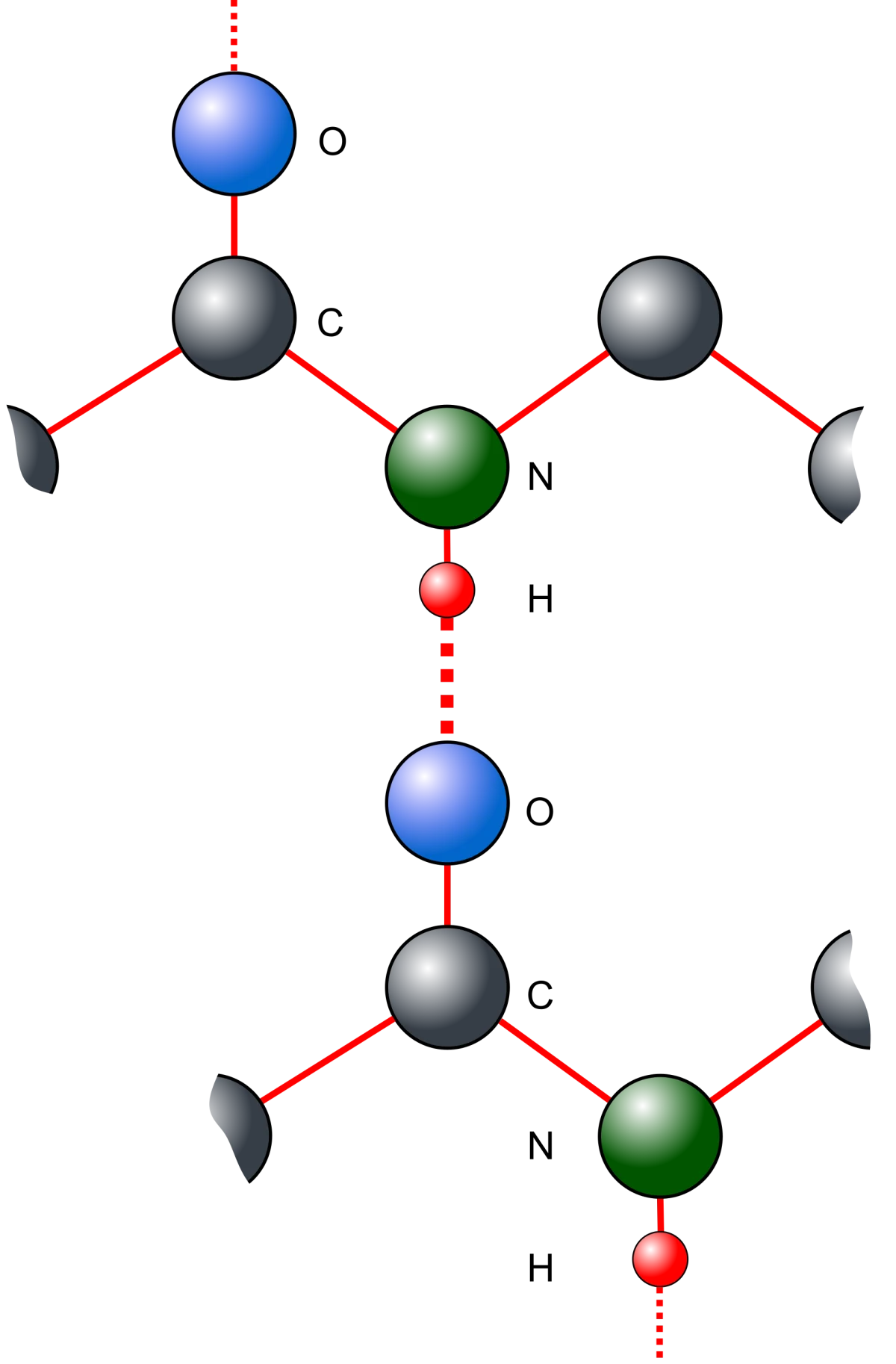
Hydrogen bonding is a special, unusually strong type of dipole-dipole interaction. It occurs when a hydrogen atom bonded to a highly electronegative atom (F, O, or N) is attracted to a lone pair on a nearby F, O, or N atom.
Hydrogen bonding in peptide groups: an N-H donates to a C=O on a nearby residue. This classic H-bond is the interaction that stabilizes alpha helices and beta sheets in proteins. Credit: Wikimedia Commons, CC BY-SA
The requirements are specific:
Hydrogen bond donor: An H atom covalently bonded to F, O, or N (written as X-H, where X = F, O, or N)
Hydrogen bond acceptor: A lone pair on a nearby F, O, or N atom
Both the donor and acceptor must be present for hydrogen bonding to occur
Hydrogen bonding explains many unusual properties of water and biological molecules:
Water’s anomalously high boiling point (100 degrees C vs. -60 degrees C predicted by size alone)
The structure of DNA (base pairs held together by hydrogen bonds)
Protein folding (hydrogen bonds stabilize alpha-helices and beta-sheets)
The solubility of polar organic molecules in water
Water displays the partial charges that make dipole-dipole and hydrogen-bonding interactions possible. The bent geometry leaves δ+ on the hydrogens and δ− on oxygen; in bulk water, those partial charges attract neighboring molecules through both ordinary dipole-dipole forces and the stronger hydrogen bonds (since H is bonded directly to O). London dispersion forces act on every molecule in addition to these. Credit: Wikimedia Commons, CC BY-SA
Ranking IMF Strength
Force
Relative strength
Requirements
Example
Ion-ion (ionic)
Strongest
Full charges
NaCl
Ion-dipole
Very strong
Ion + polar molecule
Na+ in water
Hydrogen bonding
Strong
H bonded to F, O, or N near lone pair on F, O, or N
Water-water
Dipole-dipole
Moderate
Polar molecules
Acetone-acetone
London dispersion
Weakest (but universal)
All molecules
Hexane-hexane
IMF and Boiling Points in Organic Chemistry
The MCAT frequently asks you to rank boiling points of organic compounds. Use this decision tree:
Step 1: Can the molecule hydrogen bond? (Does it have N-H, O-H, or F-H?) If yes, it will have a relatively high boiling point for its size.
Step 2: Is the molecule polar? If yes (but no H-bonding), dipole-dipole forces give it a moderate boiling point boost.
Step 3: How big is the molecule? Larger molecules have stronger LDF and higher boiling points, regardless of polarity.
Step 4: What is the molecular shape? Branching decreases surface area and weakens LDF, lowering the boiling point.
Boiling Point Practice
Compound
MW (g/mol)
IMF present
Boiling point
Ethane (C2H6)
30
LDF only
-89 degrees C
Formaldehyde (CH2O)
30
LDF + dipole-dipole
-19 degrees C
Methanol (CH3OH)
32
LDF + dipole-dipole + H-bonding
65 degrees C
Ethanol (CH3CH2OH)
46
LDF + dipole-dipole + H-bonding
78 degrees C
Propane (C3H8)
44
LDF only
-42 degrees C
Acetone (CH3COCH3)
58
LDF + dipole-dipole
56 degrees C
Notice the pattern: molecules with hydrogen bonding have dramatically higher boiling points than those with only LDF, even when molecular weights are similar (methanol at 65 degrees C vs. ethane at -89 degrees C).
IMF and Solubility
The rule “like dissolves like” is a direct consequence of intermolecular forces:
Polar solutes dissolve in polar solvents because the solute-solvent IMFs (dipole-dipole, H-bonding) are strong enough to compensate for breaking solute-solute and solvent-solvent interactions.
Nonpolar solutes dissolve in nonpolar solvents because the weak LDF between solute and solvent are comparable to the LDF being broken.
Polar solutes do NOT dissolve well in nonpolar solvents because the weak LDF with the solvent cannot compensate for the strong dipole-dipole or H-bonding being broken.
In organic chemistry, this determines which solvents to use for reactions and separations. It also explains why cell membranes (nonpolar lipid bilayers) are permeable to nonpolar molecules but block polar and charged species.
Hydrogen Bonding in Specific Functional Groups
Functional group
Can donate H-bonds?
Can accept H-bonds?
Example
Alcohol (-OH)
Yes (O-H)
Yes (lone pairs on O)
Ethanol
Carboxylic acid (-COOH)
Yes (O-H)
Yes (lone pairs on O)
Acetic acid
Amine (-NH2, -NHR)
Yes (N-H)
Yes (lone pair on N)
Methylamine
Amide (-CONH2)
Yes (N-H)
Yes (lone pairs on O and N)
Acetamide
Ether (-O-)
No
Yes (lone pairs on O)
Diethyl ether
Aldehyde/Ketone (C=O)
No
Yes (lone pairs on O)
Acetone
Ester (-COOR)
No
Yes (lone pairs on O)
Ethyl acetate
Alkane
No
No
Hexane
A molecule that can both donate and accept hydrogen bonds (like an alcohol) forms more extensive H-bonding networks and has a higher boiling point than one that can only accept (like an ether of similar size).
Why does ethanol (MW 46, bp 78 degrees C) boil much higher than dimethyl ether (MW 46, bp -24 degrees C) even though they have the same molecular formula?
Click to reveal answer
Ethanol can donate and accept hydrogen bonds; dimethyl ether can only accept. Ethanol has an O-H bond, making it both a hydrogen bond donor and acceptor. Dimethyl ether (CH3-O-CH3) has no O-H or N-H bonds, so it cannot donate hydrogen bonds - it can only accept them through oxygen's lone pairs. The extensive H-bonding network in ethanol requires much more energy to overcome, resulting in a dramatically higher boiling point.
Nonpolar octane (MW 114) has a higher boiling point than polar acetone (MW 58). How is this possible if dipole-dipole forces are stronger than London dispersion forces?
Click to reveal answer
Octane's much larger surface area creates stronger London dispersion forces that outweigh acetone's dipole-dipole advantage. While dipole-dipole forces are stronger per interaction, octane has nearly twice the molecular weight and significantly more surface area, generating much stronger total LDF. When molecules differ substantially in size, LDF can dominate. This is why you must consider size alongside polarity when ranking boiling points.