
Polarity & Dipoles
Two kids sit on a seesaw. If they weigh the same, the seesaw balances perfectly - the “center of weight” is right in the middle. If one kid is heavier, the seesaw tilts toward them - the center of weight shifts in their direction. Chemical bonds work the same way. When two atoms share electrons equally, the bond is nonpolar. When one atom pulls electrons more strongly (higher electronegativity), the shared electrons shift toward it, creating a polar bond.
But here is the twist: a molecule can have polar bonds and still be nonpolar overall. Just as four equally heavy kids sitting at equal distances around a round table create no net tilt in any direction, bond dipoles can cancel out when the geometry is symmetric. Polarity depends on both bond polarity AND molecular geometry.
Bond Polarity
A bond is polar when the two atoms have different electronegativities. The more electronegative atom pulls electron density toward itself, creating a partial negative charge (delta minus) on its end and a partial positive charge (delta plus) on the other end.
The greater the electronegativity difference, the more polar the bond:
| Bond | Electronegativity difference | Polarity |
|---|---|---|
| C-H | 0.4 | Very slightly polar (often treated as nonpolar) |
| C-N | 0.5 | Slightly polar |
| C-O | 1.0 | Moderately polar |
| C-F | 1.5 | Highly polar |
| O-H | 1.4 | Highly polar |
| N-H | 0.9 | Moderately polar |
For the MCAT, you do not need to memorize exact electronegativity values. Know the trend: F > O > N > C approximately equals S > H. This order lets you predict which end of any bond is delta-negative.
Bond Dipole vs. Molecular Dipole
A bond dipole is the polarity of a single bond. A molecular dipole is the vector sum of all bond dipoles in the molecule. To determine if a molecule is polar, you must add up all bond dipole vectors and see if they cancel.
This is where geometry becomes critical:
Symmetric molecules have zero net dipole even if they have polar bonds:
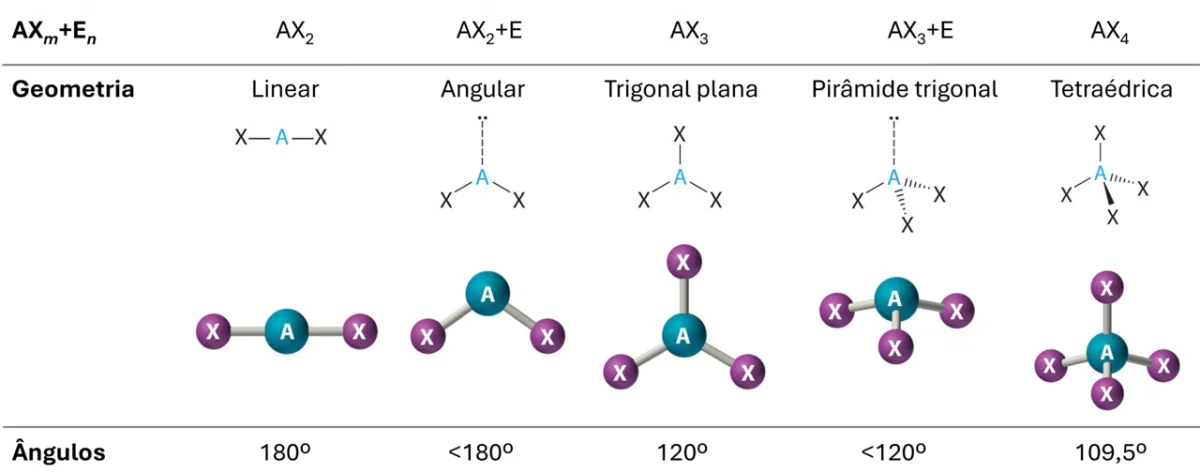
- CO2 (O=C=O): Two C=O bond dipoles point in exactly opposite directions. They cancel perfectly. Net dipole = 0. Nonpolar.
- CCl4: Four C-Cl bond dipoles point toward the corners of a tetrahedron. They cancel perfectly by symmetry. Net dipole = 0. Nonpolar.
- BF3: Three B-F dipoles in a trigonal planar arrangement cancel. Net dipole = 0.
Asymmetric molecules have a net dipole:
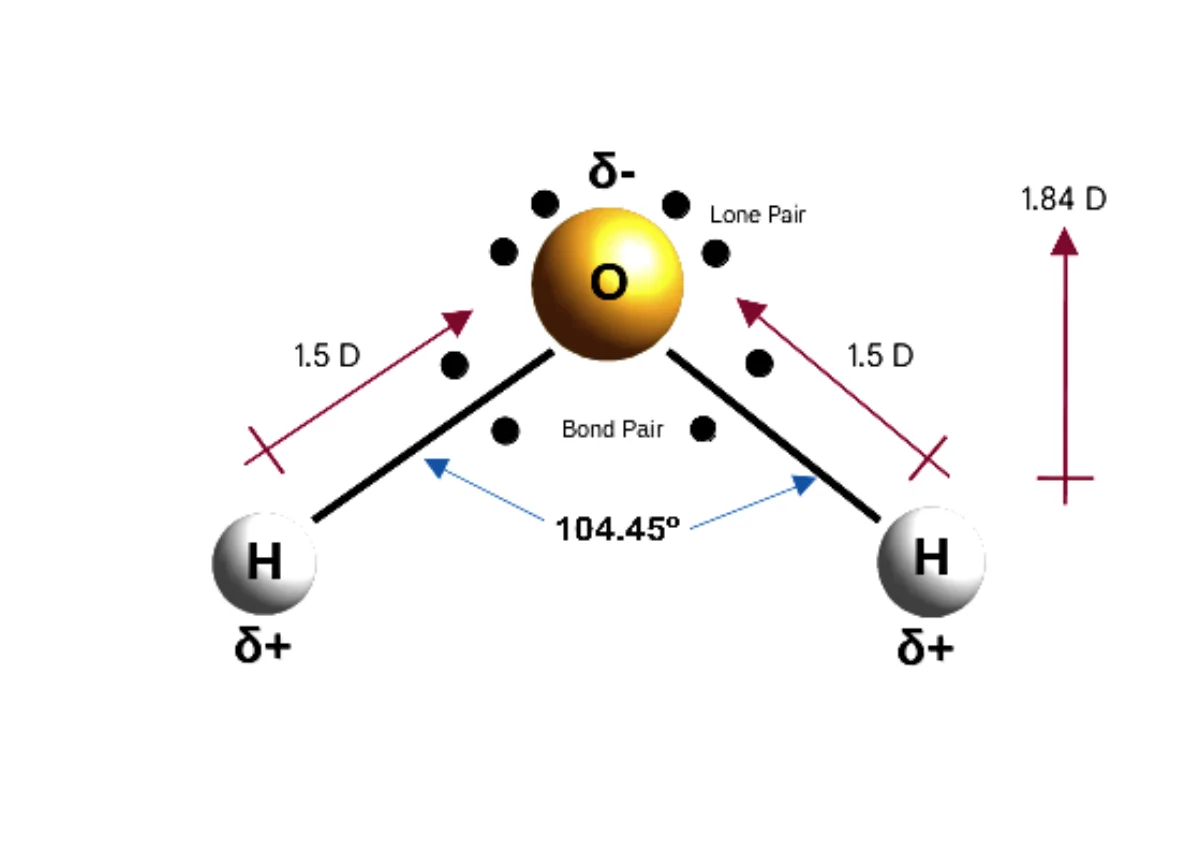
- Water (H2O): Two O-H dipoles point away from oxygen at about 104.5 degrees. They do NOT cancel (the angle is not 180 degrees). Net dipole points from H toward O. Polar.
- CHCl3 (chloroform): Three C-Cl dipoles and one C-H dipole. The three Cl dipoles do not cancel with the single H dipole. Net dipole exists. Polar.
- CH2Cl2 (dichloromethane): Two C-Cl dipoles and two C-H dipoles. They do not cancel. Polar.
Predicting Polarity - A Systematic Approach
Step 1: Identify all polar bonds in the molecule. Any bond between atoms with different electronegativities is polar.
Step 2: Draw the bond dipole vectors. Each vector points from the less electronegative atom toward the more electronegative atom.
Step 3: Add the vectors. If they cancel by symmetry, the molecule is nonpolar. If they do not cancel, the molecule is polar, and the net dipole points in the direction of the resultant vector.
Polarity in Common Organic Functional Groups
| Functional group | Polar? | Key polar bond | Direction of dipole |
|---|---|---|---|
| Alkane (C-C, C-H only) | Nonpolar | None significant | - |
| Alkene (C=C) | Nonpolar (if symmetric) | Depends on substituents | Depends on substitution |
| Alcohol (-OH) | Polar | O-H and C-O | Toward oxygen |
| Amine (-NH2) | Polar | N-H and C-N | Toward nitrogen |
| Carbonyl (C=O) | Polar | C=O | Toward oxygen |
| Carboxylic acid (-COOH) | Polar | C=O, O-H, C-O | Toward oxygen |
| Ether (C-O-C) | Slightly polar | C-O | Toward oxygen |
| Ester (-COOR) | Polar | C=O, C-O | Toward oxygen |
The Special Case of Carbon-Hydrogen Bonds
C-H bonds have an electronegativity difference of only 0.4, making them very slightly polar. In practice, C-H bonds are typically treated as nonpolar for most purposes. This is why hydrocarbons (alkanes, alkenes, alkynes with no heteroatoms) are considered nonpolar molecules.
However, do not confuse “slightly polar bond” with “nonpolar molecule.” A molecule with many C-H bonds but no other polar bonds (like hexane) is nonpolar. A molecule with C-H bonds plus an O-H bond (like ethanol) is polar because of the O-H bond.
Dipole Moment and Physical Properties
A molecule’s dipole moment directly influences:
- Boiling point: Polar molecules have stronger intermolecular forces and higher boiling points than nonpolar molecules of similar size.
- Solubility: Polar molecules dissolve in polar solvents; nonpolar molecules dissolve in nonpolar solvents.
- Melting point: Polar molecules tend to pack better in crystal lattices, raising melting points.
- Chromatographic behavior: Polar molecules interact more strongly with polar stationary phases (e.g., silica gel in TLC and column chromatography).