
Aromaticity
Imagine a group of people standing in a line, each holding hands with the person next to them. Now rearrange them into a circle, everyone holding hands all the way around. The circle is inherently more stable - if one person stumbles, the ring supports them. No one person bears all the strain. That is aromaticity. When pi electrons are delocalized in a continuous loop around a ring, the result is extraordinary stability.
Benzene was the molecule that forced chemists to rethink everything they knew about bonding. It has three double bonds, which should make it highly reactive - but it stubbornly resists the addition reactions that other alkenes undergo. Instead of adding bromine across its double bonds (like cyclohexene does), benzene prefers substitution reactions that preserve its ring. Something about benzene makes it abnormally stable. That something is aromaticity.
The Four Criteria for Aromaticity
A molecule is aromatic if and only if it meets ALL four of these criteria:
- Cyclic - The conjugated system forms a complete, unbroken ring
- Planar - All atoms in the ring lie in the same plane, so p orbitals can align
- Fully conjugated - Every atom in the ring contributes a p orbital to the pi system (no sp3 atoms in the ring)
- 4n + 2 pi electrons - The number of pi electrons in the ring follows Huckel’s rule
If a molecule meets the first three criteria but has 4n pi electrons instead of 4n + 2, it is antiaromatic - actually destabilized.
If a molecule fails any of the first three criteria (not cyclic, not planar, or not fully conjugated), it is non-aromatic - neither stabilized nor destabilized.
Huckel’s Rule: 4n + 2
Huckel’s rule is the mathematical test for aromaticity. Count the pi electrons in the cyclic conjugated system. If the count equals 4n + 2 (where n is a non-negative integer), the molecule is aromatic.
| n | 4n + 2 (aromatic) | 4n (antiaromatic) |
|---|---|---|
| 0 | 2 | 0 |
| 1 | 6 | 4 |
| 2 | 10 | 8 |
| 3 | 14 | 12 |
Benzene - The Classic Aromatic
Benzene (C6H6) has six pi electrons in a six-membered ring. Every carbon is sp2, contributing one p orbital. The ring is planar. The system is fully conjugated. 6 = 4(1) + 2. All four criteria are met. Benzene is aromatic.

The consequences of benzene’s aromaticity:
- Bond lengths are equal. All six C-C bonds are 140 pm (between single at 154 pm and double at 134 pm). Bond order is 1.5 for each.
- Resonance energy is enormous. Benzene is approximately 150 kJ/mol more stable than a hypothetical “cyclohexatriene” with localized double bonds.
- Substitution over addition. Benzene undergoes electrophilic aromatic substitution (preserving the aromatic ring) rather than addition (which would destroy it).
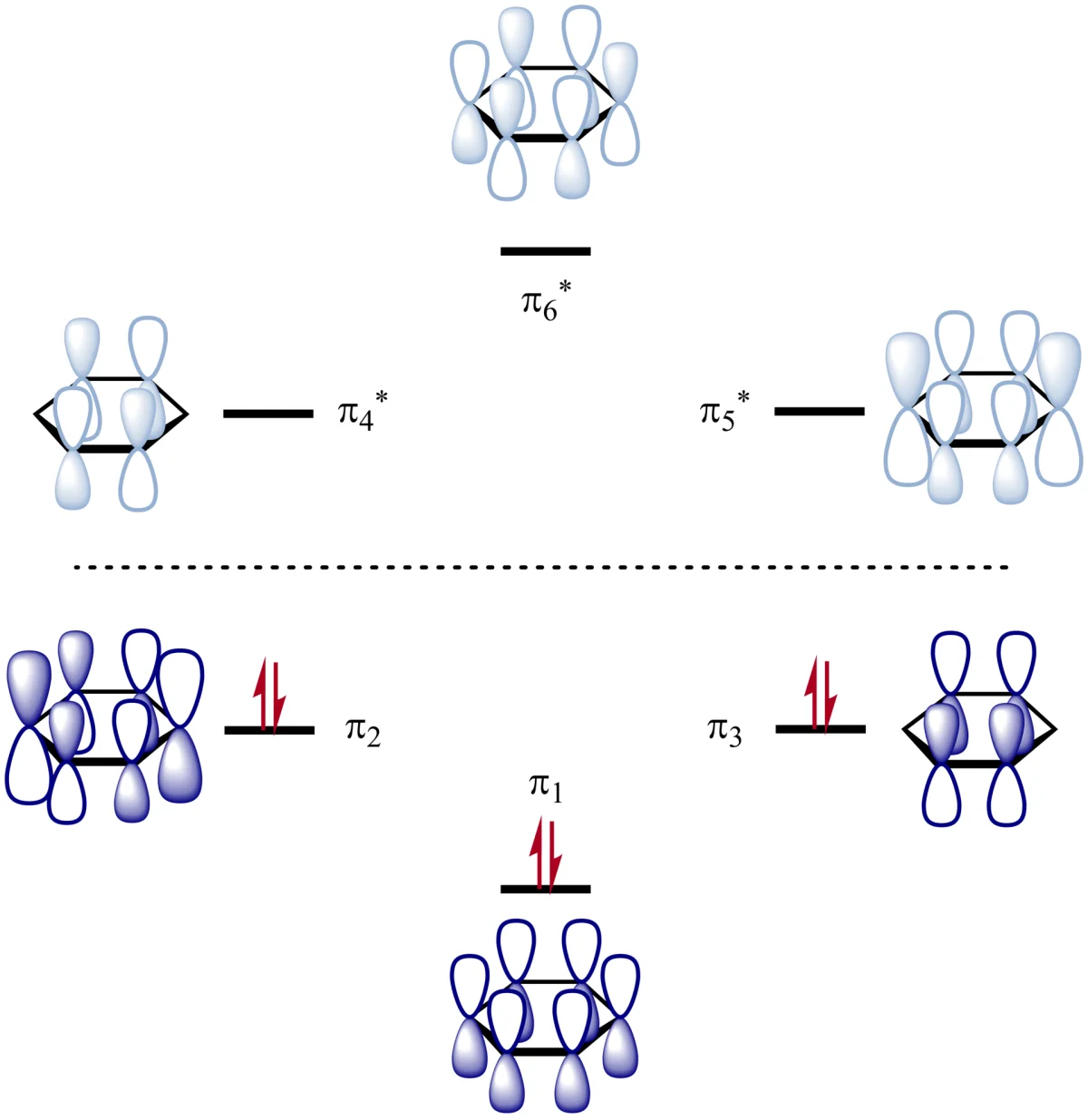
Other Aromatic Molecules
Aromaticity is not limited to benzene. Any molecule meeting the four criteria qualifies:
Cyclopentadienyl anion (C5H5-): Five carbons in a ring, each sp2. Four carbons contribute one pi electron each from the double bonds. The fifth carbon (which was sp3) becomes sp2 when deprotonated, and its lone pair goes into a p orbital. Total: 4 + 2 = 6 pi electrons. Aromatic.
Cycloheptatrienyl cation (tropylium, C7H7+): Seven carbons in a ring, each sp2. Three double bonds contribute 6 pi electrons. The carbocation has an empty p orbital but does not add electrons. Total: 6 pi electrons. Aromatic.
Pyridine: Six-membered ring with one nitrogen. The nitrogen contributes one pi electron from the double bond (its lone pair is in an sp2 orbital in the plane, NOT part of the pi system). Total: 6 pi electrons. Aromatic.
Pyrrole: Five-membered ring with one nitrogen. The nitrogen’s lone pair IS part of the pi system (it is in a p orbital perpendicular to the ring). Total: 4 (from two double bonds) + 2 (from nitrogen’s lone pair) = 6 pi electrons. Aromatic.
Antiaromaticity - Worse Than Nothing
A molecule that is cyclic, planar, fully conjugated, and has 4n pi electrons is antiaromatic. Antiaromaticity is not just the absence of stability - it is active destabilization. An antiaromatic molecule is LESS stable than a comparable non-aromatic (non-conjugated) molecule.
Cyclobutadiene is the textbook example. It has 4 pi electrons (4n where n = 1), is cyclic, planar, and fully conjugated. It is so unstable that it can only be observed at temperatures below 35 K (-238 degrees C). At room temperature, it immediately dimerizes to escape its antiaromatic fate.
Aromatic vs. Antiaromatic vs. Non-aromatic Summary
| Category | Cyclic? | Planar? | Conjugated? | Pi electrons | Stability |
|---|---|---|---|---|---|
| Aromatic | Yes | Yes | Yes | 4n + 2 | Extra stable |
| Antiaromatic | Yes | Yes | Yes | 4n | Extra unstable |
| Non-aromatic | No, or not planar, or not conjugated | - | - | Any | Normal |
Heterocyclic Aromatics
Many biologically important molecules are heterocyclic aromatics - aromatic rings containing atoms other than carbon (usually nitrogen, oxygen, or sulfur). These show up constantly on the MCAT because they form the structural basis of DNA bases, amino acids (histidine, tryptophan), and many drug molecules.
| Molecule | Ring size | Heteroatom | Pi electrons | Lone pair in ring? |
|---|---|---|---|---|
| Pyridine | 6 | N | 6 | No (in sp2 orbital) |
| Pyrrole | 5 | N | 6 | Yes (in p orbital) |
| Furan | 5 | O | 6 | Yes (one lone pair in p orbital) |
| Thiophene | 5 | S | 6 | Yes (one lone pair in p orbital) |
| Imidazole | 5 | 2 N | 6 | One N yes, one N no |