
Geometry & VSEPR
You learned VSEPR (Valence Shell Electron Pair Repulsion) in general chemistry as a way to predict molecular shapes. In organic chemistry, the same theory applies, but the context is different. Instead of predicting the shape of an entire small molecule like water or ammonia, you are now predicting the geometry around every single atom in a large organic structure. And the geometry around each atom determines the overall three-dimensional shape of the molecule.
The core idea of VSEPR is simple: electron groups repel each other and arrange themselves as far apart as possible. That is it. Everything else follows from this one principle.
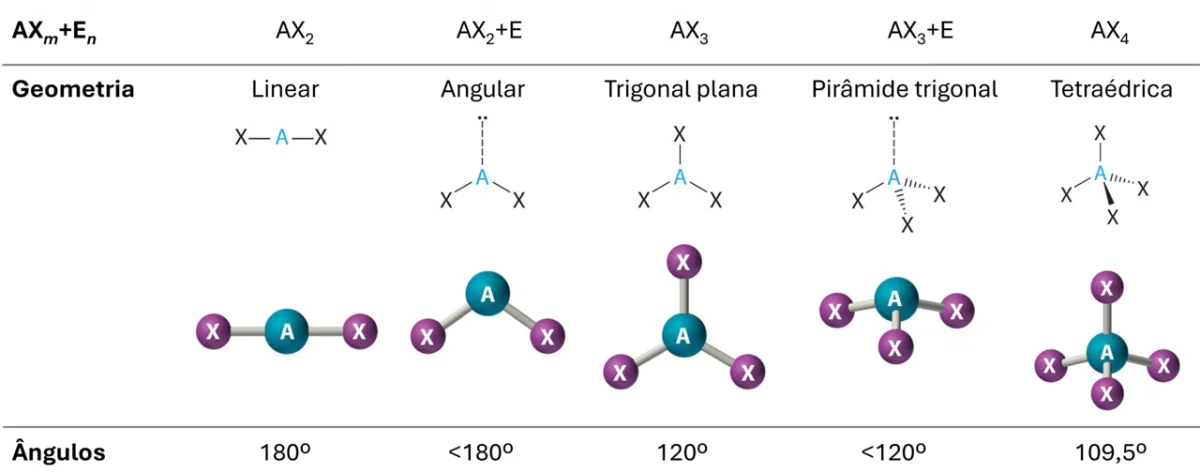
Electron Geometry vs. Molecular Geometry
This distinction trips up many students, so let us be very clear:
- Electron geometry counts ALL regions of electron density (bonds AND lone pairs) and describes how they arrange around the central atom.
- Molecular geometry describes only where the ATOMS are. Lone pairs are invisible in molecular geometry, but they still push the bonded atoms around.
The electron geometry tells you the hybridization. The molecular geometry tells you the actual shape someone would see.
The Four Geometries You Need for Organic Chemistry
Almost every atom in organic chemistry has one of these four geometries:
1. Tetrahedral (sp3) - 4 electron groups
- Bond angle: 109.5 degrees
- Example: carbon in methane, carbon in any alkane
- All single bonds, maximum separation in 3D
- The carbon is at the center of a tetrahedron with bonds pointing to the four corners
2. Trigonal planar (sp2) - 3 electron groups
- Bond angle: 120 degrees
- Example: carbon in ethene (C=C), carbonyl carbon (C=O)
- Three groups in a flat triangle, with any remaining p orbital perpendicular to the plane
- Found wherever there is a double bond
3. Linear (sp) - 2 electron groups
- Bond angle: 180 degrees
- Example: carbon in CO2, carbon in alkynes
- Two groups pointing in exactly opposite directions
4. Bent - 2 bonded atoms + lone pairs
- A special case of tetrahedral or trigonal planar electron geometry
- Molecular geometry appears bent because lone pairs push the bonded atoms closer together
- Example: water (tetrahedral electron geometry, bent molecular geometry with bond angle ~104.5 degrees)
Impact of Lone Pairs on Bond Angles
Lone pairs occupy more space than bonding pairs because they are attracted to only one nucleus (not two). They squeeze bonded atoms closer together, reducing bond angles below the ideal values.
| Molecule | Electron groups | Lone pairs | Electron geometry | Molecular geometry | Bond angle |
|---|---|---|---|---|---|
| CH4 | 4 | 0 | Tetrahedral | Tetrahedral | 109.5 degrees |
| NH3 | 4 | 1 | Tetrahedral | Trigonal pyramidal | ~107 degrees |
| H2O | 4 | 2 | Tetrahedral | Bent | ~104.5 degrees |
| BF3 | 3 | 0 | Trigonal planar | Trigonal planar | 120 degrees |
Notice the pattern: more lone pairs means more compression of bond angles. Each lone pair squeezes the bonded atoms closer by about 2-2.5 degrees.
Applying VSEPR to Organic Molecules
In organic chemistry, you rarely need to analyze an entire molecule’s shape at once. Instead, you analyze the geometry around each individual atom. Here is a systematic approach:
Step 1: Pick an atom.
Step 2: Count the number of sigma bonds + lone pairs on that atom. (Double and triple bonds count as one region of electron density for VSEPR purposes.)
Step 3: Match to the geometry:
- 4 regions = tetrahedral electron geometry
- 3 regions = trigonal planar electron geometry
- 2 regions = linear electron geometry
Step 4: Remove lone pairs to get the molecular geometry around that atom.
Worked Example: Acetic Acid (CH3COOH)
Let us analyze every heavy atom:
Carbon 1 (the CH3 carbon): 4 sigma bonds (3 C-H + 1 C-C), 0 lone pairs. Tetrahedral, 109.5 degrees.
Carbon 2 (the carboxyl carbon): 3 sigma bonds (1 C-C + 1 C=O + 1 C-O), 0 lone pairs. (The C=O double bond counts as one region.) Trigonal planar, 120 degrees.
Oxygen (C=O): 1 sigma bond to C + 0 pi bonds counted as electron regions + 2 lone pairs = 3 regions. But wait - actually the double bond means oxygen has 2 sigma bonds… Let us count carefully. This oxygen is double-bonded to carbon. For VSEPR: the C=O counts as 1 region on the oxygen side (1 bond to carbon) + 2 lone pairs = 3 regions. Trigonal planar electron geometry, but molecular geometry is bent (one bond, two lone pairs visible… actually one bond makes it just a terminal atom). Since this oxygen only bonds to one atom, we do not typically describe its geometry - it is just part of carbon’s geometry.
Oxygen (O-H): 2 sigma bonds (1 C-O + 1 O-H) + 2 lone pairs = 4 regions. Tetrahedral electron geometry, bent molecular geometry (~104.5 degrees).
Common Organic Geometries at a Glance
| Atom | Typical bonding | Hybridization | Geometry |
|---|---|---|---|
| C with 4 single bonds | Alkane C | sp3 | Tetrahedral |
| C with 1 double bond | Alkene C, carbonyl C | sp2 | Trigonal planar |
| C with 1 triple bond | Alkyne C, nitrile C | sp | Linear |
| N with 3 bonds, 1 lone pair | Amine N | sp3 | Trigonal pyramidal |
| N with 2 bonds, 1 lone pair (in C=N) | Imine N | sp2 | Bent |
| O with 2 bonds, 2 lone pairs | Alcohol O, ether O | sp3 | Bent |
Geometry and Reactivity
Molecular geometry is not just an academic exercise - it directly affects reactivity:
- Tetrahedral carbons (sp3) have bond angles of 109.5 degrees. Nucleophilic substitution reactions (SN2) require the nucleophile to approach from the back side, 180 degrees from the leaving group.
- Trigonal planar carbons (sp2) in carbonyls are accessible from both faces. Nucleophilic addition to aldehydes and ketones proceeds because the flat sp2 carbon is exposed.
- Ring strain occurs when bond angles are forced away from the ideal. Cyclopropane has 60-degree angles (vs. 109.5 ideal for sp3), creating enormous angle strain that makes the C-C bonds unusually weak and reactive.