
Molecular Orbital Theory
In the last section, you learned about atomic orbitals - the rooms where electrons live in isolated atoms. But organic chemistry is not about isolated atoms. It is about atoms bonded together. What happens to those atomic orbitals when two atoms approach each other and their electron clouds start to overlap?
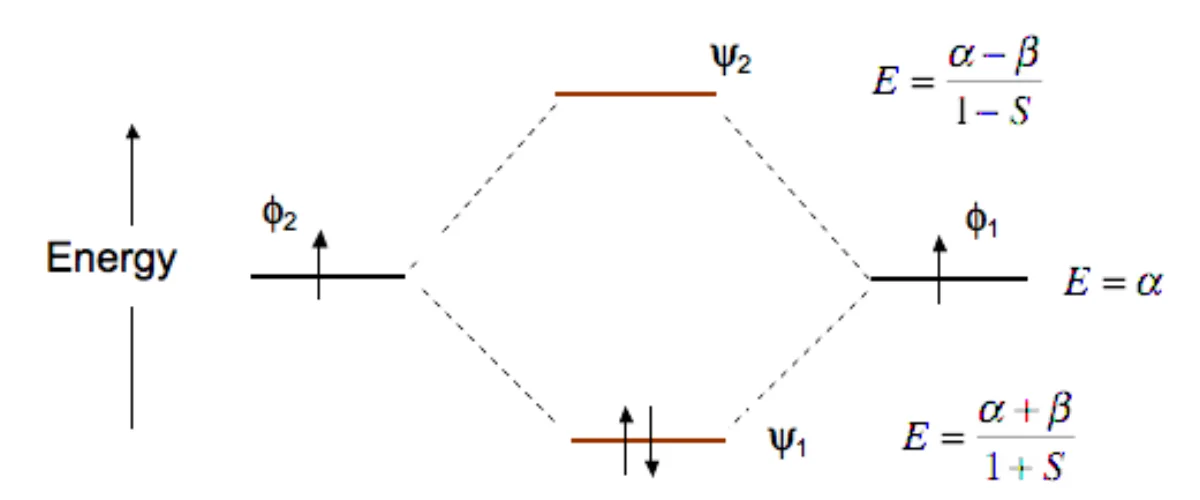
Molecular orbital (MO) theory gives the answer. When two atomic orbitals combine, they do not simply coexist. They merge into new orbitals that belong to the entire molecule. And here is the critical part: two atomic orbitals always produce exactly two molecular orbitals - one that is lower in energy than either original (the bonding orbital) and one that is higher in energy (the antibonding orbital).
Bonding Orbitals
When two atomic orbitals overlap in phase (same sign of the wave function), they undergo constructive interference. Electron density builds up in the region between the two nuclei, pulling them together. The result is a bonding molecular orbital - it is lower in energy than either atomic orbital alone, and electrons in it stabilize the bond.
A bonding orbital concentrates electron density between the nuclei. This shared electron density is what holds the two atoms together. More electron density between nuclei means a stronger bond.
Antibonding Orbitals
When two atomic orbitals overlap out of phase (opposite signs), they undergo destructive interference. Electron density is pushed away from the region between the nuclei, creating a node right in the middle. The result is an antibonding molecular orbital - it is higher in energy than either atomic orbital, and electrons in it destabilize the bond.
Antibonding orbitals are labeled with an asterisk: sigma-star (sigma*) or pi-star (pi*). If an antibonding orbital is occupied, its electrons actively work against the bond.
MO Diagrams for Diatomic Molecules
An MO diagram shows the energy levels of atomic orbitals on the sides and molecular orbitals in the middle. Electrons fill molecular orbitals from lowest to highest energy, just like atomic orbitals follow the Aufbau principle.
For simple diatomics like H2:
- Each hydrogen contributes one 1s atomic orbital (two total)
- Two atomic orbitals combine to form two molecular orbitals: one sigma bonding (lower energy) and one sigma* antibonding (higher energy)
- The two electrons (one from each H) fill the bonding orbital
- Result: bond order = 1, stable molecule
For He2 (hypothetical):
- Each helium contributes one 1s orbital (two total)
- Same two molecular orbitals form: sigma and sigma*
- Four electrons total: two fill the bonding, two fill the antibonding
- Bonding and antibonding cancel - bond order = 0, molecule does not exist
Bond Order
Bond order tells you how many net bonds hold two atoms together. It is calculated from the MO diagram:
Examples:
| Molecule | Bonding e- | Antibonding e- | Bond Order | Stable? |
|---|---|---|---|---|
| H2 | 2 | 0 | 1 | Yes |
| He2 | 2 | 2 | 0 | No |
| N2 | 8 | 2 | 3 | Yes (triple bond) |
| O2 | 8 | 4 | 2 | Yes (double bond) |
| Ne2 | 8 | 8 | 0 | No |
MO Diagrams for Second-Row Diatomics
For molecules involving second-row elements (Li through Ne), the MO diagram gets more complex because both s and p atomic orbitals participate.
When two 2p orbitals overlap head-on, they form sigma(2p) bonding and sigma*(2p) antibonding MOs. When two 2p orbitals overlap side-by-side, they form pi(2p) bonding and pi*(2p) antibonding MOs.
The key complication is s-p mixing. For elements Li through N, the sigma(2p) and sigma(2s) orbitals interact, pushing sigma(2p) above pi(2p) in energy. For O and F, s-p mixing is weaker, so sigma(2p) drops below pi(2p).
The practical consequence: the filling order for B2, C2, and N2 differs from O2 and F2. You do not need to memorize every MO diagram, but you should understand the concept and be able to determine bond order and magnetic properties.
HOMO and LUMO
Two molecular orbitals are especially important for understanding reactivity:
- HOMO (Highest Occupied Molecular Orbital): The highest-energy MO that contains electrons. This is where the molecule donates electrons from - it acts as the nucleophile’s “active orbital.”
- LUMO (Lowest Unoccupied Molecular Orbital): The lowest-energy empty MO. This is where the molecule accepts electrons - it acts as the electrophile’s “active orbital.”
Chemical reactions in organic chemistry are fundamentally about electrons flowing from one molecule’s HOMO into another molecule’s LUMO. The better the energy match and orbital overlap between HOMO and LUMO, the faster the reaction proceeds.
Paramagnetism from MO Theory
One of the greatest successes of MO theory is explaining the magnetic properties of O2. Lewis structures predict that O2 should be diamagnetic (all electrons paired), but experiments show it is paramagnetic (attracted to a magnet).
The MO diagram for O2 resolves this. After filling all bonding and antibonding orbitals, two electrons end up in the two degenerate (equal energy) pi*(2p) orbitals. By Hund’s rule, they fill one per orbital with parallel spins. These two unpaired electrons make O2 paramagnetic.
MO Theory vs. Lewis Structures vs. Valence Bond Theory
The MCAT expects you to understand three bonding models and when each one is most useful:
| Model | What it shows | Best for |
|---|---|---|
| Lewis structures | Electron pairs, formal charges, octets | Quick bonding overview, predicting shape |
| Valence bond theory | Orbital overlap, hybridization | Explaining geometry and sigma/pi bonds |
| MO theory | Bonding/antibonding, bond order, magnetism | Bond strength, paramagnetism, delocalization |
Lewis structures are the fastest. Valence bond theory (hybridization) explains geometry. MO theory is the most complete but takes the most work. Use each model when it best answers the question.