
Conjugation
Line up a row of dominoes and flick the first one. The entire row falls in sequence because each domino transfers energy to the next. Now remove one domino from the middle. The chain stops dead at the gap - the remaining dominoes stand untouched.
Conjugation works exactly the same way. When p orbitals on adjacent atoms are aligned parallel to each other, pi electrons can delocalize across the entire system. Every atom in the chain participates, and the result is a molecule that is more stable, absorbs light at longer wavelengths, and behaves differently in reactions. But insert one sp3 carbon (an atom with no p orbital to contribute), and the chain breaks. The conjugation stops.
What Makes a System Conjugated?
A conjugated system is one where p orbitals on three or more adjacent atoms are aligned parallel, allowing continuous overlap. The simplest example is 1,3-butadiene: CH2=CH-CH=CH2.
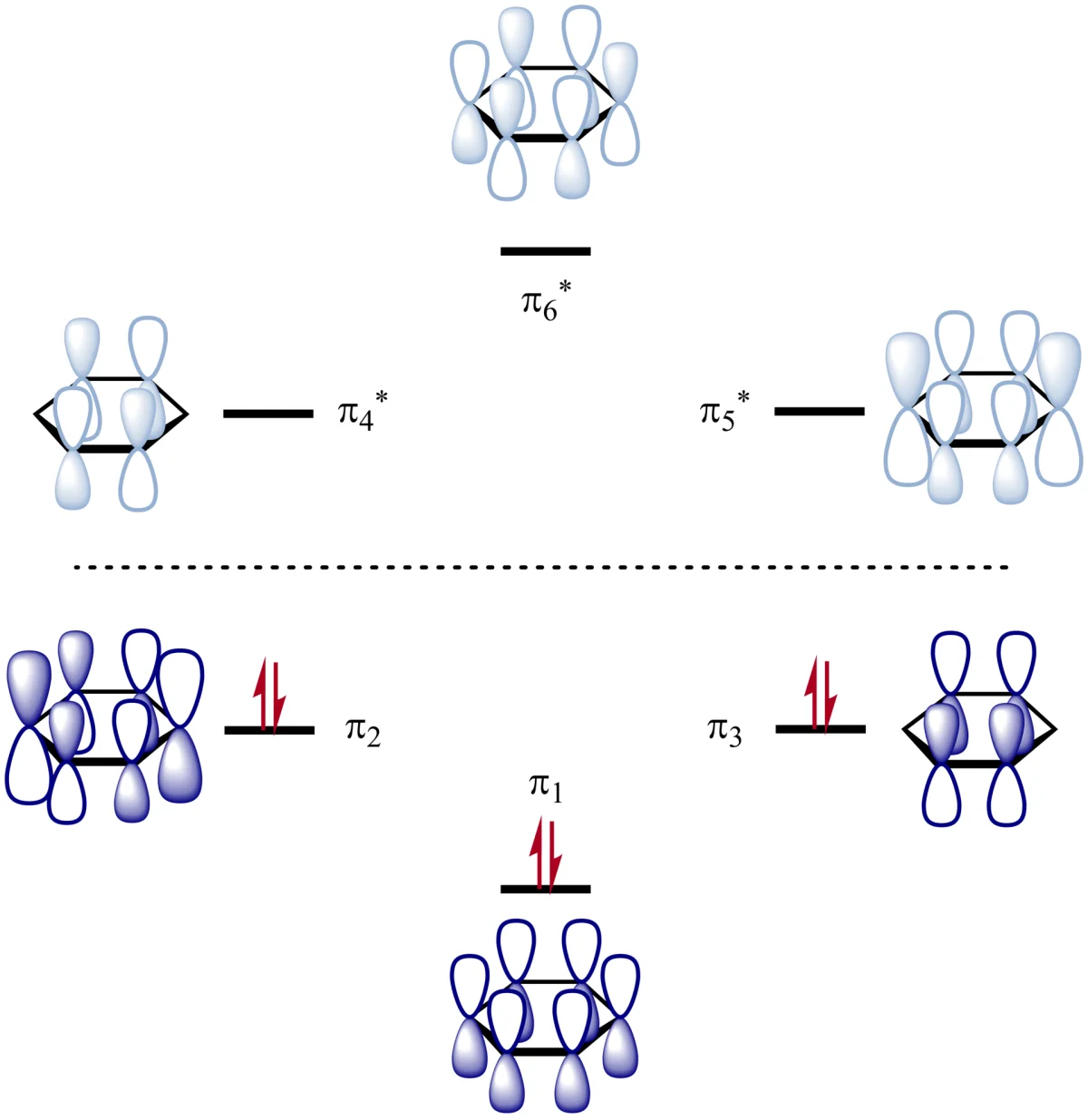
In 1,3-butadiene, all four carbons are sp2 hybridized. Each has one unhybridized p orbital perpendicular to the molecular plane. These four p orbitals overlap continuously across the molecule, creating a single extended pi system.
The key requirement for conjugation is alternating single and double bonds (or a pattern that puts a p orbital on every adjacent atom). The “single” bonds between double bonds in a conjugated system are not ordinary single bonds - they have partial double-bond character because of the pi electron delocalization.
Conjugated vs. Isolated vs. Cumulated Double Bonds
Not all systems with multiple double bonds are conjugated. There are three arrangements:
Conjugated (1,3-diene): Double bonds separated by exactly one single bond. Example: CH2=CH-CH=CH2 (1,3-butadiene). The p orbitals overlap continuously. This is the most stable arrangement.
Isolated (1,4-diene): Double bonds separated by two or more single bonds. Example: CH2=CH-CH2-CH=CH2 (1,4-pentadiene). The sp3 carbon in the middle breaks conjugation. Each double bond behaves independently.
Cumulated (allene): Double bonds on the same carbon with no intervening single bond. Example: CH2=C=CH2 (allene). The central carbon is sp hybridized, and the two pi bonds are perpendicular to each other. This is the least stable arrangement.
| Type | Pattern | Example | Stability |
|---|---|---|---|
| Conjugated | C=C-C=C | 1,3-butadiene | Most stable |
| Isolated | C=C-CH2-C=C | 1,4-pentadiene | Middle |
| Cumulated | C=C=C | Allene | Least stable |
Why Conjugation Stabilizes Molecules
Conjugation stabilizes molecules for the same reason that spreading weight across a bridge’s supports is better than putting it all on one: delocalization distributes electron density across more atoms, reducing electron-electron repulsion and lowering the overall energy.
You can measure this stabilization experimentally. The heat of hydrogenation of 1,3-butadiene is 16 kJ/mol less than what you would predict by doubling the value for an isolated double bond. That 16 kJ/mol difference is the resonance energy (or delocalization energy) - free stability that the molecule gains just from being conjugated.
How to Identify Conjugation in Complex Molecules
Follow these steps to find conjugated systems in any organic molecule:
- Identify all double bonds, lone pairs on p orbitals, and empty p orbitals.
- Check if they are on adjacent atoms. If a double bond is next to another double bond (separated by one single bond), they are conjugated.
- Check for lone pairs or empty p orbitals. A lone pair on an atom adjacent to a double bond can participate in conjugation if the atom has a p orbital (e.g., the nitrogen lone pair in aniline is conjugated with the aromatic ring).
- Look for sp3 carbons that break the chain. Any sp3 atom interrupts conjugation.
Common conjugated systems in organic chemistry:
- 1,3-dienes (butadiene, isoprene)
- Alpha, beta-unsaturated carbonyls (C=C-C=O)
- Aromatic rings (benzene and its derivatives)
- Enolate ions (C=C-O-)
- Amides (N-C=O, where the nitrogen lone pair is conjugated)
Conjugation and UV-Vis Absorption
One practical consequence of conjugation is that it lowers the energy gap between the HOMO and LUMO. When this gap decreases, the molecule absorbs longer-wavelength (lower-energy) light.
Short conjugated systems absorb in the UV range (invisible to our eyes). As conjugation extends, the absorption shifts toward visible wavelengths. This is why many colored compounds - beta-carotene (orange), lycopene (red), chlorophyll (green) - have extensive conjugated systems.
Conjugation and Reactivity
Conjugated systems react differently than isolated double bonds. In 1,3-butadiene, electrophilic addition can produce both 1,2-addition and 1,4-addition products because the intermediate allylic carbocation is stabilized by conjugation.
At low temperatures, the 1,2-product (kinetic product) forms faster. At high temperatures, the 1,4-product (thermodynamic product) predominates because it produces the more substituted, more stable alkene. This kinetic vs. thermodynamic control is a major MCAT topic covered in later chapters.