
Atomic Orbitals
Before you can understand how atoms bond, you need to understand where electrons live. Electrons do not orbit the nucleus like planets around the sun. They exist in regions of probability called orbitals - three-dimensional shapes that tell you where an electron is most likely to be found. The shape of an orbital determines how it can overlap with orbitals on neighboring atoms, and that overlap is what creates chemical bonds.
Think of an orbital as a room in a house. The shape of the room determines what furniture you can fit inside and how you can connect it to the room next door. A round room connects differently than a long, narrow room. In the same way, a spherical s orbital overlaps with its neighbors differently than a dumbbell-shaped p orbital. Understanding these shapes is the first step to understanding organic bonding.
s Orbitals
s orbitals are spherical. The electron density is distributed equally in all directions around the nucleus. Every energy level (n = 1, 2, 3, …) has exactly one s orbital.
The key properties of s orbitals for organic chemistry:
- Shape: Sphere centered on the nucleus
- Number per shell: 1
- Maximum electrons: 2 (one spin-up, one spin-down)
- Directional preference: None - s orbitals have no preferred direction, which means they can overlap with a neighboring orbital along any axis
As the principal quantum number n increases, s orbitals get larger. A 2s orbital is bigger than a 1s orbital, and a 3s orbital is bigger still. Larger orbitals mean the electron is, on average, farther from the nucleus.
Higher-energy s orbitals also develop radial nodes - spherical shells within the orbital where the probability of finding the electron drops to exactly zero. The 1s has zero radial nodes, the 2s has one, and the 3s has two. The general formula is: radial nodes = n - l - 1.
p Orbitals
p orbitals are dumbbell-shaped, with two lobes on opposite sides of the nucleus separated by a nodal plane. Each p orbital has one angular node - a flat plane passing through the nucleus where the electron will never be found.
Starting at n = 2, every energy level has three p orbitals oriented along the three spatial axes: px, py, and pz. These three orbitals are identical in shape and energy but point in different directions.
The directional nature of p orbitals is crucial for organic chemistry. When a p orbital on one atom lines up with a p orbital on a neighboring atom, the side-by-side overlap creates a pi bond. When a p orbital points directly at a neighbor, the head-on overlap creates a sigma bond. The orientation matters.
d Orbitals
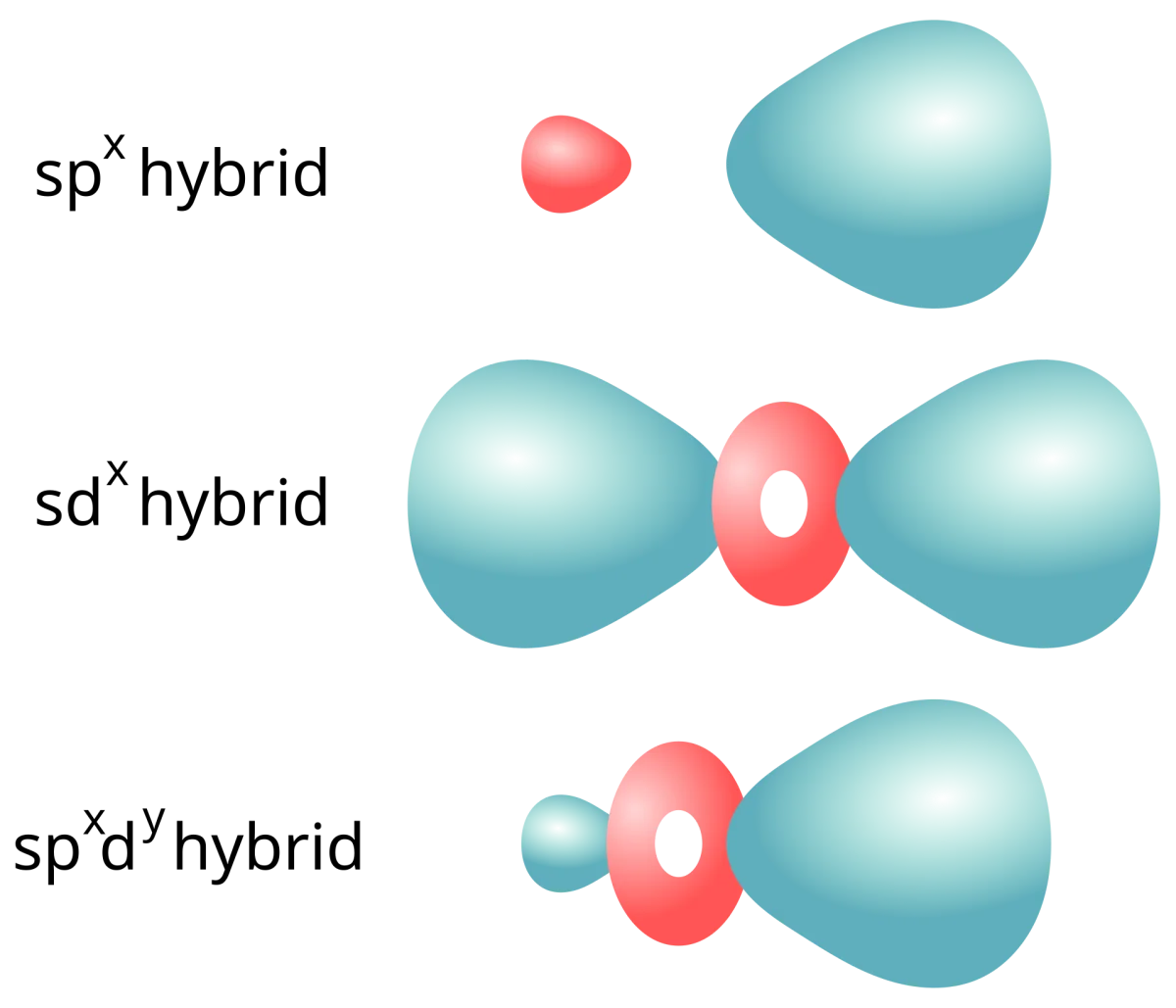
d orbitals have more complex cloverleaf shapes, with four lobes in most cases. They first appear at n = 3, and there are five d orbitals per shell, holding up to 10 electrons.
For organic chemistry on the MCAT, d orbitals matter in two contexts:
- Expanded octets: Elements in the third row and below (like sulfur and phosphorus) have accessible d orbitals, which allows them to form more than four bonds. This is why sulfur in SF6 has six bonds - it uses d orbitals.
- Molecular orbital theory: When you construct MO diagrams, d orbitals can participate in bonding for heavier atoms.
You do not need to draw d orbital shapes on the MCAT. What matters is knowing they exist, they start at n = 3, there are five of them, and they enable expanded octets for third-row elements.
f Orbitals
f orbitals are the most complex, with seven per shell starting at n = 4. They hold up to 14 electrons and are relevant to the lanthanides and actinides. The MCAT does not test f orbital shapes. Know they exist and move on.
Nodes - Where Electrons Cannot Be
A node is a region where the probability of finding an electron is exactly zero. There are two types:
- Radial (spherical) nodes: Spherical shells within the orbital where electron density drops to zero. A 2s orbital has one radial node - imagine a hollow sphere inside the larger sphere of electron density.
- Angular (planar) nodes: Flat planes or conical surfaces through the nucleus. A p orbital has one angular node (the plane between its two lobes). d orbitals have two angular nodes.
The formulas you need:
| Formula | Value |
|---|---|
| Total nodes | n - 1 |
| Angular nodes | l |
| Radial nodes | n - l - 1 |
For a 3p orbital: total nodes = 3 - 1 = 2, angular nodes = 1, radial nodes = 2 - 1 = 1.
Why Orbital Shapes Matter in Organic Chemistry
In general chemistry, you learned orbital shapes to understand electron configurations. In organic chemistry, orbital shapes matter for a different reason: they determine how bonds form.
- s + s overlap creates sigma bonds in H2.
- s + p overlap creates sigma bonds in molecules like HF.
- p + p head-on overlap creates sigma bonds between carbon atoms.
- p + p side-by-side overlap creates pi bonds in double and triple bonds.
- Hybrid orbitals (sp3, sp2, sp) are mixtures of s and p orbitals with shapes designed for specific molecular geometries.
Every bond you will encounter in organic chemistry traces back to the overlap of atomic or hybrid orbitals. The rest of this chapter builds on this foundation.
Orbital Shape Summary
| Orbital | l | Shape | Number per shell | Max electrons | First appears |
|---|---|---|---|---|---|
| s | 0 | Sphere | 1 | 2 | n = 1 |
| p | 1 | Dumbbell | 3 | 6 | n = 2 |
| d | 2 | Cloverleaf | 5 | 10 | n = 3 |
| f | 3 | Complex | 7 | 14 | n = 4 |