
Adaptive Immunity Overview
Innate immunity buys time. Adaptive immunity finishes the job.
The adaptive immune system is slower to activate (taking days to weeks on first exposure), but it has two superpowers that innate immunity lacks: specificity (it targets one particular pathogen) and memory (it remembers that pathogen forever).
Two Arms, Two Targets
Adaptive immunity splits into two branches based on the type of threat:
Humoral immunity (“humor” = body fluid) uses antibodies produced by B cells to fight pathogens circulating freely in the blood, lymph, and tissue fluids. If the enemy is floating around outside of cells - bacteria in the bloodstream, toxins, viruses before they enter cells - humoral immunity handles it.
Cell-mediated immunity uses T cells to fight pathogens hiding inside cells. If a virus has already infected a cell and is replicating inside it, antibodies cannot reach it. Instead, cytotoxic T cells recognize the infected cell and destroy it, sacrificing the cell to kill the pathogen within.
Extracellular vs. Intracellular Pathogens
This distinction is critical for MCAT reasoning:
| Pathogen Location | Examples | Primary Defense |
|---|---|---|
| Extracellular (in body fluids) | Most bacteria, fungi, parasites, viral particles before cell entry | Humoral immunity (antibodies from B cells) |
| Intracellular (inside host cells) | Viruses (replicating), some bacteria (e.g., Mycobacterium tuberculosis), some parasites (e.g., Plasmodium) | Cell-mediated immunity (cytotoxic T cells) |
Important nuance: viruses exist in both states. Before entering a cell, a virus is an extracellular particle (virion) targetable by antibodies. Once inside a cell, it can only be reached by cell-mediated immunity. This is why both arms are needed for a complete antiviral response.
B Cells and T Cells: Origin and Maturation
Both B cells and T cells originate from hematopoietic stem cells in the bone marrow, but they mature in different locations:
- B cells mature in the Bone marrow
- T cells migrate to and mature in the Thymus
After maturation, both cell types are mature but naive - they are fully functional but have not yet encountered their specific antigen. Think of them as trained soldiers who have graduated boot camp but have never seen combat. They circulate through the blood and lymph, waiting in lymph nodes and the spleen until they encounter their matching antigen.
The Adaptive Response Timeline
On first exposure to a new pathogen (primary response):
- Innate immunity responds immediately (hours)
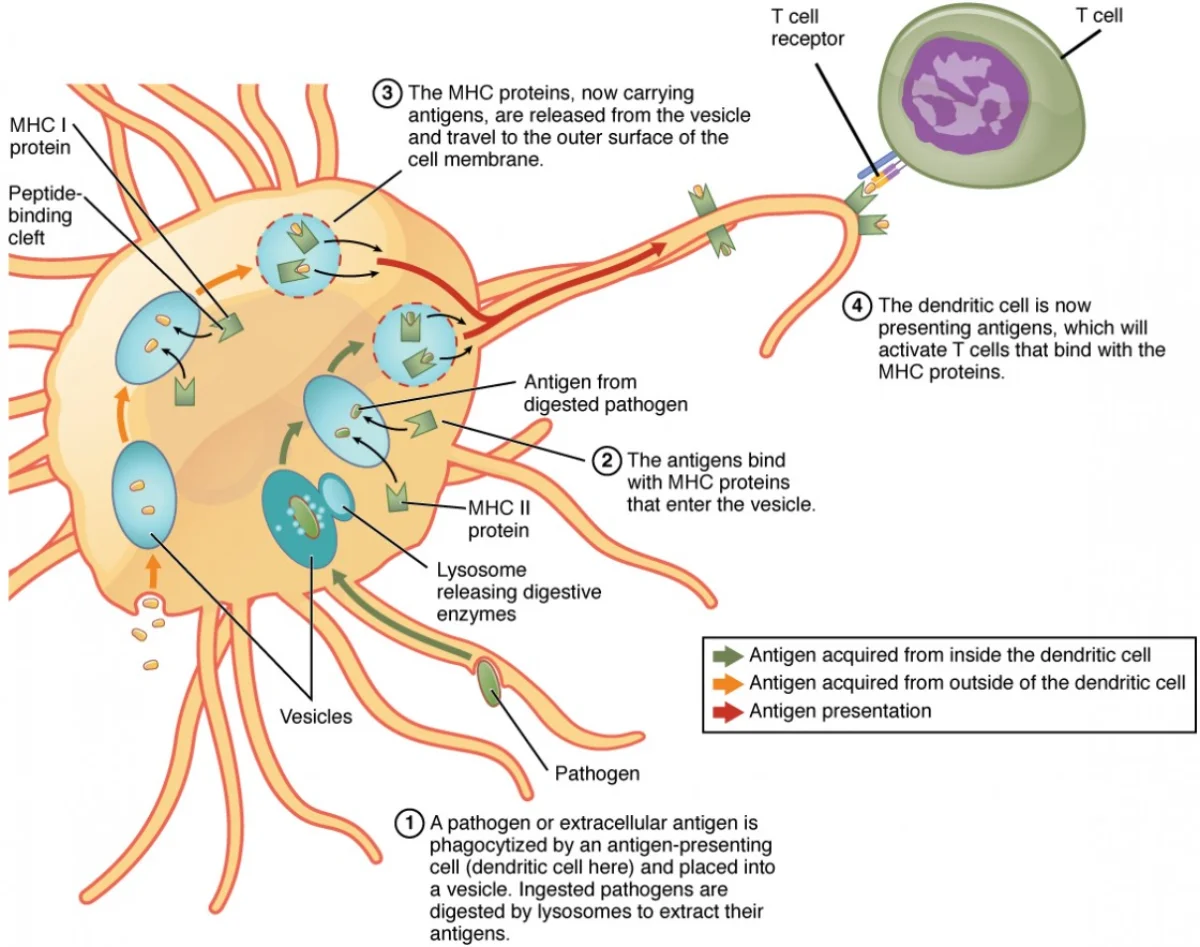
- Dendritic cells capture antigens and migrate to lymph nodes (hours to days)
- Naive T and B cells that match the antigen are activated (days)
- Clonal expansion produces an army of identical effector cells (days to weeks)
- Antibodies appear in the blood and effector T cells deploy (~7-10 days)
- The pathogen is cleared
- Most effector cells die, but memory cells persist
On second exposure (secondary response):
- Memory cells recognize the pathogen immediately
- Response is faster (1-2 days), stronger (more antibodies, higher affinity), and longer-lasting
- The person may never develop symptoms
This is exactly why vaccines work - they trigger the primary response without causing disease, so the secondary response is ready when the real pathogen arrives.
How the Two Arms Cooperate
Humoral and cell-mediated immunity are not independent - they work together, with helper T cells (CD4+) acting as the coordinator:
- Dendritic cells present antigen to helper T cells via MHC II
- Activated helper T cells release cytokines that:
- Stimulate B cells to produce antibodies (activating humoral immunity)
- Stimulate cytotoxic T cells to kill infected cells (activating cell-mediated immunity)
- Enhance macrophage killing ability
Without helper T cells, both branches of adaptive immunity collapse. This is precisely why HIV - which destroys CD4+ helper T cells - is so devastating. The entire adaptive immune system depends on them.
| Feature | Humoral Immunity | Cell-Mediated Immunity |
|---|---|---|
| Effector cells | B cells (plasma cells) | T cells (CD8+ cytotoxic) |
| Coordinator | Helper T cells (CD4+) | Helper T cells (CD4+) |
| Weapon | Antibodies | Perforin + granzymes |
| Target | Extracellular pathogens | Intracellular pathogens |
| Works against | Bacteria, toxins, free viruses | Virus-infected cells, cancer cells |
| Memory? | Yes (memory B cells) | Yes (memory T cells) |