If hemoglobin is the bus that carries oxygen, what about the return trip? Carbon dioxide - the waste product of aerobic metabolism - needs to get from the tissues back to the lungs for exhalation. But CO2 does not just hitch a ride on hemoglobin the way oxygen does. Instead, CO2 travels by three different routes, and the dominant one involves a clever chemical conversion that also happens to be your blood’s primary pH buffering system.
The Three Mechanisms of CO2 Transport
Mechanism
Percentage
How It Works
Dissolved CO2
~7-10%
CO2 dissolves directly in plasma (follows Henry’s Law)
Bicarbonate ion (HCO3-)
~70%
CO2 is converted to HCO3- inside RBCs by carbonic anhydrase
Carbaminohemoglobin
~20-23%
CO2 binds to the amino groups on hemoglobin (not the heme group)
The Bicarbonate Buffer System
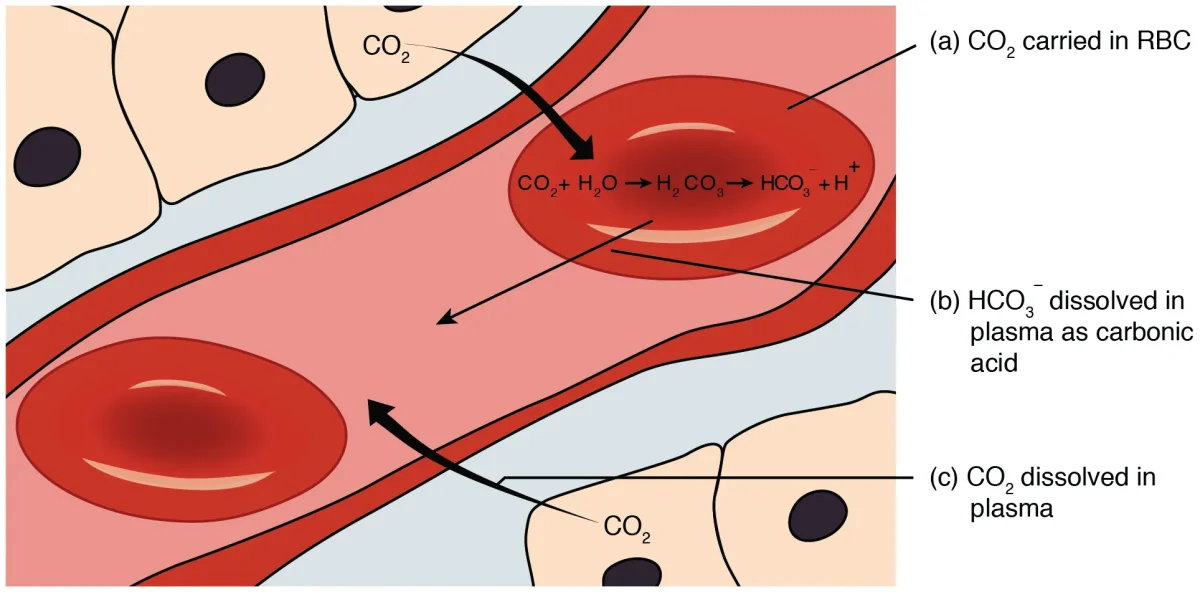
The bicarbonate pathway is the most important CO2 transport mechanism and the body’s primary blood pH buffer. Here is the complete reaction:
The three methods of CO2 transport: dissolved in plasma (~7-10%), as bicarbonate (~70%), and as carbaminohemoglobin (~20-23%). Note the chloride shift maintaining electrical neutrality as HCO3- exits the RBC. Credit: OpenStax Anatomy & Physiology 2e, CC BY 4.0
The Process in the Tissues
CO2 diffuses from metabolizing tissue cells into the blood and enters red blood cells
Carbonic anhydrase (inside RBCs) catalyzes: CO2 + H2O → H2CO3
H+ binds to hemoglobin (buffered - this is the Bohr effect mechanism)
HCO3- is transported out of the RBC into the plasma
The Chloride Shift
When HCO3- exits the RBC into the plasma, it would create a charge imbalance (too much negative charge leaving). To maintain electrical neutrality, chloride ions (Cl-) move into the RBC from the plasma via an antiport protein. This 1:1 exchange - one HCO3- out, one Cl- in - is called the chloride shift.
The Process in the Lungs
Everything reverses:
In the pulmonary capillaries, the high PO2 environment promotes oxygen binding to hemoglobin
As hemoglobin binds O2 (Haldane effect), it releases H+ and CO2
Cl- exits the RBC, HCO3- re-enters (reverse chloride shift)
Inside the RBC: H+ + HCO3- → H2CO3 → CO2 + H2O (carbonic anhydrase runs in reverse)
CO2 diffuses into the alveolus and is exhaled
Blood pH and the Bicarbonate Buffer
Normal arterial blood pH is 7.35-7.45. The bicarbonate buffer system maintains this narrow range because the two sides of the equilibrium can be independently regulated:
The lungs control CO2 levels (respiratory component)
The kidneys control HCO3- levels (metabolic component)
Acid-Base Disturbances
There are four primary acid-base disturbances. Each alters the 20:1 ratio differently:
Disturbance
Primary Change
pH
Compensation
Respiratory acidosis
Increased CO2 (hypoventilation)
Decreased (< 7.35)
Kidneys retain HCO3-
Respiratory alkalosis
Decreased CO2 (hyperventilation)
Increased (> 7.45)
Kidneys excrete HCO3-
Metabolic acidosis
Decreased HCO3- or excess acid
Decreased (< 7.35)
Lungs hyperventilate (blow off CO2)
Metabolic alkalosis
Increased HCO3- or loss of acid
Increased (> 7.45)
Lungs hypoventilate (retain CO2)
The body always compensates by adjusting the opposite system: respiratory problems get renal compensation, and metabolic problems get respiratory compensation. Compensation returns the ratio toward 20:1 but rarely fully normalizes pH.
What is the most common form of CO2 transport in the blood, and what enzyme is required?
Click to reveal answer
Bicarbonate (HCO3-) accounts for ~70% of CO2 transport. The enzyme carbonic anhydrase (found inside red blood cells) catalyzes the conversion of CO2 + H2O to H2CO3, which then dissociates to H+ + HCO3-. The HCO3- exits the RBC via the chloride shift (exchanged for Cl-) and travels in plasma to the lungs, where the process reverses.
A patient is hyperventilating due to anxiety. What acid-base disturbance is this, and how would the kidneys compensate?
Click to reveal answer
Respiratory alkalosis. Hyperventilation blows off excess CO2, shifting the equilibrium: less CO2 means less H2CO3 means fewer H+ ions, so pH rises above 7.45. The kidneys compensate over hours to days by excreting more HCO3- (reducing the numerator in the Henderson-Hasselbalch equation) to bring the HCO3-/CO2 ratio back toward 20:1.