
Gas Exchange
Gas exchange is the entire reason the respiratory system exists. Every tube, every muscle, every membrane in the previous sections is designed to get oxygen from the atmosphere into your blood and carbon dioxide from your blood into the atmosphere. The mechanism is simple: diffusion down partial pressure gradients. No pumps, no active transport, no ATP. Just molecules moving from where there are more of them to where there are fewer.
Dalton’s Law of Partial Pressures
The total pressure of a gas mixture equals the sum of the individual partial pressures of each gas. This is the same Dalton’s law from general chemistry - here we apply it to respiration.
The composition of dry atmospheric air:
| Gas | Percentage | Partial Pressure (at 760 mmHg) |
|---|---|---|
| Nitrogen (N2) | 78% | 593 mmHg |
| Oxygen (O2) | 21% | 160 mmHg |
| Argon (Ar) | 0.9% | 7 mmHg |
| Carbon dioxide (CO2) | 0.04% | 0.3 mmHg |
Alveolar Gas Composition
The air inside alveoli is not the same as atmospheric air. It differs because:
- Water vapor is added (airways humidify incoming air to 100% humidity), which dilutes all other gas partial pressures
- Oxygen is continuously being absorbed into the blood
- Carbon dioxide is continuously being added from the blood
| Gas | Atmospheric Air | Alveolar Air |
|---|---|---|
| 160 mmHg | ~104 mmHg | |
| 0.3 mmHg | ~40 mmHg | |
| Variable | 47 mmHg (at 37°C) |
The water vapor pressure at body temperature (37°C) is always 47 mmHg. This must be subtracted when calculating alveolar gas pressures.
Henry’s Law
Henry’s Law governs how much gas dissolves in a liquid (like blood):
Fick’s Law of Diffusion
Fick’s Law describes the rate at which a gas diffuses across a membrane like the respiratory membrane:
How Fick’s Law Applies to Disease
Every factor in Fick’s Law can be disrupted by disease:
| Factor | Normal | Disease State | Effect |
|---|---|---|---|
| Surface area (A) | ~70 m² | Emphysema (alveolar walls destroyed) | Decreased diffusion |
| Membrane thickness (T) | ~0.5 µm | Pulmonary fibrosis, edema (thickened barrier) | Decreased diffusion |
| Pressure gradient (ΔP) | 60 mmHg for O2 | High altitude (low atmospheric ) | Decreased diffusion |
| Diffusion coefficient (D) | Normal | Not usually altered by disease | N/A |
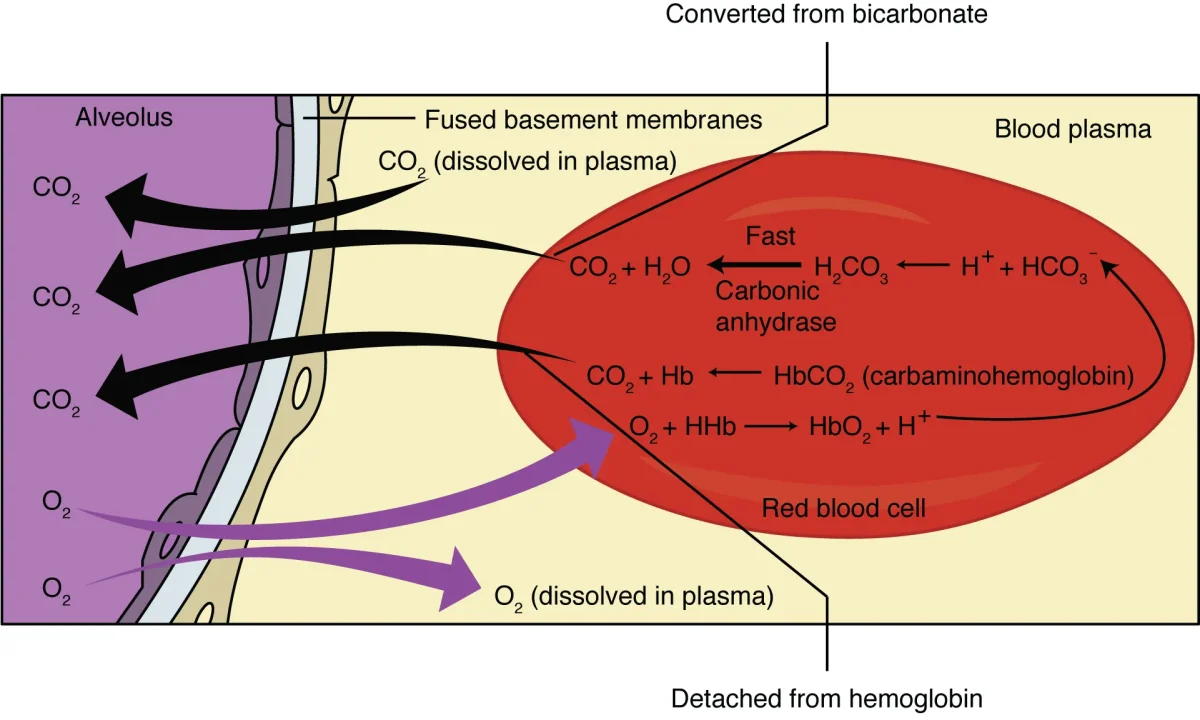
The Partial Pressure Gradients Driving Gas Exchange
Gas exchange happens at two locations: the lungs and the tissues.
At the lungs (external respiration):
| Gas | Alveolar Air | Pulmonary Capillary Blood (arriving) | Direction |
|---|---|---|---|
| O2 | 104 mmHg | 40 mmHg | Into blood |
| CO2 | 40 mmHg | 46 mmHg | Into alveolus |
Oxygen diffuses from the alveolus ( = 104) into the blood ( = 40) because of the 64 mmHg gradient. CO2 diffuses from the blood ( = 46) into the alveolus ( = 40) because of the 6 mmHg gradient. Blood leaving the lungs has of ~100 mmHg and of ~40 mmHg.
At the tissues (internal respiration):
| Gas | Systemic Capillary Blood | Tissue Cells | Direction |
|---|---|---|---|
| O2 | 100 mmHg | ~40 mmHg | Into tissues |
| CO2 | 40 mmHg | ~46 mmHg | Into blood |
The process reverses: oxygen diffuses from blood into tissues, and CO2 diffuses from tissues into blood.
Normal vs. Impaired Gas Exchange
Under normal conditions, blood flowing through the pulmonary capillary has enough time to fully equilibrate with alveolar air - oxygen transfer is very efficient. In diseases that thicken the membrane (fibrosis, edema) or reduce the surface area (emphysema), diffusion slows and blood may not fully equilibrate before leaving the capillary, resulting in hypoxemia.