
Breathing Mechanics
Here is a question that trips up many students: do you actively suck air into your lungs? No. You create a pressure difference, and the atmosphere pushes air in for you. Breathing is entirely about pressure gradients, and the physics behind it is Boyle’s Law - one of the simplest gas laws you will encounter on the MCAT.
Inspiration (Inhalation)
Inspiration is an active process. It requires muscle contraction and energy expenditure. Here is what happens in sequence:
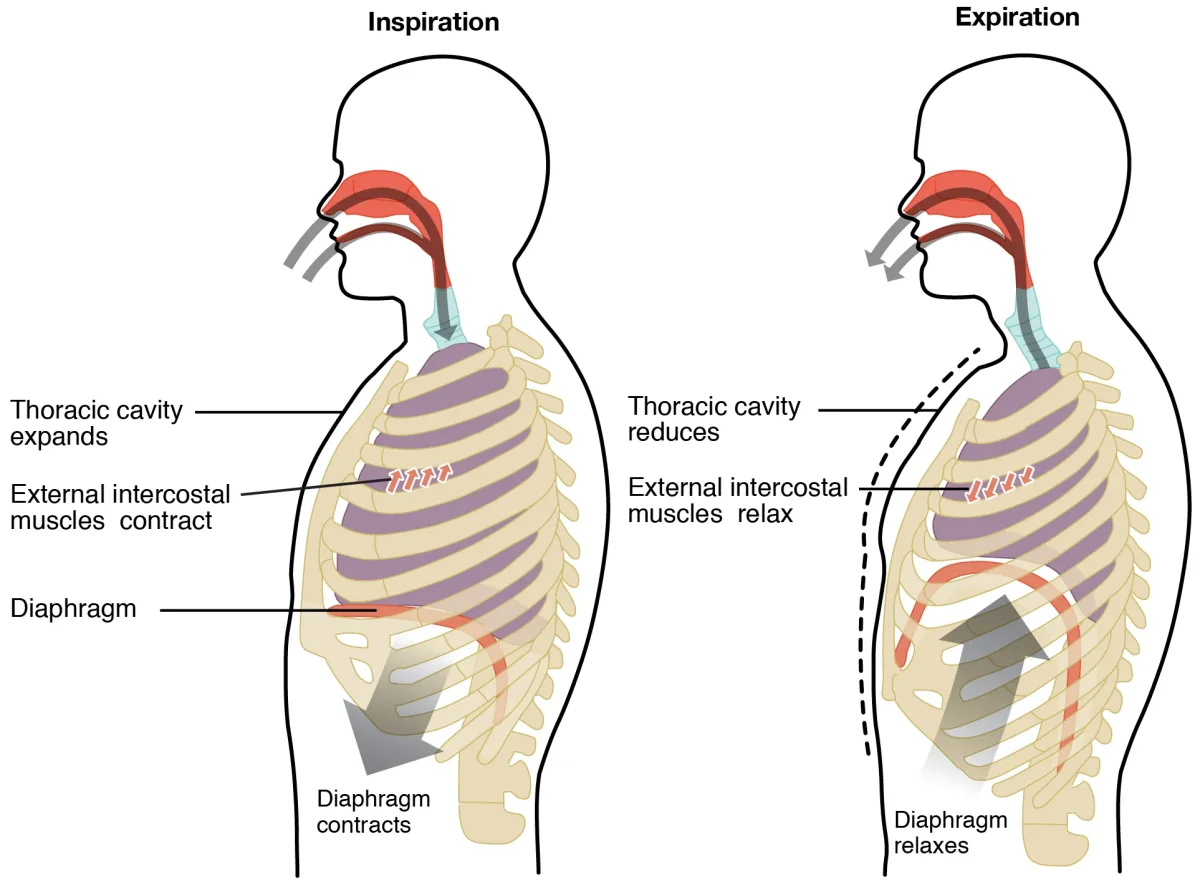
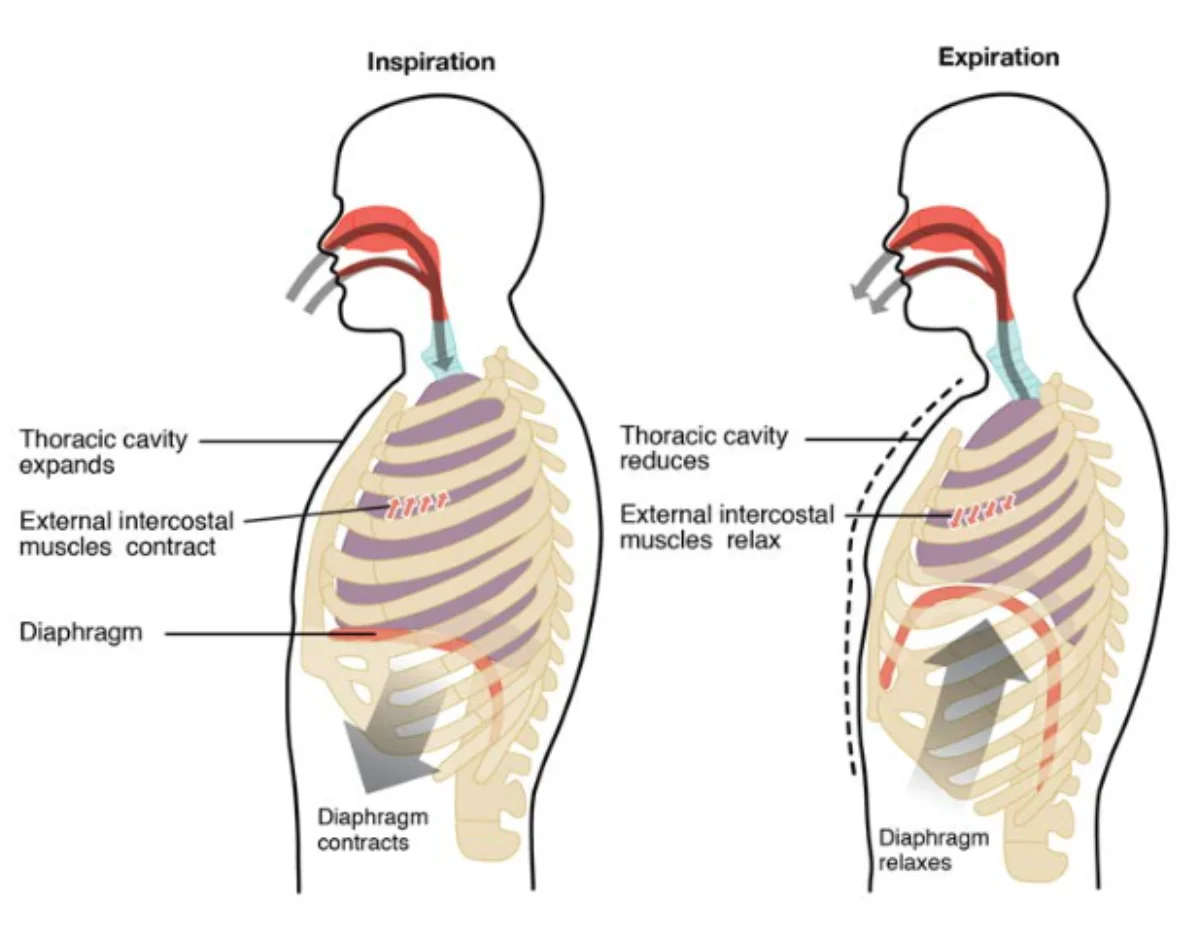
Step 1: Muscle contraction. The diaphragm (the dome-shaped muscle separating the thoracic and abdominal cavities) contracts and flattens downward, increasing the vertical dimension of the thoracic cavity. Simultaneously, the external intercostal muscles contract, pulling the ribs upward and outward (think of a bucket handle lifting), increasing the anteroposterior and lateral dimensions.
Step 2: Volume increases. The thoracic cavity expands in all three dimensions.
Step 3: Pressure drops. Per Boyle’s Law, as volume increases, intrapulmonary pressure (pressure inside the lungs) drops below atmospheric pressure. This creates a negative pressure gradient.
Step 4: Air rushes in. Air always flows from high pressure to low pressure. Since atmospheric pressure (760 mmHg at sea level) is now higher than intrapulmonary pressure, air flows into the lungs until pressures equalize.
Expiration (Exhalation)
Quiet expiration is a passive process. It requires no muscle contraction:
Step 1: Muscles relax. The diaphragm relaxes and domes upward. The external intercostal muscles relax, and the ribs move down and inward due to gravity and elastic recoil of the chest wall.
Step 2: Volume decreases. The thoracic cavity shrinks.
Step 3: Pressure rises. Per Boyle’s Law, decreased volume means increased intrapulmonary pressure, which now exceeds atmospheric pressure.
Step 4: Air is pushed out. Air flows from the higher-pressure lungs to the lower-pressure atmosphere.
The key insight: quiet expiration is driven entirely by elastic recoil of the lungs and chest wall. The lungs are stretched during inspiration like a rubber band, and they snap back passively. No energy required.
Forced Expiration
During exercise, coughing, or any situation requiring rapid, forceful exhalation, forced expiration becomes an active process:
- Internal intercostal muscles contract, pulling the ribs downward and inward
- Abdominal muscles (rectus abdominis, obliques) contract, pushing the abdominal organs upward against the diaphragm
These muscles actively compress the thoracic cavity, rapidly decreasing volume and increasing pressure far above atmospheric pressure, forcing air out quickly.
Pressure Changes During Breathing
Understanding the three pressures involved in breathing is essential:
| Pressure | Definition | During Inspiration | During Expiration |
|---|---|---|---|
| Atmospheric () | Pressure of outside air | 760 mmHg (constant) | 760 mmHg (constant) |
| Intrapulmonary () | Pressure inside the alveoli | Drops below 760 mmHg | Rises above 760 mmHg |
| Intrapleural () | Pressure in the pleural space | Drops further negative (~-6 mmHg) | Less negative (~-4 mmHg) |
The critical relationship: intrapleural pressure is always more negative than intrapulmonary pressure during normal breathing. This keeps the lungs inflated. If intrapleural pressure ever equals atmospheric pressure (as in a pneumothorax), the lung collapses.
The Role of the Diaphragm
The diaphragm is the primary muscle of respiration. It is innervated by the phrenic nerve, which arises from cervical spinal cord levels C3, C4, and C5.
Compliance and Elastance
Two opposing properties determine how easily the lungs move:
- Compliance = how easily the lungs stretch. High compliance = inflate easily. Emphysema destroys alveolar walls and elastic tissue, so compliance goes up.
- Elastance = how readily the lungs snap back. High elastance = strong recoil. Pulmonary fibrosis deposits stiff scar tissue, so elastance goes up.
The two trade off: emphysema is easy to inflate but hard to deflate (air trapping). Fibrosis is hard to inflate but easy to deflate (restrictive pattern). Surfactant raises compliance by lowering surface tension, so its absence (preterm RDS) makes the alveoli hard to inflate.
During heavy exercise or respiratory distress, accessory muscles (neck muscles for inspiration, abdominals for forced expiration) join in to help the primary respiratory muscles.