
Countercurrent Multiplier
The countercurrent multiplier is one of the most elegant mechanisms in all of physiology - and one of the most commonly tested on the MCAT. It explains how the kidney creates a concentrated environment in the medulla that allows the collecting duct to produce concentrated urine. Without this gradient, you could never conserve water during dehydration.
The concept is straightforward once you see it clearly: two parallel tubes running in opposite directions, doing different things, amplifying a small difference into a large gradient.
How It Works: Step by Step
The countercurrent multiplier depends on two facts:
- The descending limb is permeable to water but NOT to salt
- The thick ascending limb actively pumps salt out (via Na+/K+/2Cl- co-transport) but is impermeable to water
These two limbs run side by side in opposite directions (countercurrent flow).
The single effect: At any horizontal level, the thick ascending limb pumps NaCl into the medullary interstitium. This raises the interstitial osmolarity by a small amount (~200 mOsm/L above the filtrate).
The multiplication: Because the descending limb is permeable to water, water leaves the descending limb (drawn out by the salty interstitium), concentrating the filtrate inside. This concentrated filtrate then flows around the hairpin turn into the ascending limb, where more salt is pumped out. Each “cycle” adds to the gradient.
The result:
- Cortex: ~300 mOsm/L (isotonic with plasma)
- Outer medulla: ~600 mOsm/L
- Inner medulla: ~900 mOsm/L
- Deepest medulla (papilla): ~1200 mOsm/L
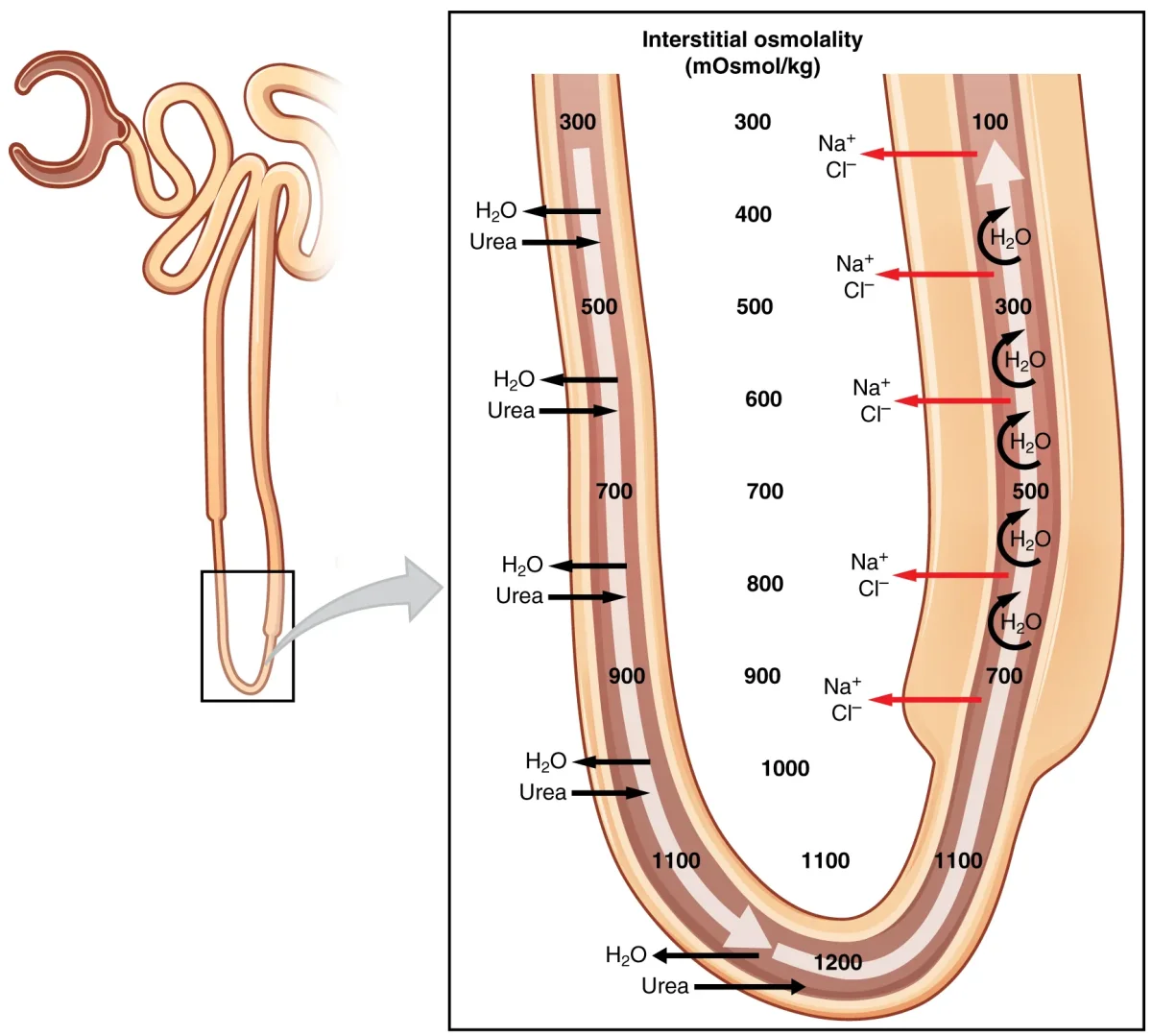
Why “Countercurrent” and Why “Multiplier”?
Countercurrent - the fluid flows in opposite directions in the two limbs. Descending filtrate flows down; ascending filtrate flows up. This is critical because it means the ascending limb is always adjacent to a slightly less concentrated section of the descending limb, allowing continuous salt extraction to have a cumulative effect.
Multiplier - the single effect (a ~200 mOsm/L difference at any one level) gets multiplied along the length of the loop into a much larger total gradient (300 to 1200 mOsm/L).
If flow were concurrent (same direction in both tubes), the gradient would equilibrate and you would get a uniform, modest difference. The opposite flow directions are what allow the small single effect to be amplified.
The Vasa Recta: Countercurrent Exchanger
The vasa recta are the capillaries that run alongside the loops of Henle in juxtamedullary nephrons. They have a critical job: supply blood to the medulla WITHOUT washing away the osmotic gradient.
The vasa recta accomplish this through countercurrent exchange:
- As blood descends into the salty medulla, water leaves and solutes enter (blood equilibrates with the surrounding interstitium)
- As blood ascends back toward the cortex, water re-enters and solutes leave (blood re-equilibrates)
- Net effect: blood delivers oxygen and nutrients to the medulla while maintaining the gradient
Urea Recycling: The Gradient Booster
Urea contributes about 50% of the medullary osmotic gradient in the inner medulla. Here is how:
- Urea is filtered at the glomerulus and partially reabsorbed in the PCT
- In the inner medullary collecting duct (under ADH stimulation), urea transporters allow urea to diffuse out into the medullary interstitium
- Some of this urea enters the thin ascending limb of the loop of Henle (urea recycling)
- The urea travels through the nephron again and re-enters the medulla through the collecting duct
This recycling keeps urea concentrated in the inner medulla, adding to the osmotic gradient that drives water reabsorption from the collecting duct.
What Happens If the Gradient Is Destroyed?
Loop diuretics block the Na+/K+/2Cl- co-transporter in the thick ascending limb. Without active NaCl pumping, the medullary gradient collapses. The collecting duct has nothing to drive water reabsorption against, so large volumes of dilute urine are produced. This is why loop diuretics are the most powerful class of diuretics - they attack the gradient at its source.