
Collecting Duct
The collecting duct is where the final decision is made: will you produce dilute urine or concentrated urine? Everything upstream - the glomerulus, PCT, loop of Henle, DCT - has been preparing the filtrate. The collecting duct uses the medullary gradient (built by the countercurrent multiplier) to determine how much water to reclaim based on hormonal signals.
The key hormone is ADH (antidiuretic hormone, also called vasopressin). ADH is the single most important regulator of urine concentration.
ADH: The “Don’t Pee” Hormone
Where ADH comes from:
- Osmoreceptors in the hypothalamus detect increased blood osmolarity (dehydration)
- The hypothalamus synthesizes ADH
- ADH is transported down axons to the posterior pituitary
- The posterior pituitary releases ADH into the bloodstream
- ADH travels to the kidneys and binds receptors on collecting duct principal cells
What ADH does at the collecting duct:
- ADH binds receptors on the basolateral membrane of principal cells
- This activates a cAMP signaling cascade
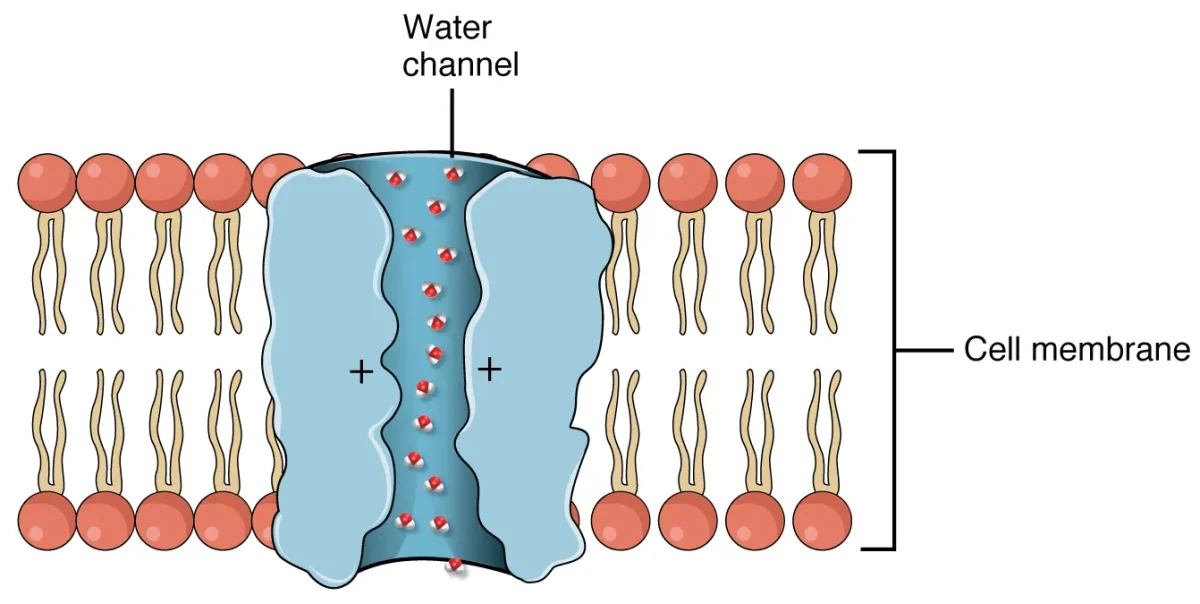
- Aquaporin water channels are inserted into the apical (lumen-facing) membrane
- Water flows from the tubular lumen through aquaporins, through the cell, and out the basolateral side
- Water enters the hypertonic medullary interstitium and is picked up by the vasa recta
Two Scenarios: Hydrated vs. Dehydrated
When you are well-hydrated (low ADH):
- Blood osmolarity is low, so little ADH is released
- Collecting duct remains impermeable to water (few aquaporins)
- The dilute filtrate (~100 mOsm/L from the ascending limb) passes through the collecting duct without losing water
- Result: large volume of dilute urine (~50-100 mOsm/L)
When you are dehydrated (high ADH):
- Blood osmolarity is high, so ADH is released
- Collecting duct becomes permeable to water (aquaporins inserted)
- Water is reabsorbed as the collecting duct passes through the increasingly concentrated medulla
- Result: small volume of concentrated urine (up to ~1200 mOsm/L)
| Condition | ADH Level | Aquaporins | Collecting Duct Permeability | Urine Volume | Urine Osmolarity |
|---|---|---|---|---|---|
| Overhydrated | Very low | Few/none | Impermeable | High (~18 L/day max) | Low (~50 mOsm/L) |
| Normal | Moderate | Some | Moderately permeable | Normal (~1-2 L/day) | ~300-600 mOsm/L |
| Dehydrated | High | Many | Highly permeable | Low (~0.5 L/day) | High (~1200 mOsm/L) |
Cell Types in the Collecting Duct
The collecting duct has two main cell types:
Principal cells - respond to ADH (insert aquaporins) and aldosterone (Na+ reabsorption, K+ secretion). These handle water and electrolyte balance.
Intercalated cells - handle acid-base balance.
- Type A intercalated cells - secrete H+ into the lumen and reabsorb HCO3- into the blood. Active during acidosis.
- Type B intercalated cells - secrete HCO3- into the lumen and reabsorb H+. Active during alkalosis.
Diabetes Insipidus: When ADH Fails
Diabetes insipidus (DI) is a condition where ADH signaling fails, resulting in massive volumes of dilute urine (up to 18-20 L/day) and severe dehydration.
Central DI - the hypothalamus/posterior pituitary does not produce enough ADH. Caused by head trauma, tumors, or surgery.
Nephrogenic DI - the kidneys do not respond to ADH (defective receptors or aquaporin channels). ADH levels are actually HIGH, but the collecting duct cannot respond.
The key distinction: in central DI, the problem is upstream (no hormone produced). In nephrogenic DI, the problem is downstream (hormone is present but the effector is broken). This is the same “primary vs. secondary” reasoning pattern you learned for endocrine disorders.
SIADH: When There Is Too Much ADH
Syndrome of Inappropriate ADH secretion (SIADH) is the opposite of DI. Too much ADH is released (often from lung tumors, brain injury, or certain drugs), causing excessive water reabsorption. The result:
- Very concentrated, low-volume urine
- Dilutional hyponatremia (blood Na+ drops because excess water dilutes it)
- Patients may develop confusion, seizures, or cerebral edema from the low sodium