
Thermoregulation
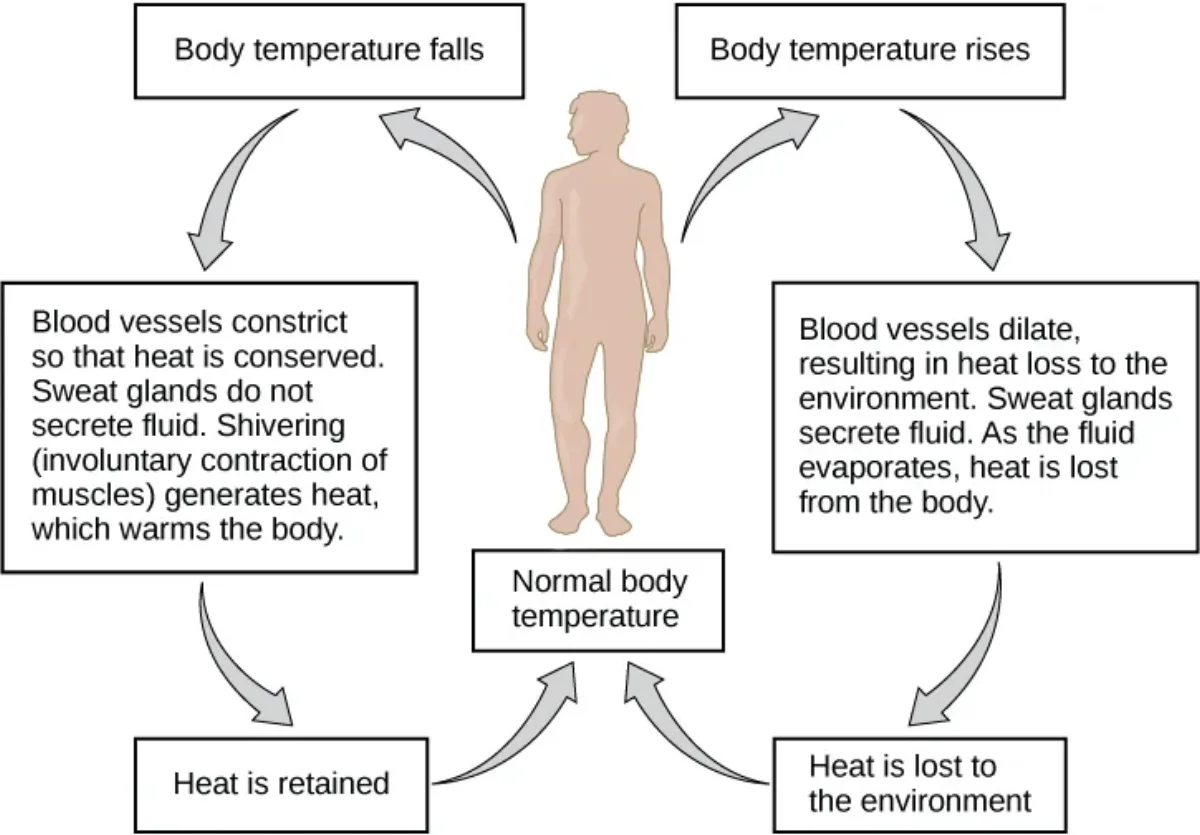
Humans are endotherms - we generate our own body heat and maintain a stable core temperature regardless of the environment. The hypothalamus acts as the body’s thermostat, integrating temperature information from peripheral and central thermoreceptors and coordinating the appropriate heating or cooling response.
Thermoregulation is a classic example of negative feedback, and the MCAT frequently tests your ability to trace the loop from stimulus to response.
The Hypothalamic Thermostat
The hypothalamus receives temperature input from:
- Central thermoreceptors in the hypothalamus itself (monitor blood temperature directly)
- Peripheral thermoreceptors in the skin (detect environmental temperature changes early)
The hypothalamus compares incoming data to the set point (~37 degrees C) and activates the appropriate effectors.
Cooling Mechanisms (When Body Temp Is Too High)
1. Cutaneous vasodilation - arterioles in the skin dilate, increasing blood flow to the body surface. Heat radiates from the blood through the skin to the environment. This is why you look flushed when hot.
2. Sweating - eccrine sweat glands secrete water and electrolytes onto the skin surface. As sweat evaporates, it removes heat (evaporative cooling). This is the most effective cooling mechanism in humans. In high humidity, sweating is less effective because the air is already saturated with water vapor.
3. Behavioral responses - seeking shade, removing clothing, reducing activity. These are voluntary but highly effective.
Heating Mechanisms (When Body Temp Is Too Low)
1. Cutaneous vasoconstriction - arterioles in the skin constrict, reducing blood flow to the surface. Heat is retained in the core. This is why you look pale when cold.
2. Shivering - involuntary rapid contraction of skeletal muscles generates heat as a byproduct of ATP hydrolysis. Shivering can increase heat production by 5-fold.
3. Non-shivering thermogenesis - brown adipose tissue generates heat by uncoupling oxidative phosphorylation. Uncoupling proteins in the inner mitochondrial membrane allow H+ to flow back across the membrane without passing through ATP synthase - the energy is released as heat instead of making ATP. Infants have significant brown fat; adults retain smaller amounts.
4. Piloerection - contraction of arrector pili muscles at the base of hair follicles. In furred animals, this traps an insulating layer of air. In humans, it produces goosebumps - a vestigial response with minimal insulating value.
5. Thyroid hormone - chronic cold exposure stimulates thyroid hormone production (T3/T4), which increases basal metabolic rate and heat generation over days to weeks.
6. Behavioral responses - adding clothing, seeking warmth, curling up (reducing surface area).
Four Mechanisms of Heat Transfer
Heat moves between your body and the environment by four physical mechanisms:
| Mechanism | Definition | Example |
|---|---|---|
| Radiation | Heat transferred as infrared electromagnetic waves | Feeling warmth from a fire without touching it |
| Conduction | Heat transferred by direct contact with a surface | Sitting on a cold metal bench |
| Convection | Heat carried away by moving air or fluid | Wind chill making a cold day feel colder |
| Evaporation | Heat lost when liquid converts to gas | Sweating; stepping out of a pool and feeling cold |
Countercurrent Heat Exchange
In the extremities (arms, legs), arteries and veins run parallel and close together. Warm arterial blood heading to the fingers transfers heat to the cooler venous blood returning to the core. This means:
- Less heat reaches the extremities (conserving core temperature)
- The returning venous blood is pre-warmed before reaching the core
This is the same countercurrent principle as the loop of Henle, but for heat instead of solutes. It is especially important in cold environments and in aquatic mammals (whales, penguins) that have highly developed countercurrent heat exchangers in their flippers.
Fever: A Shifted Set Point
Fever is NOT a failure of thermoregulation. It is the hypothalamus deliberately raising its set point.
How fever works:
- Infection triggers immune cells to release pyrogens (e.g., IL-1, IL-6, TNF-alpha)
- Pyrogens stimulate the hypothalamus to produce prostaglandin E2 (PGE2)
- PGE2 raises the hypothalamic set point (e.g., from 37 degrees C to 39 degrees C)
- The body now “thinks” it is too cold and activates warming mechanisms (shivering, vasoconstriction)
- Body temperature rises to the new set point and stabilizes
When the fever breaks:
- The infection is controlled, pyrogen levels drop
- PGE2 decreases, and the set point returns to 37 degrees C
- The body now “thinks” it is too hot and activates cooling mechanisms (sweating, vasodilation)
- Temperature falls back to normal
Anti-inflammatory drugs reduce fever by inhibiting cyclooxygenase (COX), which blocks PGE2 synthesis, lowering the set point back toward normal.
Endotherms vs. Ectotherms
| Feature | Endotherms (mammals, birds) | Ectotherms (reptiles, fish, amphibians) |
|---|---|---|
| Heat source | Internal metabolism | External environment |
| Body temperature | Stable (homeothermic) | Variable (poikilothermic) |
| Metabolic rate | High | Low |
| Caloric requirement | High | Low |
| Activity in cold | Maintained | Reduced |
| Examples | Humans, dogs, eagles | Lizards, frogs, snakes |