
Homeostasis Principles
Your body temperature right now is approximately 37 degrees C (98.6 degrees F). It was the same temperature yesterday. It will be the same tomorrow. Whether you are running a marathon in the desert or skiing in a blizzard, your core temperature barely budges. The same is true for your blood pH (7.35-7.45), your blood glucose (~70-100 mg/dL fasting), your blood osmolarity (~285-295 mOsm/L), and dozens of other variables.
This is not an accident. Your body is constantly measuring, adjusting, and correcting. That process - maintaining a stable internal environment despite changing external conditions - is homeostasis.
Why Homeostasis Matters for the MCAT
Homeostasis is not just one topic. It is the organizing principle behind every organ system. The endocrine system uses hormones to maintain blood glucose. The respiratory system adjusts breathing rate to maintain blood pH. The cardiovascular system changes heart rate to maintain blood pressure. The renal system adjusts urine output to maintain fluid balance.
Every time the MCAT asks “what happens when X changes,” the answer almost always involves a homeostatic mechanism restoring the variable to its set point.
The Three Components of Every Homeostatic System
Every feedback loop has three parts:
1. Sensor (receptor) - detects the current value of the variable. Example: osmoreceptors in the hypothalamus detect blood osmolarity.
2. Control center (integrator) - compares the current value to the set point and decides what to do. Example: the hypothalamus compares detected osmolarity to the normal range.
3. Effector - carries out the correction. Example: the posterior pituitary releases ADH, which tells the kidneys to reabsorb more water.
Negative Feedback: The Default Mode
Negative feedback is the dominant control mechanism in the body. The principle: the output of a process opposes the original stimulus, pushing the variable back toward the set point.
“Negative” does not mean “bad.” It means the response negates (reverses) the change that triggered it.
How it works:
- A variable deviates from its set point
- The sensor detects the deviation
- The control center activates the effector
- The effector produces a response that opposes the original change
- The variable returns toward the set point
- As the variable normalizes, the stimulus weakens, and the response diminishes
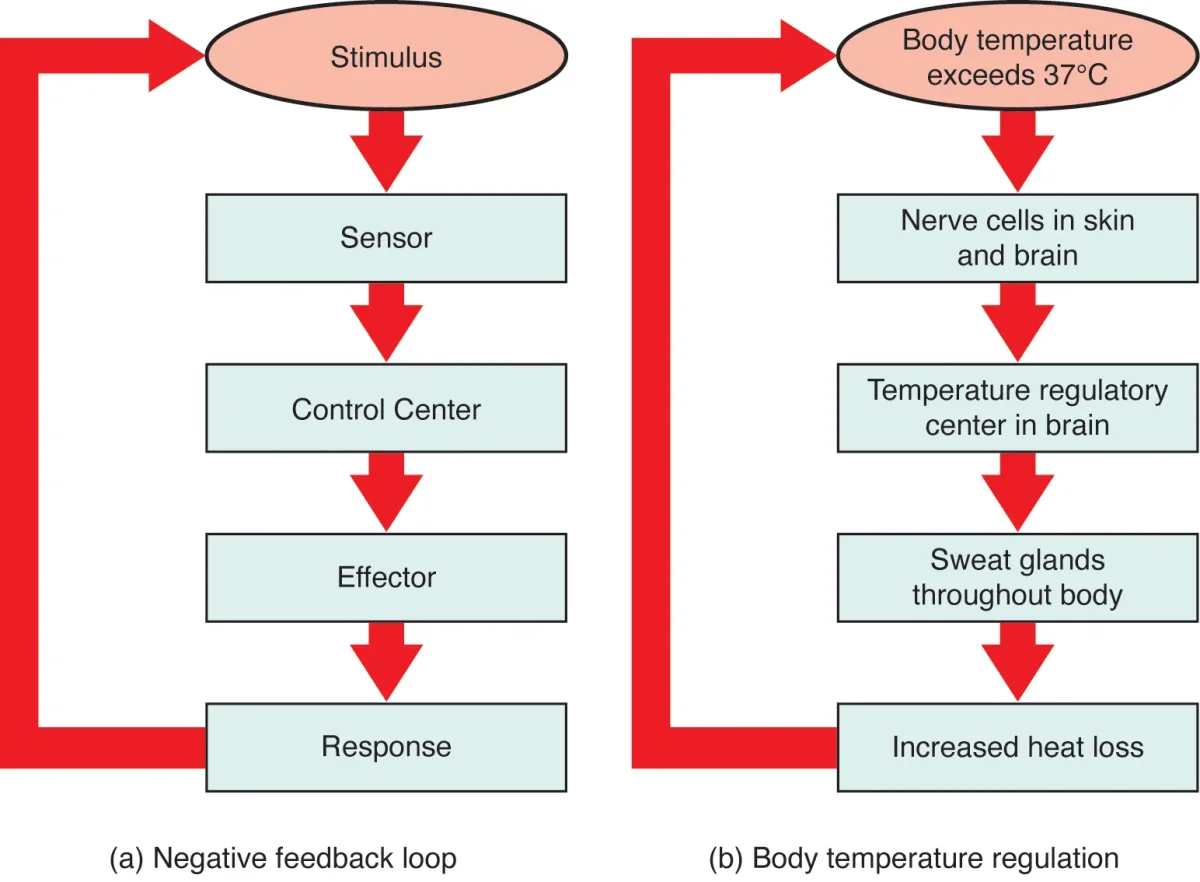
Classic examples:
| Variable | Stimulus | Sensor | Effector | Response |
|---|---|---|---|---|
| Body temp | Too high | Hypothalamus | Sweat glands, blood vessels | Sweating, vasodilation (cool down) |
| Body temp | Too low | Hypothalamus | Skeletal muscles, blood vessels | Shivering, vasoconstriction (warm up) |
| Blood glucose | Too high | Beta cells (pancreas) | Liver, muscle, adipose | Insulin drives glucose into cells |
| Blood glucose | Too low | Alpha cells (pancreas) | Liver | Glucagon releases stored glucose |
| Blood osmolarity | Too high | Osmoreceptors (hypothalamus) | Kidneys (collecting duct) | ADH increases water reabsorption |
| Blood pressure | Too low | JGA (kidney) | Blood vessels, adrenal cortex | RAAS causes vasoconstriction + Na+ retention |
Positive Feedback: The Rare Amplifier
Positive feedback is the opposite: the output amplifies the original stimulus rather than opposing it. This creates an escalating cycle that continues until an external event breaks the loop.
Positive feedback is rare because runaway amplification is dangerous. The body uses it only when a process must be driven rapidly to completion.
Key positive feedback examples for the MCAT:
- Oxytocin during labor - cervical stretch triggers oxytocin release, which causes stronger contractions, which increases cervical stretch. Loop breaks when the baby is delivered.
- LH surge during ovulation - rising estrogen from the dominant follicle triggers a massive LH surge (positive feedback on the anterior pituitary). Loop breaks when ovulation occurs and progesterone restores negative feedback.
- Blood clotting cascade - activated platelets release signals that activate more platelets. Loop breaks when the clot seals the vessel.
Negative vs. Positive Feedback Comparison
| Feature | Negative Feedback | Positive Feedback |
|---|---|---|
| Effect on stimulus | Opposes it (returns to set point) | Amplifies it (drives to completion) |
| Goal | Maintain stability | Drive rapid completion |
| Frequency | Extremely common | Rare |
| Self-limiting? | Yes (built-in shutoff) | No (needs external break) |
| Examples | Thermoregulation, blood glucose, blood pressure, pH | Childbirth, LH surge, blood clotting |
Set Points Can Shift
Set points are not permanently fixed. During a fever, the hypothalamus raises the body temperature set point (e.g., from 37 degrees C to 39 degrees C). Now the body “thinks” 37 degrees C is too cold, so it shivers and vasoconstricts to warm up. When the fever breaks, the set point drops back to normal, and you suddenly feel hot and start sweating.
This concept explains why fever is not a failure of homeostasis - it is homeostasis working perfectly around a new, temporarily elevated set point. Pyrogens (from pathogens or immune cells) cause prostaglandin release, which acts on the hypothalamus to raise the set point.