
RAAS
RAAS is the body’s emergency blood pressure rescue system. When blood pressure drops - from dehydration, hemorrhage, or heart failure - the kidneys detect the problem and launch a hormonal cascade that raises blood pressure through multiple simultaneous mechanisms. Understanding every step of this cascade is essential for the MCAT.
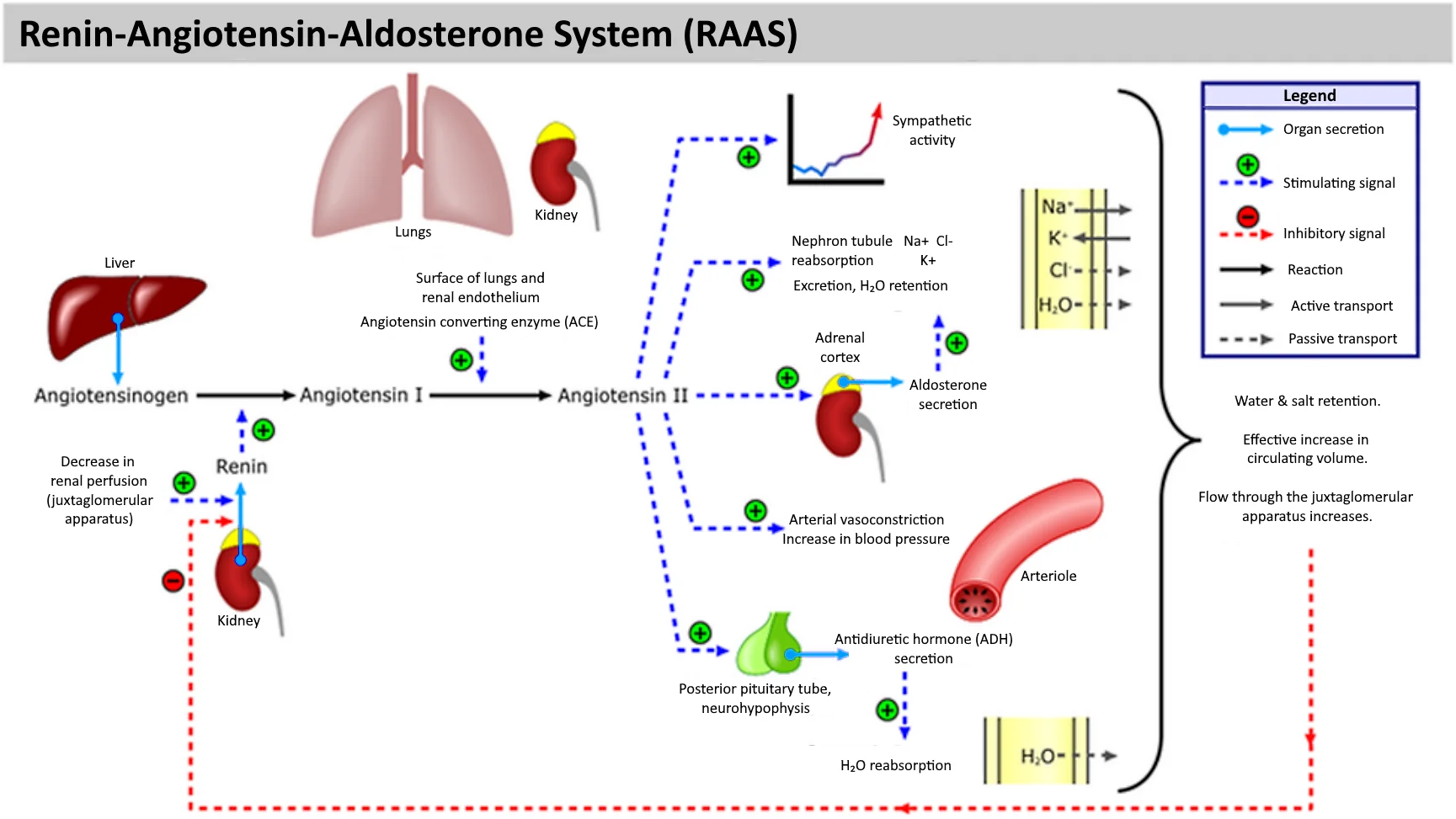
The RAAS Cascade: Step by Step
Step 1: Trigger - low blood pressure detected
The JG cells of the afferent arteriole sense reduced renal perfusion (low blood pressure). Three signals activate renin release:
- Direct detection of low pressure by baroreceptors in the afferent arteriole
- Low NaCl detected by the macula densa (signals low GFR)
- Sympathetic nervous system activation (beta-1 receptors on JG cells)
Step 2: Renin release
JG cells secrete renin (an enzyme) into the blood.
Step 3: Angiotensinogen to Angiotensin I
Renin cleaves angiotensinogen (a large protein continuously produced by the liver) into angiotensin I. Angiotensin I is inactive - it is just an intermediate.
Step 4: Angiotensin I to Angiotensin II
Angiotensin-converting enzyme (ACE), located primarily on the endothelial surface of pulmonary capillaries (lungs), converts angiotensin I into angiotensin II. ACE also degrades bradykinin (a vasodilator), which explains the dry cough side effect of ACE inhibitors.
Step 5: Angiotensin II - the effector
Angiotensin II is one of the most potent vasoconstrictors in the body, playing a central role in blood pressure regulation. It has multiple simultaneous effects:
| Effect | Mechanism | Speed |
|---|---|---|
| Vasoconstriction | Contracts arteriolar smooth muscle | Immediate (seconds) |
| Aldosterone release | Stimulates zona glomerulosa of adrenal cortex | Minutes to hours |
| ADH release | Stimulates posterior pituitary | Minutes |
| Thirst | Stimulates hypothalamic thirst center | Minutes |
| Na+ reabsorption | Direct action on PCT (stimulates Na+/H+ exchange) | Minutes |
| Efferent arteriole constriction | Preferentially constricts efferent arteriole, raising GFR | Immediate |
Pharmacological Targets in the RAAS
The MCAT commonly describes drugs that target specific steps in the RAAS cascade:
ACE inhibitors - block the conversion of angiotensin I to angiotensin II. Less vasoconstriction, less aldosterone release, blood pressure drops. ACE also normally degrades bradykinin, so blocking ACE causes bradykinin accumulation - this explains the dry cough side effect.
ARBs (angiotensin receptor blockers) - block angiotensin II receptors. Same blood pressure-lowering effects as ACE inhibitors but without the cough (bradykinin is still degraded normally).
Negative Feedback in RAAS
The RAAS cascade has built-in negative feedback:
- When blood pressure normalizes, the JG cells sense adequate pressure and stop releasing renin
- Angiotensin II directly inhibits further renin release (short-loop feedback)
- Elevated blood pressure activates baroreceptors that suppress sympathetic drive to the JG cells
- ANP (released when blood volume is high) inhibits renin, aldosterone, and ADH