
Hormonal Regulation
Three hormones dominate renal regulation: ADH, aldosterone, and ANP. Each responds to a different stimulus, acts on a different part of the nephron, and produces a different effect. But they all serve the same ultimate goal - maintaining blood volume, blood pressure, and electrolyte balance.
The MCAT tests these hormones constantly. If you know the trigger, target, and effect of each hormone, you can reason through almost any renal physiology question.
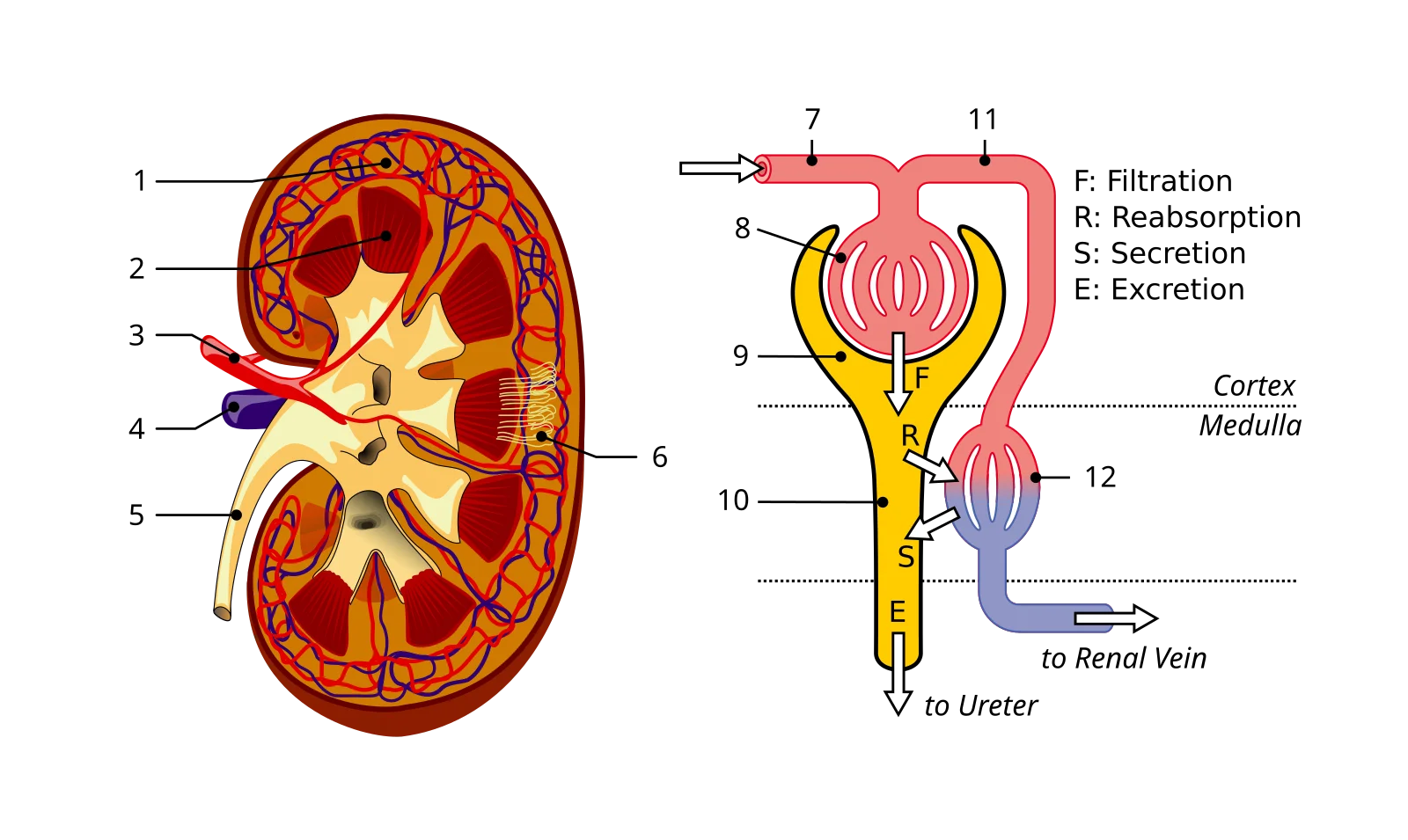
ADH (Antidiuretic Hormone / Vasopressin)
Trigger: Increased blood osmolarity (detected by hypothalamic osmoreceptors) or decreased blood volume/pressure (detected by baroreceptors in the carotid sinus and aortic arch)
Source: Synthesized in the hypothalamus, released from the posterior pituitary
Target: Receptors on collecting duct principal cells
Effect: Inserts aquaporin-2 channels into the apical membrane, increasing water reabsorption. Also promotes urea recycling in the inner medullary collecting duct.
Net result: Decreased urine volume, increased urine concentration, decreased blood osmolarity
Inhibited by: Low blood osmolarity, alcohol, ANP
Aldosterone
Trigger: Angiotensin II (from RAAS), high blood K+, low blood Na+, and ACTH (minor role)
Source: Zona glomerulosa of the adrenal cortex
Target: Principal cells of the DCT and collecting duct
Effect: Increases expression of sodium channels on the apical membrane and Na+/K+ ATPase on the basolateral membrane. This increases Na+ reabsorption and K+ secretion.
Net result: Na+ and water retention (water follows sodium), K+ excretion, increased blood volume and blood pressure
Inhibited by: ANP, high blood Na+, low K+
ANP (Atrial Natriuretic Peptide)
Trigger: Atrial stretch from increased blood volume (the atria of the heart release ANP when they are overfilled)
Source: Cardiac atrial myocytes
Target: Multiple sites - kidneys, adrenal glands, blood vessels, hypothalamus
Effects:
- Increases GFR (dilates afferent arteriole, constricts efferent arteriole)
- Inhibits Na+ reabsorption in the collecting duct
- Inhibits renin release (suppresses RAAS)
- Inhibits aldosterone secretion
- Inhibits ADH release
- Causes vasodilation
Net result: Increased Na+ and water excretion, decreased blood volume and blood pressure
Head-to-Head Comparison
| Feature | ADH | Aldosterone | ANP |
|---|---|---|---|
| Stimulus | High osmolarity, low BP | Angiotensin II, high K+ | Atrial stretch (high volume) |
| Source | Posterior pituitary | Adrenal cortex (zona glomerulosa) | Heart atria |
| Primary target | Collecting duct (principal cells) | DCT and collecting duct (principal cells) | Kidneys, adrenals, vessels |
| Mechanism | Inserts aquaporin channels | Upregulates Na+ channels and Na+/K+ ATPase | Dilates afferent arteriole, blocks Na+ reabsorption |
| Effect on Na+ | Minimal direct effect | Increases reabsorption | Increases excretion |
| Effect on K+ | No direct effect | Increases secretion | No major direct effect |
| Effect on water | Increases reabsorption | Increases reabsorption (follows Na+) | Increases excretion |
| Effect on BP | Increases | Increases | Decreases |
| Urine volume | Decreases | Decreases | Increases |
How the Three Hormones Interact
Dehydration scenario:
- Blood osmolarity rises and blood volume drops
- ADH is released - collecting duct reabsorbs water
- RAAS is activated - aldosterone causes Na+ (and water) retention
- ANP is suppressed (atria are not stretched)
- Result: concentrated, low-volume urine; blood volume and pressure restored
Overhydration scenario:
- Blood volume rises, blood osmolarity drops
- ADH is suppressed - collecting duct stays impermeable
- RAAS is suppressed - less aldosterone, less Na+ retention
- ANP is released - promotes Na+ and water excretion, further suppresses RAAS and ADH
- Result: dilute, high-volume urine; blood volume and pressure decrease