
Tubular Reabsorption
After filtration dumps 180 liters of fluid per day into Bowman’s space, the tubules must reclaim almost all of it. If they did not, you would lose your entire plasma volume in about 30 minutes. Reabsorption is the process of moving useful substances from the tubular filtrate back into the blood. Secretion is the reverse - moving additional waste from the blood into the filtrate for excretion.
Each nephron segment has a specific job. The MCAT expects you to know what happens where.
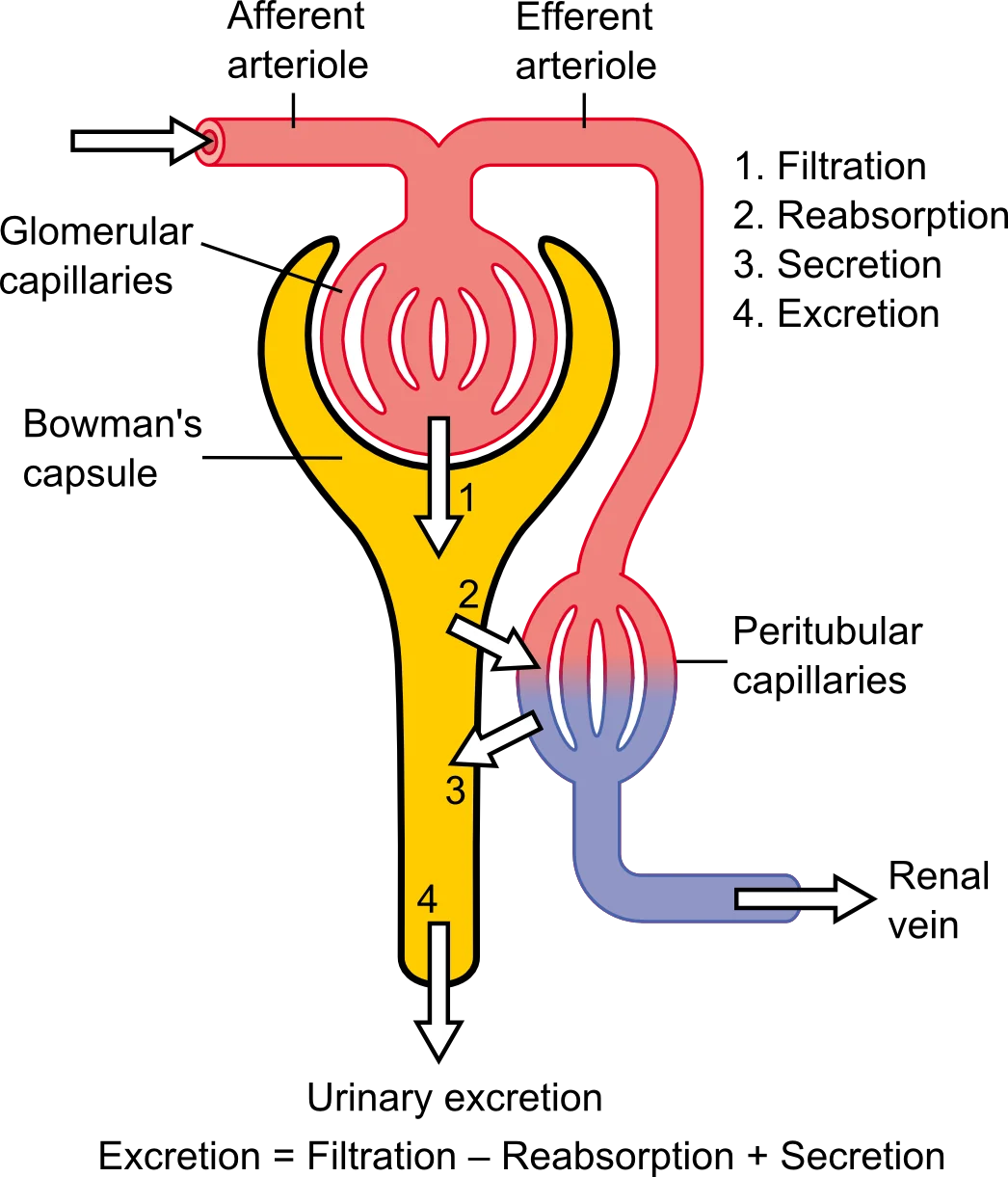
The Big Picture: Three Processes
1. Filtration (glomerulus) - bulk movement of fluid and small solutes from blood into Bowman’s space. Nonselective.
2. Reabsorption (tubules) - movement of useful substances from filtrate back into peritubular capillary blood. Selective and highly regulated.
3. Secretion (tubules) - movement of additional waste, drugs, and ions from peritubular blood into the filtrate. Provides a second chance to remove substances that were not filtered or need faster elimination.
Proximal Convoluted Tubule (PCT): The Workhorse
The PCT reabsorbs the majority of everything. It is the most metabolically active segment of the nephron, packed with mitochondria and covered in microvilli (brush border) to maximize surface area.
What the PCT reabsorbs:
- ~65% of filtered Na+ and water
- ~100% of filtered glucose (via sodium-glucose co-transporters)
- ~100% of filtered amino acids
- ~80-90% of filtered bicarbonate (HCO3-)
- Most phosphate, lactate, and citrate
- Urea (partially - ~50% is passively reabsorbed)
What the PCT secretes:
- H+ (important for bicarbonate reabsorption)
- Organic acids (uric acid, drug metabolites)
- Organic bases (creatinine, certain antibiotics)
- NH3/NH4+ (for acid-base buffering)
How sodium reabsorption works in the PCT:
The Na+/K+ ATPase on the basolateral membrane (blood side) pumps Na+ out of the cell and into the blood, keeping intracellular Na+ low. This creates a gradient that drives Na+ into the cell from the tubular lumen through various co-transporters on the apical membrane (lumen side):
- Na+-glucose co-transporter - drags glucose into the cell along with Na+
- Na+-amino acid co-transporters - drags amino acids with Na+
- Na+/H+ exchanger - trades Na+ in for H+ out (helps reclaim bicarbonate)
Water follows Na+ passively through aquaporins and paracellular pathways. The PCT reabsorbs water and solutes in roughly equal proportions, so the filtrate leaving the PCT is still isotonic (~300 mOsm/L) - just much reduced in volume.
Transport Maximum (Tm) and Glucose
Glucose reabsorption uses sodium-glucose co-transport carriers in the PCT. These carriers have a maximum transport rate - the transport maximum (Tm).
At normal blood glucose (~100 mg/dL), all filtered glucose is reabsorbed. But if blood glucose exceeds ~180-200 mg/dL (the renal threshold), the carriers become saturated. Glucose that exceeds the Tm cannot be reabsorbed and appears in the urine (glucosuria).
This is exactly what happens in uncontrolled diabetes mellitus. The excess glucose in the urine also drags water with it by osmosis, causing the classic symptoms of polyuria (excessive urination) and polydipsia (excessive thirst).
Loop of Henle: Creating the Medullary Gradient
The loop of Henle has two limbs with opposite permeability properties. This is the key to understanding urine concentration.
Descending limb:
- Permeable to water
- Impermeable to solutes (NaCl)
- As filtrate descends into the increasingly salty medulla, water leaves by osmosis
- Filtrate becomes progressively more concentrated (up to ~1200 mOsm/L at the hairpin turn)
Thin ascending limb:
- Impermeable to water
- Passively permeable to NaCl (salt diffuses out)
- Filtrate becomes less concentrated as salt leaves
Thick ascending limb:
- Impermeable to water
- Actively pumps NaCl out via the Na+/K+/2Cl- co-transporter
- This is the segment that actively creates the medullary osmotic gradient
- Filtrate becomes dilute (~100 mOsm/L) by the time it reaches the DCT
Distal Convoluted Tubule (DCT): Fine-Tuning
The DCT handles the last bit of adjustable Na+ and Ca2+ reabsorption:
- Thiazide-sensitive Na+/Cl- cotransporter - reabsorbs a small fraction of filtered Na+ (the site of thiazide diuretics).
- PTH - increases Ca2+ reabsorption here.
- Aldosterone begins to act on the late DCT but exerts its main effect on the collecting duct.
The DCT also continues H+ secretion for acid-base regulation.
Segment-by-Segment Summary Table
| Segment | Reabsorbs | Secretes | Water Permeability | Key Hormones |
|---|---|---|---|---|
| PCT | Na+, water, glucose, amino acids, HCO3-, phosphate | H+, organic acids/bases, NH3 | Always permeable (aquaporins) | None (constitutive) |
| Descending limb | Water (passively) | Nothing significant | Permeable | None |
| Ascending limb (thin) | NaCl diffuses out | Nothing significant | Impermeable | None |
| Ascending limb (thick) | NaCl (active transport) | Nothing significant | Impermeable | None |
| DCT | Na+ (aldosterone), Ca2+ (PTH) | K+, H+ | Variable (ADH in late DCT) | Aldosterone, PTH, ADH |
| Collecting duct | Water (ADH), Na+ (aldosterone), urea | K+, H+ | ADH-dependent | ADH, aldosterone, ANP |